With cheers and tears, Houston reclaims its place as ‘space city’
The Artemis II mission elicits deep feelings for many Americans, particularly in the home of mission control
[HOUSTON] The astronauts are everywhere you look, painted on walls or hovering in hoardings. Astronauts in cowboy hats and astronauts with beers. Astronauts holding hamburgers or dunking basketballs.
Houston’s identity as a space exploration hub – where Apollo 13 astronauts once called to tell Nasa’s mission control that they had “a problem” – can sometimes seem to be little more than a kind of kitschy nostalgia, mixed with a bit of municipal self-branding.
Then real astronauts took off Wednesday (Apr 1), from Kennedy Space Center in Florida. Control of their flight passed to the Lyndon B Johnson Space Center in south-east Houston. Suddenly, the metropolis that calls itself “Space City” was back at the centre of an American mission to send people around the moon.
“Houston is a city that was built on space,” said Senator Ted Cruz in an interview after the launch. “It is not an accident that one of the very first words uttered on the lunar surface was Houston: ‘Houston, the Eagle has landed’,” he added, referring to words spoken by Neil Armstrong to mission control after landing on the moon in 1969.
By then, the city had its space-themed baseball team, the Astros, playing in their space-age stadium, the Astrodome, to go along with astronauts living near and training at the then Manned Spacecraft Center. (The centre was built in the city after effective political manoeuvring by Johnson, a native Texan, and renamed for him in 1973.)
“For Houston, it was personal,” said Coco Brennan, 68, recalling the feeling of growing up during the 1960s space race in the city, as she waited to watch Wednesday’s launch at the museum attached to the Nasa campus. “It was like someone we knew was up there.”
The emotional connection to the launch stretched far beyond Houston as Americans again, young and old, alone or in families or with groups of strangers, took a moment to thrill and wonder at the power of a rocket flying off Earth’s surface. Children sat rapt in front of TVs. Adults cried.
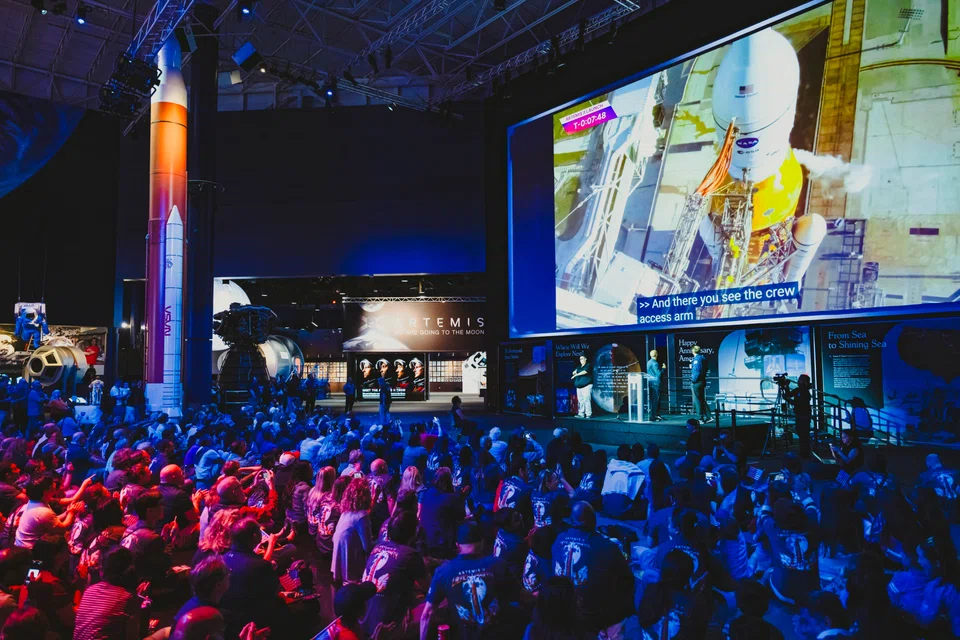
At the museum, known as Space Center Houston, more than 1,000 people waved small American flags and watched the countdown together on a giant screen amid exhibits of past space journeys.
As the numbers ticked down to zero, cheers grew louder. Then, as the engines shuddered and flames emerged, the cheers grew into an almost primal cry of excitement and joy.
“I got a little teary-eyed,” said Nick Huntsman, 24, who lives near the space centre, where his fiance works. “I don’t feel very proud of my country lately, but for this, I do. We still got things going for us.”
“It’s about all of us together,” said Patrick McAvoy, 36, who drove from St Louis with his family, including his 14-month-old daughter.
Cruz said that he held his breath and said a prayer as he watched on his phone while in a car riding through Houston, “because there’s always inherent risk in any space launch”. Once the astronauts were safely on their way, he texted congratulations to the Nasa administrator, Jared Isaacman. “The connection of Texas and the commitment of Texas to space is enormous,” Cruz added.
The launch of the Artemis II mission on Wednesday was a reminder not only of the role that Houston has long played as the home of the Nasa campus and mission control but also of the growing private space industry that has taken off across Texas.
Elon Musk’s SpaceX launches its giant moon and Mars rocket prototypes regularly near Brownsville in the state’s southern tip. Blue Origin has tested technologies for spaceflight and flew space tourists on suborbital flights in West Texas.
Firefly Aerospace, based in Central Texas, successfully landed a robotic vehicle on the moon last year. In Houston, there is Intuitive Machines, whose machines have also reached the surface of the moon, and Axiom Space, working on a commercial space station.
Each of those Texas companies has contracts with Nasa to work on aspects of the Artemis programme, helping astronauts get back to the lunar surface.
“We see Texas as a leader in space,” said Heather Pringle, CEO of Space Foundation, a Colorado nonprofit that seeks to advance the industry. She said her group has been holding Texas up as a model for other states, pointing to its combination of research support, low taxes and talent pipeline, as well as its commitment to human space travel, like the Artemis II mission, and to military technology.
The state created its own Space Commission in 2023, which has handed out US$150 million in grants and is poised to hand out hundreds of millions more. And, on the grounds of the Johnson Space Center in Houston, Texas A&M University is set to open a new US$200-million Space Institute this autumn.
The moment felt to many like a “rebirth” of the Space Age, said William Harris, the president of Space Center Houston.
“I’m excited,” said Mayor John Whitmire of Houston in an interview. He recalled gathering by the TV with friends for the moon landing in July 1969.
“We watched it in disbelief,” he remembered. “Do y’all really think somebody did that?” NYTIMES
Decoding Asia newsletter: your guide to navigating Asia in a new global order. Sign up here to get Decoding Asia newsletter. Delivered to your inbox. Free.
Share with us your feedback on BT's products and services