

China talks up 'green' Olympics but prepares to fight smog
 Add BT as a preferred source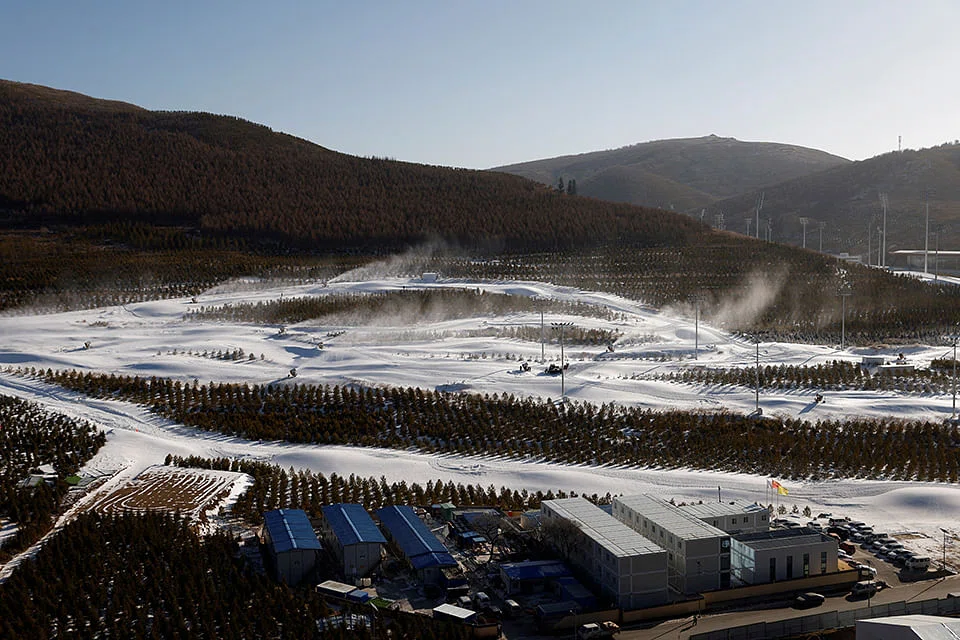
DeeperDive is a beta AI feature. Refer to full articles for the facts.
Zhangjiakou, China
China is using the Winter Olympic Games to drive its efforts to improve the environment, but smog-prone capital Beijing is still preparing for the worst as the opening ceremony looms.
Beijing has improved its air quality since China won its bid to host the Games, but the Ministry of Ecology and Environment has said winter smog risks remained "severe".
Ministry spokesman Liu Youbin told reporters on Thursday (Dec 23) that contingency plans were in place. "When the time comes, Beijing and Hebei will be guided to adopt reasonable environmental protection measures in accordance with the law," he said.
Rumours that polluting heavy industries in the area would be shuttered from Jan 1 were "not true", however, he added.
Critics warned in 2015 - when China won its bid - that the Winter Olympics could be overshadowed by hazardous smog in a region dominated by heavy industry. Chinese President Xi Jinping subsequently vowed to run a "green" Games, and Hebei promised to "transform and upgrade" its industrial economy.
Navigate Asia in
a new global order
Get the insights delivered to your inbox.
Since then, China has planted thousands of hectares of trees in Beijing and surrounding Hebei province, built sprawling wind and solar farms, and relocated hundreds of enterprises.
In Zhangjiakou city, 200 km northwest of Beijing and host to skiing and snowboarding events, 26-year-old amateur skier Deng Zhongping said he has already felt the difference.
"When I came to Beijing a few years back I would suffer with rhinitis because of pollution, but the air quality in Beijing-Tianjin-Hebei has improved a lot," he said. "I think the air quality at Zhangjiakou ski resort is even better than some foreign ski resorts."
In 2016, average concentrations of PM2.5 in the Beijing-Tianjin-Hebei region stood at 71 microgrammes per cubic metre and soared to more than 500 microgrammes over winter. That compares to an average 40 microgrammes from January to September this year.
The reading in Beijing was 33 microgrammes in the first 3 quarters, meeting China's 35-microgramme standard, although exceeding the recommended World Health Organization level of 5 microgrammes and likely to rise much higher over winter.
"China will win many medals at the Winter Olympics, but the smog... could plunge the Games into difficulties," the Washington-based International Fund for China's Environment said earlier this year.
Officials said during a government-organised tour this week that all 26 Olympic venues in Beijing and Hebei province would be 100 per cent powered by renewable energy. More than 700 hydrogen-fuelled vehicles will also be deployed, despite the government falling short of a hydrogen production target.
Preparations have included a tree-planting programme that increased forest coverage in Zhangjiakou to 70 per cent to 80 per cent, up from 56 per cent previously.
China has also said it would make the Games "carbon neutral" for the first time. Environmental group Greenpeace, though, said without more data it would be hard to evaluate whether the goal was actually met.
Water scarcity is another concern, especially when it comes to creating artificial snow and ice.
Organisers said the Games would not put additional pressure on local water supplies and rely instead on cisterns that collected mountain run-off and rainfall during the summer - in line with China's wider efforts to create a "circular" economy in which resources are fully utilised and recycled. REUTERS
Decoding Asia newsletter: your guide to navigating Asia in a new global order. Sign up here to get Decoding Asia newsletter. Delivered to your inbox. Free.
Share with us your feedback on BT's products and services
TRENDING NOW
Air India asks Tata, Singapore Airlines for funds after US$2.4 billion loss
‘Boring’ is the new black: The stars are aligning for a Singapore stock market revival

From 1MDB to ‘corporate mafia’: Is Malaysia facing a new governance test?
South-east Asian markets account for 8.8% of global capital inflows from 2021 to 2024: report

