

A Chinese cartoon so bad you have to see it becomes a box-office hit
Many want to take a peek at how awful the film really is; it has also struck a chord with more niche audiences
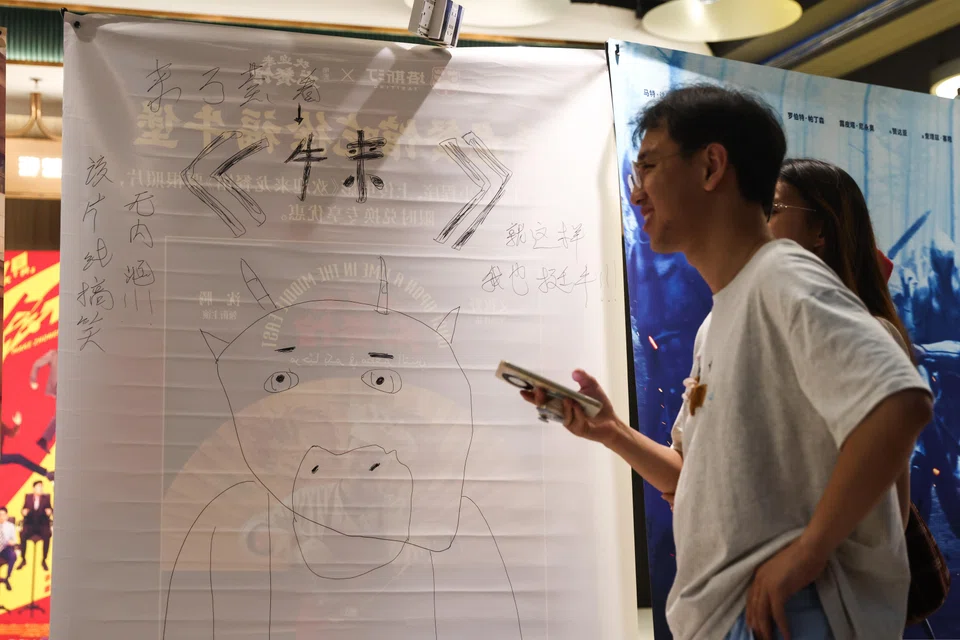
[BEIJING] A low-budget cartoon about a calf has become an unlikely box-office sensation in China, turning online ridicule into millions of dollars in ticket sales and sparking a debate over the merits of crude animation in the age of polished artificial intelligence-generated entertainment.
Niu Lai, an 86-minute production made by a self-taught filmmaker and his mother, earned just 7,000 yuan (US$1,038) during its first 10 days in theatres. By Tuesday (Aug 18), the film ranked fifth at China’s daily box office with cumulative sales exceeding 20 million yuan, according to ticketing platform Maoyan, putting it on track to reach 135 million yuan in total revenue.
The notoriety of the cartoon helped spread the word and prepared viewers for what many expected to be a poorly made spectacle. At a packed theatre hall in downtown Beijing on Tuesday afternoon, moviegoers braced themselves but ended up having a genuinely good time.
“I saw the online posts and came for the laughter,” said a 16-year-old high-school student who gave only his surname, Bai. “It is indeed very cheerful. The logic of the story also makes perfect sense!”
The film, whose title translates as Come Here, Cow, follows a newborn calf named Niu Lai as he learns about friendship, trust, responsibility and sacrifice, usually with his mother at his side.
The journey ultimately turns out to be a dream. In the happy ending, Niu Lai’s mother introduces the calf to his father.
Nobody complained when viewers photographed the screen or briefly chatted about the plot. The animation was shaky and the dialogue slow, but the audience of mostly young people was full of good cheer and everyone stuck around to the end.
Niu Lai’s improbable path to box-office riches began five years ago, according to local media reports, when Xin Yumeng, 34, a landscape architect by training, started to work on the project together with his mother, who’s an employee at a state-owned company.
Lacking any relevant qualifications or experience, the two picked up the new skills they needed on their own, from animation techniques and playwriting to voice acting. The mother, Sun Lifang, not only wrote the screenplay but also the ending theme song, whose melancholic tune and lyrics have touched a nerve among audiences.
That backstory did more to endear the cartoon to the Chinese public. Some noted in online posts that the handmade feel of the animation offered a rare display of sincerity in the AI age.
But it really began to catch on after some viewers shared the grotesque cow images on social media.
At times, the initial response was full of scorn bordering on indignation over why a product so crudely made was cleared for theatrical release by the national authorities. Some even wondered if the film was made to launder money or get government subsidies.
“This is not just bad money driving out the good,” read one of the harshest comments. “It’s ghost money” – or bills burned as an offering to ancestors – “driving out fake notes.”
Then suddenly the tide began to turn, as early ridicule gave way to curiosity, helped along by the memeification online of the rustic characters. Many just wanted a peek at how bad the film really is.
It has also struck a chord with more niche audiences.
Some Chinese stock pickers, for example, latched onto a leopard character named Bao La, whose name is a homonym for “explosive rally”, or took the cow cartoon as a harbinger of a bull market.
Others found a metaphor in the image of the calf crying out for his mother and concluded it represented an appeal for help from the central bank.
And indeed, the film’s unlikely success has started to spill into the stock market, with investors piling into companies whose names contain the Chinese character for cow.
More fan-created content has materialised in the form of emojis that quickly flooded the social media. Given it was a low-budget operation and no official posters were available, some cinemas rushed out hand-drawn posters to attract viewers.
While Niu Lai is no match for the commercial success of such top-grossing movies as the Chinese comedy Once Upon a Time in the Middle East and Christopher Nolan’s The Odyssey, its low production costs could still make it one of the most profitable films ever in the world’s second-largest film market.
On the Chinese Instagram-like social media platform Xiaohongshu, one user even compared it with the oeuvre of Marcel Duchamp, a pioneer of conceptual art who scandalously put a urinal on a pedestal and called it a sculpture.
“Niu Lai is no doubt an aesthetic betrayal of the contemporary animation industry,” the person wrote. “Its coarseness is not a compromise – it marks a Marcel Duchamp moment for mainstream taste.” BLOOMBERG
Decoding Asia newsletter: your guide to navigating Asia in a new global order. Sign up here to get Decoding Asia newsletter. Delivered to your inbox. Free.
Share with us your feedback on BT's products and services
TRENDING NOW

Grab CEO’s wife Chloe Tong on life with Anthony Tan and finding her purpose

Hwa Seng Builder, two China companies win S$1.2 billion Tuas Road Viaduct phase two contracts

Deal between tycoon friends sparks scrutiny of Philippine power sector

Canada is upping oil flows to Asia, but South-east Asia’s refineries aren’t ready to handle them yet

