

Chinese robots have beaten Usain Bolt’s 100 m record. Should we be impressed?
How such superhuman feats of athleticism translate into the real world is still an open question, experts say
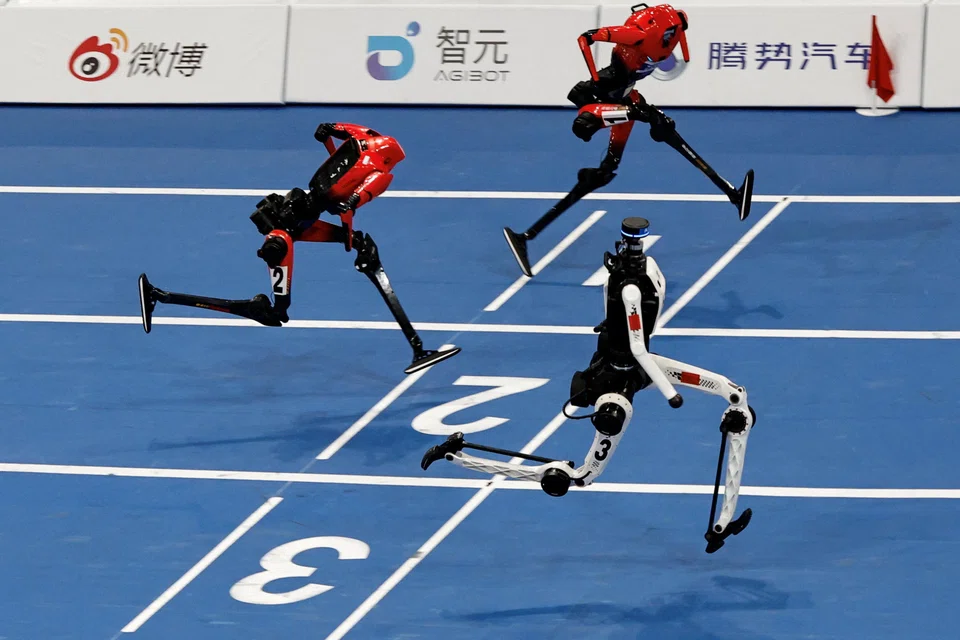
IN 2009, Usain Bolt set the men’s 100 m dash world record of 9.58 seconds at the World Athletics Championships in Berlin.
On Aug 22, a humanoid robot developed by Chinese company X-Humanoid beat that record by 0.19 second, according to Chinese state media.
Tiangong Ultra ended its sprint at the World Humanoid Robot Games in Beijing slamming full speed into a padded wall, falling down and being carried away by human assistants.
Then, on Tuesday (Aug 25), it ran 100 m in 8.86 seconds in the semifinal of the large-size robot division.
Tiangong completed its sub-nine-second sprint by striking a thick mat placed beyond the finish line to stop the sprinting machines. A small fire appeared in the robot’s torso after it collapsed from the impact. In the other semifinal, a robot disassembled mid-race.
“Reading that a motor-powered robot can run faster than a human is one thing,” said Li Hui, 26, an engineer with Fudan University’s table tennis team. “Seeing it rush past you during training is completely different. You realise how impressive it is.”
High-profile feats of robotic athleticism have become increasingly common in China, where a humanoid robotics industry has flourished, aided by generous state support and billions in investment. Robots have danced and performed martial arts at the country’s top events.
At the World Humanoid Robot Games, they boxed and participated in football matches. One played tennis against a human opponent, moving across the court and angling itself to return volleys. Earlier this year, a robot ran a marathon faster than any human in history.
But what do these robotic superhuman feats amount to?



“Most of the sports the humanoids are doing don’t directly translate into utility for many of the mundane tasks people are trying to get humanoids to perform, like being useful around the house,” said Michael Milford, a professor and director of the robotics centre at Queensland University of Technology in Australia.
The robots are “capable in very specific and somewhat contrived events”, he said.
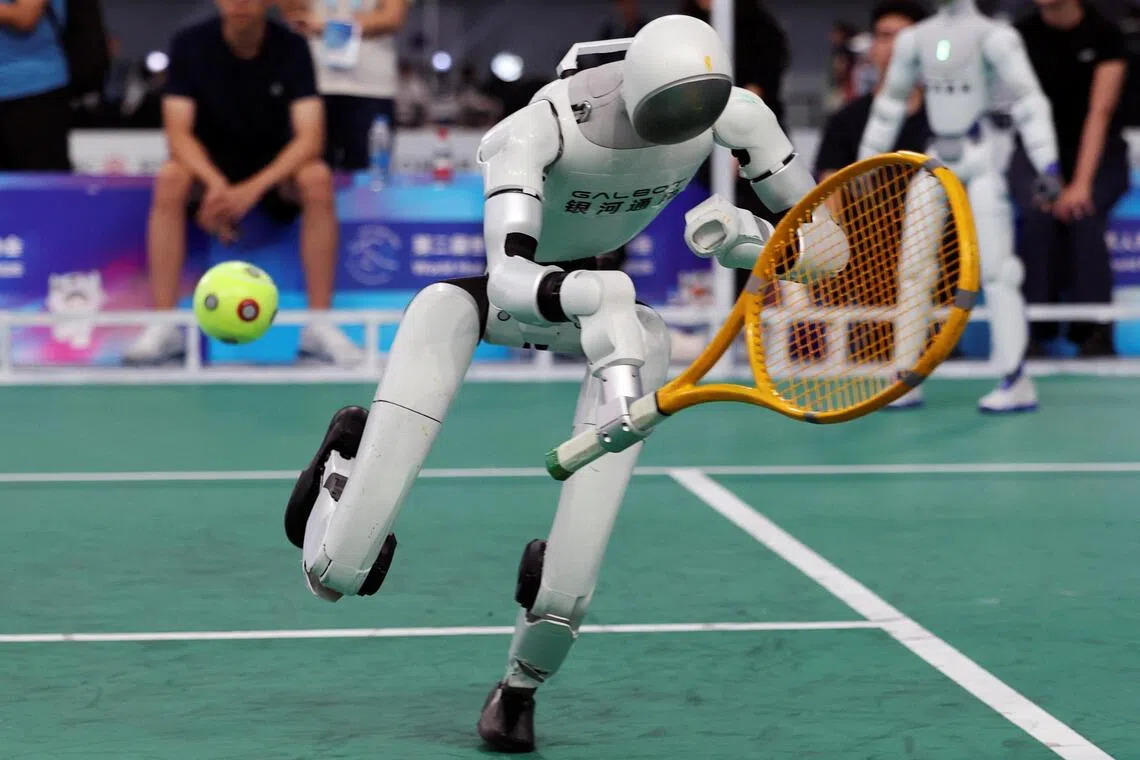
Chinese media has also acknowledged the gulf between athleticism and real-world applications in its coverage of the games.
“A factory robot does not need to win a sprint, nor does a service robot need a medal,” read a commentary in Xinhua, the state news agency. “But every gain in speed, stability and precision on the competition floor can bring robots one step closer to becoming genuinely useful beyond it.”
Even without significant and proven real-world applications, these high-profile displays and the attention they have attracted are already paying some dividends.
Unitree Robotics – a humanoid robotics company whose videos of robots performing kung fu, kickboxing and backflips have attracted millions of views online, and whose robots featured heavily at the Humanoid Robot Games last year – debuted on the Shanghai stock market on Aug 19.
Its shares ended their first day of trading up by more than 460 per cent.
Progress and imperfection
Alan Fern, a robotics professor at Oregon State University in the US, was part of a research team that set the Guinness World Record for the fastest 100 m run by a robot on two legs in 2022. That robot ran it in 24.73 seconds.
To go from that, in four years, to X-Humanoid’s 9.39 seconds was an “enormous achievement”, he said.
But he noted that robotics companies have become relatively experienced in making robots that can run, jump and do acrobatics in controlled environments.
He added that incremental improvements in these sports are mostly related to developing better hardware and refining the controls, rather than any significant technological breakthrough.
The robot at the games in Beijing that could play tennis against a human was more impressive, he said, because that involved interacting with something unpredictable.
Most robots struggle in situations in which they need to adapt to changing situations. Yet, the tennis robot had to track a fast-moving ball, decide where to move, coordinate its body and time the strike.
The robots are still far from perfect, with accidents abounding at the games. Robots fell down, sparked small fires and crashed into objects, videos of the event showed.
The unusual running style of one machine, with its arms up near its face, earned it the nickname “shy robot” on social media platform Weibo. Many of the racing robots did not seem capable of slowing down on their own and instead stopped by running into a padded barrier.
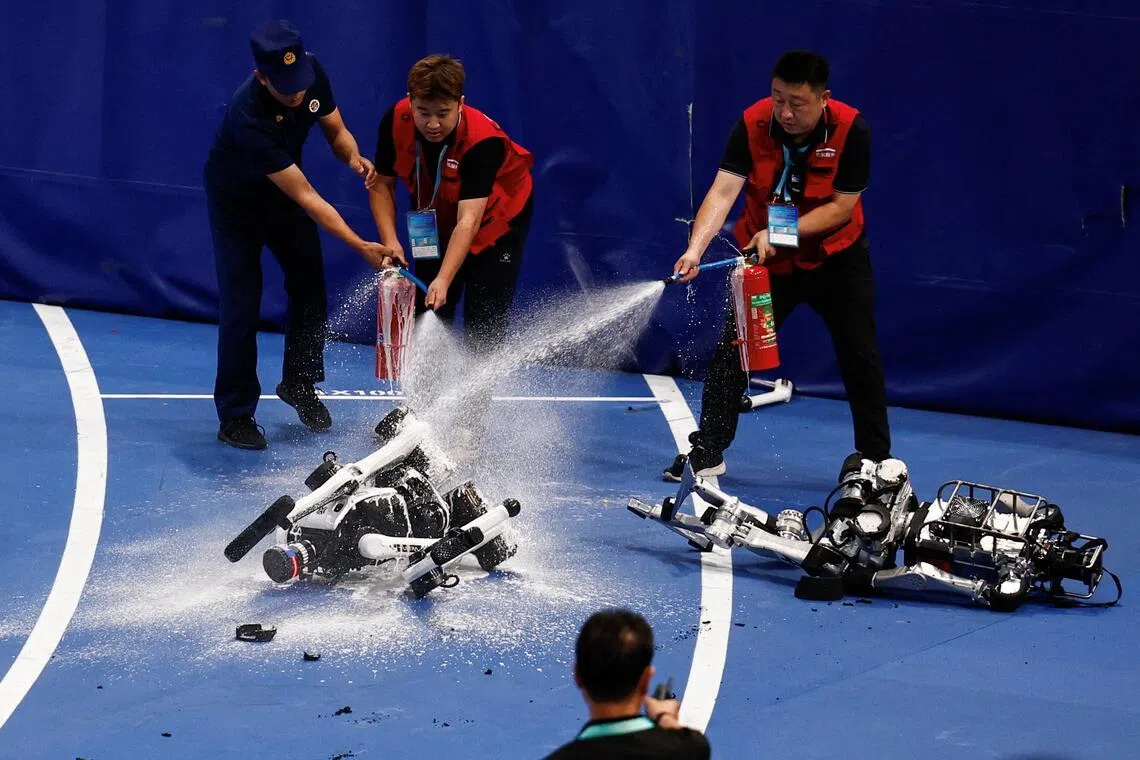
The vision of humanoid robots eventually being able to do anything a human can do is still far away, Prof Fern said.
“Outside entertainment and a limited number of tightly constrained industrial settings, these robots do not yet have the general-purpose intelligence and reliability needed to operate in messy real-world environments.”
Prof Milford said that it could take many years before robots can safely and reliably perform in everyday settings.
He drew a comparison to self-driving cars: Three or four decades ago, a self-driving car could drive across a continent on highways. But only in recent years has the technology become advanced and safe enough for such cars to be deployed widely and largely without incident.
Car racing may be another good analogy, Prof Fern said.
“We still marvel at the engineering achievements in Formula 1, and some of those advances eventually transfer elsewhere, but we do not interpret every faster lap as a revolution in transportation,” he said.
“Similarly, beating Usain Bolt does not mean that the robot has surpassed humans at locomotion in any general sense.”
The Beijing Humanoid Robot Innovation Center said on Tuesday that its Tiangong robots had already beaten four human world records. Besides the 100 m sprint, it pointed to a 400 m time of 38.15 seconds, a 1,500 m mark of 2 minutes 21.64 seconds, and a 2.88 m high jump.
The organisation’s shareholder list includes state-owned enterprises, several investment funds, artificial intelligence and cloud giant Baidu, and smartphone and electric vehicle maker Xiaomi’s robotics unit, according to Chinese corporate data provider Qichacha.
China has designated humanoid robots as a strategic emerging industry, as companies and policymakers seek to translate advances in AI, motors and sensors into uses in manufacturing, logistics and services. NYTIMES, REUTERS
Decoding Asia newsletter: your guide to navigating Asia in a new global order. Sign up here to get Decoding Asia newsletter. Delivered to your inbox. Free.
Share with us your feedback on BT's products and services
TRENDING NOW

LTA proposes combining car COE categories, adding rebate-surcharge system

StarHub to acquire MyRepublic’s mobile business amid ongoing telco consolidation

DBS, OCBC, UOB rout lops billions off STI as inflation, rate concerns spook investors

Grab CEO’s wife Chloe Tong on life with Anthony Tan and finding her purpose

