

Cooler than ICE
A plug-in version of BMW's X3 combines traditional combustion power with clean electricity
Singapore
PEOPLE who work in the car trade overseas often say that Singapore is the perfect country for Electric Vehicles (EVs), given its small size and highly urban driving conditions. Be that as it may, someone usually has to tell them that Singaporeans aren't the perfect buyers for EVs.
If you have to pay more than anyone else in the world for your car, you really want it to tick every box out there, which means it has to be able to, say, take you to Penang on a whim, even if you've ever only driven to Penang once in your life, if that. EV adoption is more about mentality than reality.
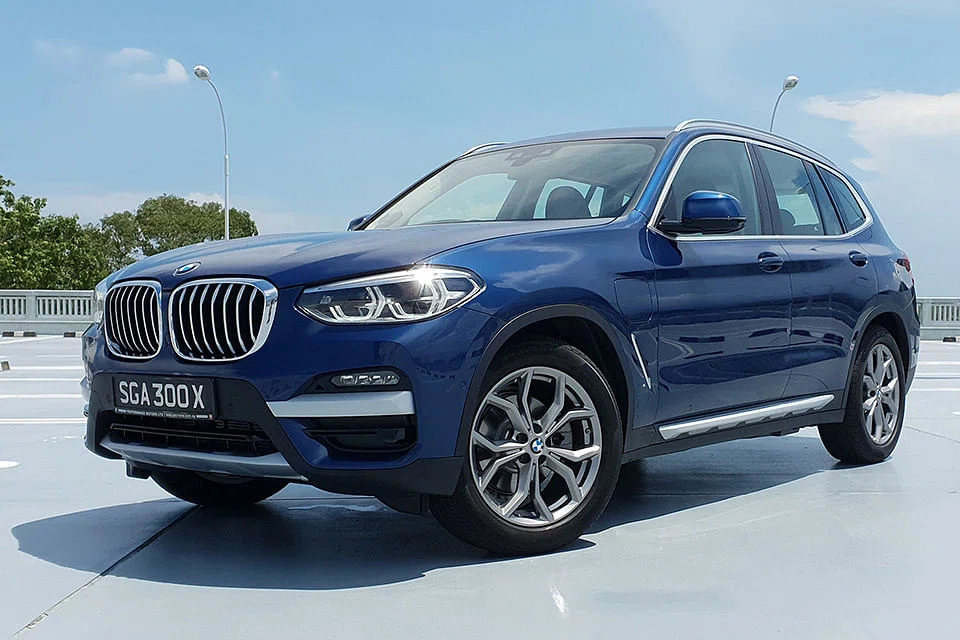
But in the electric car space here, the BMW X3 xDrive30e appears to have all the requisite bits to be a huge success: A practical sport utility vehicle (SUV) body style for the family man, a sweet turbocharged engine for the petrolhead, and an electric drivetrain for the environmentalist. Something for everyone, then.
BMW is no stranger to plug-in hybrid vehicles (PHEVs), which is what the X3 xDrive30e is. The brand has the most comprehensive line-up of such cars here, ranging from the compact 2 Series Active Tourer all the way up to the 7 Series limousine. But this is the first time that BMW is offering an electrified powertrain on the X3, which is its best selling member of its rugged-looking "X" cars around the world.
The key appeal to PHEVs is that they offer a bridge between traditional internal combustion engine (ICE) cars, and full electric vehicles (EVs). PHEVs allow you to drive a substantial distance on electric power alone, but you never have to worry about running out of juice as the engine is still there for backup if required.

BMW claims that the X3 xDrive30e can travel up to 55km while running purely on electricity. That's more than the distance from Changi to Tuas, so that sort of range should, in theory, be more than enough for most people's commutes. The average driver here covers 48km a day, incidentally.
However, as with anything involving mileage, your actual results vary depending on your driving style. The official quoted figure is only achievable if you are gentle with your right foot, but after a weekend spent with the X3 xDrive30e with a mixed driving style, The Business Times got somewhere closer to 40km before the car's electric range ran out.
Running out of juice is a pain in the patoot in a pure EV, but in a plug-in like this, it's simply a matter of carrying on with the petrol engine. Even if you somehow forget to charge the batteries again, you can carry on until it's time to put fuel in the tank.
Of course, getting the most out of any PHEV involves charging it regularly. But many PHEVs like the X3 xDrive30e (and its recently-launched rival, the Volvo XC60 Recharge) don't support fast charging, unlike some pure EVs. So you're faced with the prospect of having to plug the car in for hours (3.5 in the BMW's case) to get a decent amount of charge. Not an issue if you have your own charging point at home, but a bit of an inconvenience if you do not.
Alternatively, you can get the car to do the recharging for you, via the petrol engine. But that's an expensive way to use an expensive fuel. On the other hand, if you stick the BMW into Sport mode and get both motor and engine to work together, the result is a car that's entertainingly fast. Driving electric may be good for the planet, but the X3's powertrain reminds you why our species' love affair with petrol lasted a century.
The 2.0-litre turbocharged petrol engine develops 184hp and 300Nm of torque on its own, but when matched with the electric drivetrain the total output gets bumped up to 292hp and 420Nm of torque. That makes this the most powerful X3 that's not from the company's M performance division.
The X3 xDrive30e's default drive mode is Auto eDrive, or hybrid mode, where it switches between the electric motor and petrol engine automatically depending on the driving situation. But the system leans towards prioritising electric power, so the battery runs down rather quickly if you leave it in this mode.
You can also select Max eDrive, which instructs the car to drive purely on electric power alone. But, again, once the juice runs low, this mode becomes disabled and the BMW reverts to its default hybrid mode.
How to make sense of it all? Think of the BMW's electric drive system as your mobile phone, and the petrol engine as a huge power bank. If you're a light user, you can charge your phone overnight and get by, but if you use social media or streaming services like a fiend, you probably need to carry that power bank around with you. Like other plug-ins, this car makes sense if most of your daily commute can be covered on electric power.
As an actual car, the BMW has plenty of strengths that go beyond its engine and motor combo. It's a very effective cruiser that's smooth and refined, and the extra weight of the batteries actually contributes towards adding a sense of stability to the car. The X3 feels pretty planted whether you're driving down the highway at speed, or tackling a winding road.
By and large, there's not much difference between this and a regular X3 in terms of everyday usability. The boot floor is raised slightly to accommodate the batteries, thereby reducing cargo capacity from 550 to 450 litres over the standard car. But aside from that, it feels like any other BMW: solidly built, good to drive, and practical like any other X3.
Given that its price tag of S$246,888, inclusive of Certificate of Entitlement (COE), matches that of the top-spec regular X3, the xDrive 30i M Sport, the plug-in version suddenly starts to appear good value. You get more power, plus the ability to drive without using petrol, so over the long term it actually saves you money, because electricity is much cheaper than fuel on a per-kilometre basis. That's the sort of reality that fits well with local mentality.
BMW X3 xDrive30e
Engine 1,998cc, inline four, turbocharged Power 184hp at 5,000-6,500rpm Torque 300Nm at 1,350-4,000rpm Gearbox 8-speed automatic Electric motor 109hp Battery Lithium ion, 12kWh Charge time/type 3.5 hours/Wallbox Electric range 51-55km System power 292hp System torque 420Nm 0-100km/h 6.1 seconds Top speed 210km/h Fuel efficiency 2.8L/100km Agent Performance Motors Limited Price S$246,888 with COE Available Now
Decoding Asia newsletter: your guide to navigating Asia in a new global order. Sign up here to get Decoding Asia newsletter. Delivered to your inbox. Free.
Share with us your feedback on BT's products and services






