Creating enormous bronze apples for Farrer Park hotel
CHEAH UI-HOON goes behind the scenes of a monumental sculpture-in-the-making
THERE are Buddha figurines everywhere, in various stages of being made including a gigantic one where the lower half of the body is touching the roof of the foundry warehouse. In the midst of heads and limbs lying about waiting to be soldered together, two giant apples are in the final stage of completion.
Dust of all kinds - metal, ceramic and fine sand - swirls in the air as work at the bronze foundry is in full swing. In a hot but windy afternoon, the workers assigned to artist Kumari Nahappan's apple sculptures are polishing and smoothening the surface (a process called "chasing"), filling up and welding tiny holes to create a flawless finish. Kumari - in face mask and gloves - is closely overseeing the work to make sure it's done correctly.
Ever so quietly, in her characteristically gentle style, Kumari is putting the pressure on the Thai workers of Asia Fine Art (AFA) as the deadline to deliver the apples draws nearer. "They are very good in what they do, but this sculpture is also very different from the work they normally do, so I have to be here to supervise every step because it's more difficult and much more costly to correct something gone wrong," she explains. In two weeks, the monumental sculptures will be shipped from the foundry in Ayuthya, Thailand, to Singapore.
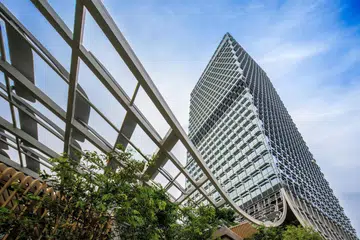
The giant apples will be gracing the entrance to the first five-star hotel in Farrer Park - One Farrer Hotel & Spa - and the adjoining Farrer Park Hospital, both of which are housed in a multi-use complex, Connexion.
The monumental sculptures are the very first art commission that One Farrer Park Company made, says Richard Helfer, member of the company's board and chairman of One Farrer Pte Ltd who is driving the company's art collection.
"We knew that we wanted to work with Kumari, but we left it to her to propose the idea," he explains. After months of discussion and thought, Kumari proposed the apples, which was a departure from her iconic tropical fruit such as peppers and nutmegs.
"In this case, I thought that there'd be much more acceptance for the apples - which I'd named Apollo and Artemis - given the nature of the buildings," she says.
The green "apple of life" was named after Artemis, the Greek goddess known for her affiliation for the wild and the pursuit of lifestyle, while the red apple is named after her twin, Apollo, who's the god of medicine and healing.
"I think the colours will be quite iconic because that's what people will remember as well, which helps makes that visual connection," says Dr Helfer.
The colour inspiration will come from Red Washington and Granny Smith apples. AFA's workers are experimenting with the shades now, using acid and fire to prepare the bronze surface before dabbing pigment on it so that the metal is able to hold the colour. The apples aren't going to be painted but given the right patina, which is an art in itself, explains Kumari.
It's not every day that she gets commissioned for her monumental sculptures, and in fact, Kumari can undertake only one or two such time-consuming projects like this in one year.
Her giant peppers burst onto Singapore's sculpture scene about a decade ago, and since then, her iconic works have made a monumental mark on the landscape - there is the bronze chilli-pepper, Pedas Pedas (2006) commissioned by the National Museum of Singapore, while her giant Saga (2007) can be seen at Changi Airport and the Nutmeg (2009) outside ION Orchard. Pembungaan (2011) is another monumental bronze mural of over 45m in length at OUE Bayfront.
"I couldn't do more than two projects like this a year," she says, and a first-hand look at the arduous process of making bronze sculptures helps one understand why. Besides the lengthy process, the complexity is further scaled up with monumental sculptures.
For a small sculpture using the lost wax method, the artist makes the mould, after which a negative wax imprint is made of it. Then it has to be dipped in several layers of ceramic glue, then fine sand and coarse sand (to retain its structure) over the course of a few days to a week. When everything has dried fully, melted bronze is poured into the moulds, cooled, and then the ceramic structure around it is broken, after which the bronze object has to be treated and given its final finish. All this takes weeks, much more so when it's a new, one-off creation.
For Kumari's gigantic works, the sculpture is made in parts and then later soldered together. Because they're so large, the parts are put into a sand mould rather than a ceramic mould. "And because it's made with a sand mould, the surface is much less perfect than when it's made with a ceramic mould," she explains.
But she's worked with this foundry since 2002 because of the high quality of the bronze it uses (it is imported from Australia) and its willingness to work on her pieces, she says, as well as the high standards maintained.
The foundry's main income is from the Buddhist statues and also statues of Thai kings, present and past. "So you can understand that they are working out of the norm when they have to work on my sculptures," she notes.
But Kumari's works also perk up the workers' otherwise quite predictable routine, pushes the limit of their expertise, and her ideas are inspiring, says Thawan Muengchang, the owner of AFA, beaming at us as he pops by to chat. "She really has unusual and good ideas . . . we like working with her," he adds in halting English. He has assigned a few staff who speak English well enough to work with Kumari.
The foundry also works with other artists. Sometimes, however, commissions can fall through - we were shown a huge sculpture, almost three meters tall, of a muscular man standing on top of a globe. Instead of piecing the almost-finished work together though, workers were taking it apart as the order was cancelled at the last minute.
It's heart-breaking to see all the man hours go down the drain, and even if the bronze can be melted down to be used again, its quality is compromised.
At least, though, there's the foundry's satisfaction of knowing that Kumari's sculptures will get to their final destination in Singapore - where they'll stand as a testimony to one artist's concept and a foundry's craftsmanship.
Share with us your feedback on BT's products and services