

Creepy clown hysteria spreads to Britain
Some see trend being fuelled by demonic clown in Stephen King's novel It, being remade into a film
London
THERE was the student who spread terror this week by running across the campus of Brunel University in west London dressed as a killer clown and wielding a chain saw.
There was the creepy clown in Leicestershire, in the Midlands, who frightened a resident strolling through a cemetery next to a school. The clown was brandishing an axe, according to a Facebook post accompanied by a blurry photograph.
And there was a pair of male clowns in a black van who approached two girls on their way to school in Essex, inviting them to a birthday party. As a result of that scare, Clacton County High School in Essex forbade students to leave the school premises during their lunch hour, The Guardian reported.
The clown craze - a mix of childish pranks and more serious menacing - appears to have migrated to Britain from the United States, where novelist Stephen King warned on Twitter this month that it was "time to cool the clown hysteria" after a spate of appearances by terrifying clowns.
Dozens of clown episodes have been reported across Britain in recent days, police say, including a clown jumping out from behind a bush or climbing onto a car at a traffic light. So far no injuries have been reported, though police said anti-clown patrols had been increased in some areas.

Mark Griffiths, a psychologist at Nottingham Trent University who studies behavioral addictions, said several traumatised children had been kept home from school after recent clown scares.
Clown sightings in the United States took on a sinister edge in August in Greenville County, South Carolina, with reports that people dressed as clowns were offering money to children to try to lure them into the woods. At least a dozen people from across the country have since been arrested.
The sudden appearance of frightening clowns has also raised alarm in Australia, where an axe-wielding clown was arrested on Tuesday in Victoria, in the southeast of the country, after accosting a woman in her car.
Why clowns are suddenly spooking people in Britain remains a mystery. Police said copycat pranksters incited by social media and the upcoming celebration of Halloween could be the spur. Others have suggested that the trend is being fuelled by the demonic clown featured in Stephen King's novel It, which is being remade into a new Hollywood film.
Dr Griffiths favours the copycat explanation for the sudden proliferation of fake "killer clowns" in Britain. He said the pranks were tapping into a fear of clowns fuelled by popular culture, from Jack Nicholson's depiction of the Joker in Batman to graphic comic books.
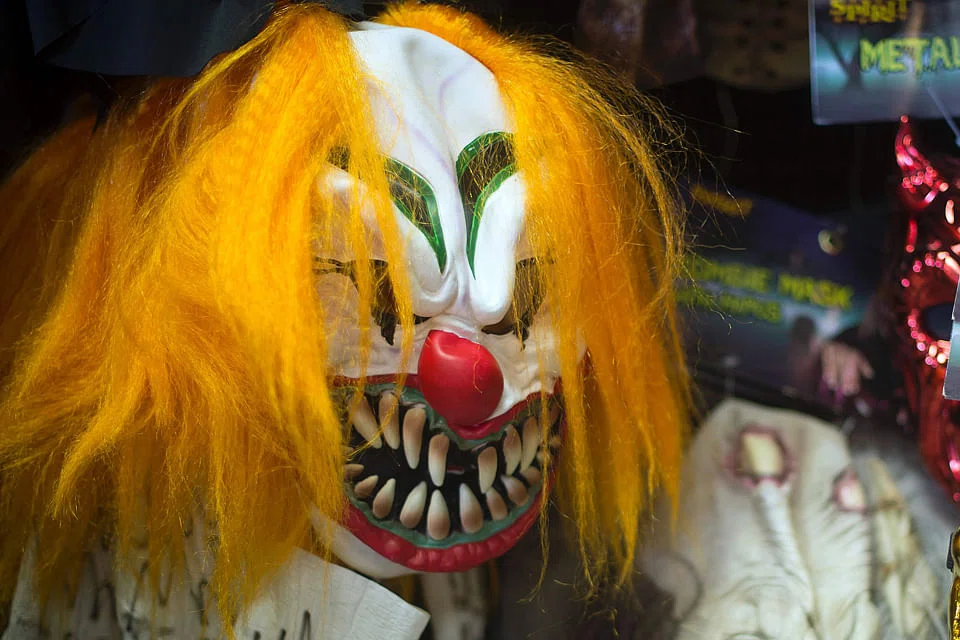
"There is an evil clown trope running through popular culture," he said. "With their exaggerated features, big feet, hands and noses, white makeup and wildfire hair, clowns are scary because they are caricatures. Like mannequins or androids, they are human but something is not quite right, and this can make people feel uncomfortable."
A fear of clowns - never mind one wielding a fake machete - is no laughing matter. Clowns have a centuries- long history of delighting Britons, but "coulrophobia" (a fear of the jesters) can also cause panic, difficulty in breathing and sweating.
Police warned that the clown pranks were disturbing the peace, taking up valuable police resources and, in some cases, breaking the law.
Last Sunday, police in the Thames Valley (which covers the areas of Berkshire, Buckinghamshire and Oxfordshire) said they had received calls about 14 scary clowns intimidating people across the region over the previous 24-hour period.
Chief Superintendent Andy Boyd, head of neighborhood policing at Thames Valley police, said that while he did not want to ruin anyone's fun, there was nothing amusing about scaring someone half to death, particularly a child.
"While we do not want to be accused of stopping people enjoying themselves, we would also ask those same people to think of the impact of their behavior on others and themselves," he said.
"Their actions can cause fear and anxiety," he added, noting that intimidation and threats could lead to public order offences.
True clowns, meanwhile, are outraged at the clown rampage. "This plays on the fear of a certain type of clown," said Suki Jobson, who studied at the École Philippe Gaulier, a celebrated clown school in France, and noted that clowning is an art form that is meant to bring joy and comfort.
"It is easy to scare people," she said. "It is harder to communicate and bring pleasure." NYTIMES
Share with us your feedback on BT's products and services






