

Crypto elite shun NFTs for 69-million-year-old dinosaur fossils
The triceratops skeleton now resides in an 82-square-metre, windowless room inside Le Freeport
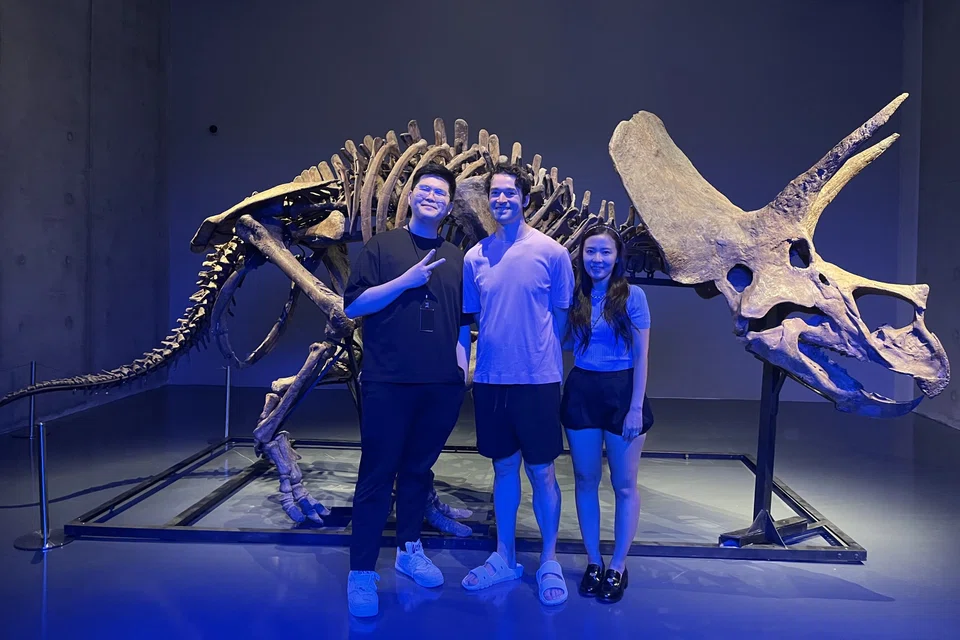
[SINGAPORE] Deep inside a Singaporean vault that’s been dubbed “Asia’s Fort Knox”, nestled alongside fine wines and priceless paintings, is a fully-formed, 69-million-year-old triceratops skeleton – one of only 24 known specimens.
Its owners: a group of collectors, including Yoann Turpin, co-founder of crypto market maker Wintermute.
The trading executive and his co-investors paid about US$5 million for the more than five-metre-long fossil, which was shipped from Wyoming to Singapore’s Le Freeport earlier this year. All four owners invest in crypto, including Chaw Wei Yang, who runs a platform called Co-Museum focused on collectibles.
The purchase is indicative of the transitioning tastes of the crypto elite, whose fascination with digital artworks known as non-fungible tokens (NFTs) petered out after a 2022 boom. In those heady days, entrepreneur Vignesh Sundaresan made headlines splashing US$69 million on a single NFT made by the artist known as Beeple.
Now, executives from the world of digital coins are increasingly drawn to antiques, precious metals and statues.
It’s a shift that suggests narratives about the mass digitisation of luxury goods using blockchains, the transaction architecture that underpins cryptocurrencies, “may have been vapour”, said Ben Charoenwong, associate professor of finance at Insead. “For a meaningful segment of the market, crypto functions less as an ideological movement and more like any other speculative bet where the end goal is still conversion into traditional, tangible stores of value.”
Le Freeport itself serves as a case in point. Built in 2010 near Changi Airport, with its three floors of fire-safe, temperature and humidity controlled vaults, and a three-storey deep basement that can store 2,000 tonnes of gold, the facility certainly was not made with cryptocurrency entrepreneurs in mind.
But it was purchased in 2022 for S$40 million by crypto billionaire Jihan Wu, founder of Bitcoin miner Bitdeer Technologies Group, who previously co-founded Bitmain Technologies, the world’s largest manufacturer of crypto mining equipment.
The facility has since experienced a surge in custom from wealthy crypto investors looking for a place to stash precious metal holdings, said Lincoln Ng, chief executive officer of Le Freeport Management. That’s “a signal that there’s a changing pattern of wealth creation and asset diversification” under way, he said, adding that the firm also offers safes for storing portable hard drives containing hundreds of millions of dollars’ worth of tokens.
Wu himself is a customer. His crypto investment platform, Matrixport Technologies, offers a tokenised gold product backed by physical bars stowed in Le Freeport’s vault, and elsewhere, according to the company’s website.
Tokenisation boom
Prior to a sharp sell-off that began in October, cryptocurrency prices had boomed this year, thanks in large part to favourable policy emanating from the US under pro-crypto US President Donald Trump. The same is true of an array of tokenised products, and gold in particular.
Perhaps the best example is Tether, whose XAUt product, a digital token physically backed by gold, has surged to a market value of about US$2.2 billion. Tether itself has amassed one of the world’s biggest gold hoards outside of banks and nation states, as part of its more than US$180 billion in reserve assets.
Meanwhile, crypto executives’ penchant for esoteric and at times bizarre purchases continues – albeit with a more tangible, more fungible flavour.
Billionaire Justin Sun paid US$6.2 million for a banana duct-taped to a wall in November 2024. Yat Siu, co-founder of Animoca Brands, bought a 1708 Stradivarius violin valued at more than US$9 million in 2023, later pledging it, along with an NFT version, as collateral for a loan from Galaxy Digital. In late October 2024, Tether and others unveiled a lakeside statue of Satoshi Nakamoto, Bitcoin’s pseudonymous creator, in front of a villa in Switzerland.
The triceratops skeleton now resides in an 82-square-metre, windowless room inside Le Freeport.
For Turpin, part of the appeal is that, like Bitcoin, only a finite number of such fossils are left in the world. But there is also “something quite special to see it displayed, to be able to touch it and experience it in the real world”, he said. BLOOMBERG
Decoding Asia newsletter: your guide to navigating Asia in a new global order. Sign up here to get Decoding Asia newsletter. Delivered to your inbox. Free.
Share with us your feedback on BT's products and services
TRENDING NOW

Once staunchly pro-China, Malaysian Chinese businesses are now distancing themselves from Beijing

Looking beyond looming CEO succession, should UOB potentially pursue a transformative merger?

Could stablecoins be the future of money?

Grab CEO’s wife Chloe Tong on life with Anthony Tan and finding her purpose

