Difficult? Shocking? Maybe it's just good art
The arts festival has been accused of being too challenging. But perhaps audiences should open their minds, says HELMI YUSOF

Helmi Yusof
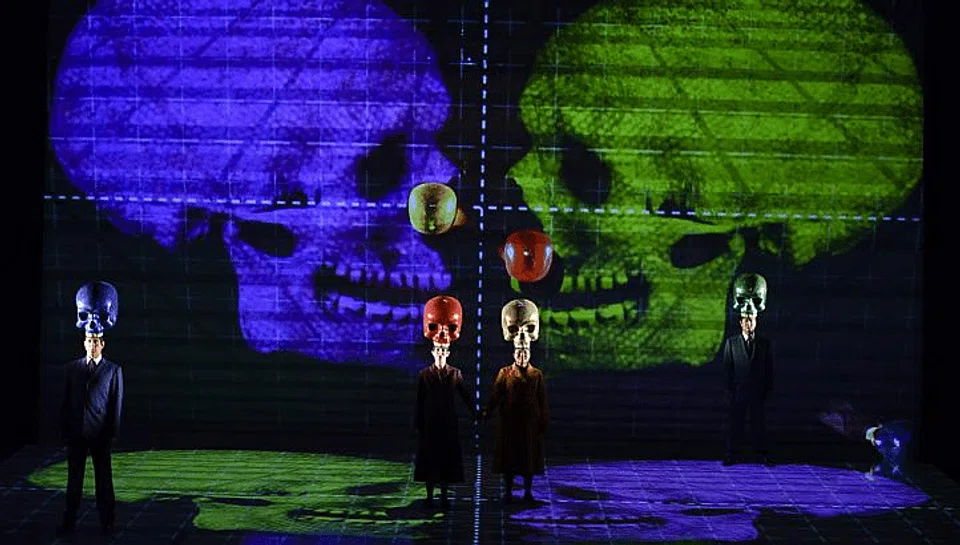
THE curtain-raiser for the Singapore International Festival of Arts (SIFA), the contemporary opera Facing Goya, certainly set tongues a-wagging. After the opening night, an arts journalist from Europe said to me: "That was absolutely terrible. Does this Ong Keng Sen even know how to block actors? They were just standing there like pieces of furniture."
I said: "He's directed actors since the 80s. He started with hit musicals and moved to classic dramas like Miss Julie and The Trojan Women . . . So, yes, he knows how to block actors."
"Then why didn't he do it this time?"
"Um, well, I think he's challenging tradition - including blocking."
The journalist and I spent a few minutes disagreeing with each other, although essentially, neither of us liked the opera.
As it turned out, this was the first of several contentious conversations I was to have with other audience members regarding various polarising productions in the festival.
The revamped, newly independent festival, under the leadership of Ong and CEO Lee Chor Lin, ended on Sunday after a six-week run, with several of the 13 shows simultaneously praised and panned.
As both director of Facing Goya and festival director of SIFA, Ong is responsible for curating all the shows. And not unpredictably, there has been some hue and cry over the "challenging", "non-mainstream" works.
Chinese daily Lianhe Zaobao described the festival as "niche" and "appealing to a narrow audience". It wrote: "In the 21st century, the avant garde form of artistic expression was not something that was readily accepted by audiences."
Poet Alvin Pang joked that the festival was "preaching to the converted".
Among the controversial works this year was Disabled Theatre, which featured mentally challenged performers dancing to their own choreographic routines. It prompted the question of whether it was a celebration of humanity in all its hues, or a glorified freakshow.
Then, there was I Stand Corrected, a South African dance-drama about the rape and murder of a lesbian bride who is about to marry another woman.
There were also the concerts by the London Sinfonietta which specialises in playing the iconoclastic, atonal - some would say "unlistenable" - classical music of the 20th century.
Other productions such as Cry, Trojans!, Mystery Magnet and Amid The Clouds similarly had their share of fans and detractors.
Any observer of the 35-year-old festival can see why such harsh criticism surfaced. Mirroring Ong's own uncompromising style of theatre-making, the festival has placed itself on the cutting-edge of art, and shows no interest in playing to the gallery.
But in an increasingly crowded arts landscape, it may well be the savviest thing the festival can do. The truth of the matter is, in the past few years, the festival had been flirting with irrelevance.
Looking back, there was a time when Singapore was a cultural dessert, and the-then Singapore Arts Festival provided the few opportunities for Singaporeans to catch high-quality fare from abroad.
That all changed in 2002 with the opening of the Esplanade, the country's premier performing arts venue. The Esplanade brought big names onto its stage all year round - Sylvie Guillem, Joshua Bell, Stan Lai, Ninagawa Company and Jessye Norman, among others. Today, it holds 14 excellent annual festivals.
In the next two months, you can catch blockbusters such as Matthew Bourne's Swan Lake, the Stuttgart Ballet's Onegin and the London Symphony Orchestra under the baton of the great Valery Gergiev. More experimental works can be found in its black box space under its terrific Studios programme.
The other heavyweight performing arts venue - though not all may call it that - is Marina Bay Sands (MBS). It hosts many popular musicals such as Wicked, The Lion King and My Fair Lady. In November, the Israel Philharmonic Orchestra will hold its inaugural Singapore concert there, under the baton of the legendary Zubin Mehta.
With so much crowd-pleasing fare on offer, SIFA must distinguish itself or die - on its not-too-lavish S$6.5million budget. Ong and his team have chosen to focus on edgy, challenging fare that confronts the audience and forces them to think hard. The odds of some of these works showing at the Esplanade or MBS are arguably slim. MBS, in particular, tends to host works that have already garnered popularity elsewhere and have an in-built audience here.
The works that Ong curates for SIFA, in contrast, are largely from the left field. The artists are under-the-radar (India's Nikhil Chopra, Belgium's Miet Warlop), under-appreciated (the US's Wooster Group, the UK's London Sinfonietta) or under-represented on stage (mentally challenged performers, openly lesbian performers). SIFA did have a few big crowd-pleasers such as Peter Pan and Sambaso. But these were the exceptions.
Generally, the works pushed envelopes, divided audiences and spurred debate. There were numerous free talks given by the artists before the performances because the organisers knew these works were no walk in the park.
In doing so, SIFA has served a bold antidote to the more popular fare offered all year round. And it may be what the country needs to take the arts scene to a new level.
Audiences could stay in their comfort zones by staying away - or they could work a little harder at broadening their tastes and seeing how other practices and art forms are possible. The arts - as almost everything else in the world - is rapidly globalising.
Indeed, the talented New York visual artist Paul Chan once said, the reason artists make art is that they look at the status quo and think, "Well, that's just not good enough." Ong and his team must have looked at the arts scene here - and rightfully decided to change the game.
Copyright SPH Media. All rights reserved.