Don't judge a wine by the grape on its label
New York
THE word "varietal" is among the most misused in wine.
Many people think of it as a synonym for "grape", as in: "What varietals are in that wine?"
Not to be pedantic, but that is wrong. Varietal is not a noun, it is an adjective. One may properly refer to a "varietal wine", like a cabernet Sauvignon or a chardonnay, in which the wine is made with a dominant grape variety.
This distinction pertains directly to our most recent topic, California Grenache, in which we had one varietal wine, made entirely out of Grenache, and two blends, in which Grenache was one of several varieties in the wine.
Here at Wine School, we try not to be sticklers, but we do feel compelled to be accurate, if not exact. This is difficult when considering the leeway that California offers in its labelling rules, which require that a varietal wine contain at least 75 per cent of that particular grape. In other words, a wine can still bear the varietal label "Grenache" even if other grapes account for 25 per cent. But if the blend includes less than 75 per cent of Grenache, it cannot be called by the name of the grape.
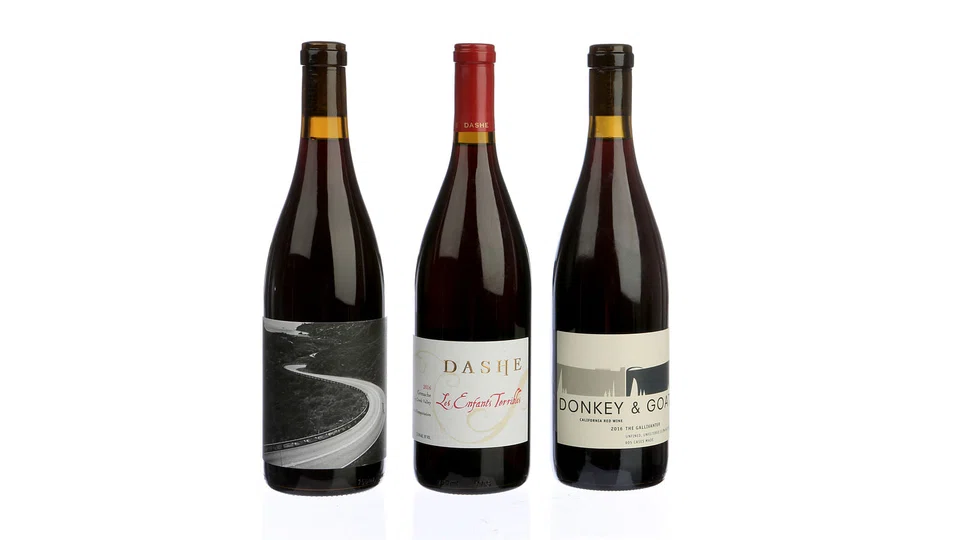
Of the three wines I recommended, only one is labelled Grenache, the 2016 Les Enfants Terribles from Dashe in the Dry Creek Valley. The other two, the 2015 Jolie-Laide Rossi Ranch Sonoma County and the 2016 Donkey & Goat California Gallivanter, are blends.
One, the Jolie-Laide, gives an indication of its blend on the label, with Grenache and syrah written in big letters, and viognier and muscat d'Alexandria in a subordinate font. But the Donkey & Goat does not list any grapes on its label, and information was not easy to obtain. This led to some confusion.
"The '16 Donkey & Goat, referred to as a 'red blend', contains no Grenache," noted one reader, Caroline Moore of Eugene, Oregon, who wondered why it was included.
Actually, the Gallivanter does contain quite a bit of Grenache, though I understand why some curious readers thought otherwise. In previous years, the blend was completely different; in 2015, pinot noir and syrah were used. But Jared Brandt, an owner of Donkey & Goat, told me that the blend was changed in 2016. That year, it was made with a plurality of merlot and a sizable percentage of Grenache, along with syrah, mourvèdre and a few others "for fining tuning", he said.
He did not want to detail exact percentages. "Specificity is something we are trying to get away from," he said. "As winemakers, we think that blends are often more complex and pleasing."
Grenache is among those grapes that have historically been blended. It is the dominant variety in Châteauneuf-du-Pape, but seven other red grapes are permitted, and a vast majority of the wines (with some exceptions, like the highly coveted Château Rayas) are blends.
The 2016 Dashe, made entirely of Grenache, was fascinating. It was balanced in its own right, packed with red fruit flavors, which were initially a bit jammy but tightened with exposure to air, becoming stonier.
Yet fruitiness was the dominant character, and as someone who does not generally gravitate to powerfully fruity wines, I couldn't help wondering whether a blend might have diminished the berry-flavoured wallop.
It drew contrasting reactions. Some readers, like William Barnier of Sonoma County - who drank the 2015 Dashe and is perhaps used to California wines with less acidity - found it a bit austere, though he liked it with a wild king salmon fillet.
Martin Schappeit of Forest, Virginia, likened it to "strawberry shortcake".
The 2015 Jolie-Laide - with its blend of Grenache and syrah, and tiny amounts of the aromatic white grapes viognier and muscat - seemed like a more complex mouthful, with the bright Grenache fruit given depth by the dark, spicy syrah. It was earthy, lightly tannic and altogether intriguing.
The 2016 Donkey & Goat was lithe, juicy and focused, with precise flavours that balanced fruit with earth and energy. Some readers noted this quality. Dan Barron of New York called it "vibrant and electric".
These three wines are obviously too small a sample for sweeping generalizations, but that will not stop me from offering a few thoughts. For one thing, I thought the three wines affirmed the traditional wisdom of using other grapes to harmonise with Grenache. The 100-per cent Grenache Dashe was a fine, pure wine, but it seemed less complete than the other two. Would blending have given it more depth and a wider spectrum? Maybe.
The tasting also underlined a deficiency in the labelling rules, which perhaps encourages winemakers to reach that 75 per cent threshold so they can give the wine the easier-to-market varietal label. You could argue that California merlot suffered qualitatively as winemakers often used too high a percentage of the grape in their blends simply so they could call it merlot. Only in a very few places, like the Right Bank of Bordeaux, can complete wines be made with that much merlot. NYTIMES
Share with us your feedback on BT's products and services