

El Anatsui builds monumental art from daily life
 Add BT as a preferred source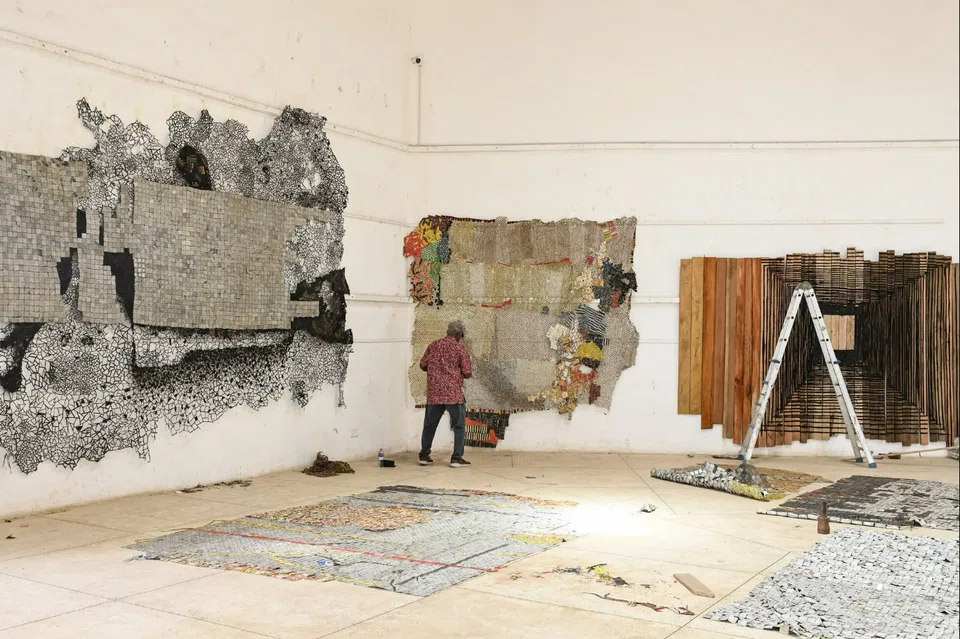
IT’S one of the great origin stories in contemporary art, a flash of instinct that would revolutionise a field. In 1998, El Anatsui was walking around Nsukka, Nigeria, and noticed a bag of aluminium bottle caps by the roadside.
Anatsui, then a professor at the University of Nigeria who was drawn to daily-life materials in his own art practice, took the bag to his studio. He began to play with the caps: folding them, slicing them in rounds and opening their cylindrical sides.
Working with assistants, he found a method. He punctured the metal bits in several places and linked them with copper wire. The compositional language rewarded scale: Soon individual works would enfold hundreds of thousands of these molecules. They would dance when hung on walls and cover entire buildings.
As they have awed viewers worldwide – at the Venice Biennale in 2007 or the Brooklyn Museum in 2013, for instance – Anatsui’s bottle-cap confections have defied description and category. Is he sculpting, or weaving? Is this art modern, abstract, universal, African?
The answer to all of these is: Yes.
This week, Anatsui’s latest monumental work opens in the cavernous Turbine Hall at Tate Modern in London. Titled “Behind the Red Moon,” it evokes the celestial and the maritime. Come down the entry ramp and an immense red-on-red sail with a central orb billows over your head. Its back unfurls in shades of yellow. At the far end, another sheet dips to the ground, dark like a looming shore. In between, panels of silvery diaphanous rings glitter in the light; they suggest human figures and come together to form a globe.
Twenty-five years after Anatsui’s roadside intuition, his bottle-cap compositions still reward and elude. Grand but down-to-earth, they exude sensuousness and sweep, yet, on approach, grow prickly and particular. They invite close looking – for the sheer craft, but also for insights, in their weave of recirculated materials, about the world we live in. With its navigational theme and the fact that it is on view in London, “Behind the Red Moon,” which Anatsui conceived working with Tate curators Osei Bonsu and Dina Akhmadeeva, carries allusions to colonial trade and empire while operating through metaphor.
For Princeton University art historian Chika Okeke-Agulu – an Anatsui expert who helped organise a major 2019 Munich retrospective – Anatsui has done nothing less than reinvent sculpture.
“When you look at these gossamer structures in space, monumental in scale yet so fragile, that paradoxical invocation of power and poetry, it’s hard to find equivalents,” Okeke-Agulu said. “It’s a completely new proposition.”
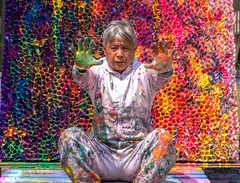
Anatsui, whom everyone calls “Prof,” is soft-spoken and witty. The more analytic the point, the more likely he will offset it with a chuckle or wry smile.
His art comes pre-loaded with meaning. Sorted into crates and sacks in the studio, the caps and foils – from alcohol, other drinks, medicines – suggest a kind of material sociology of daily life, consumption and commerce. He still obtains them mostly in Nigeria but is building his Ghana circuits; minor local differences in products and tastes could ramify through his artwork into new colors and patterns.
In societies where adaptive reuse is the norm, Anatsui rejects the premise of trash. Consider the foil buffet trays at weddings or funerals, he said, which can be smelted back into cooking pots. “We are not working with waste material, because there are other people who use them for other things,” he said. Art is one option in the cycle.
He is keenly conscious of his own work’s industrial organisation – particularly now that its supply chain crosses countries. The Nsukka studio produces works up to the point where his eye and touch are needed. Folded into crates, they are shipped by DHL to Tema, from where the finished pieces head out into the world.
In designing the Turbine Hall work, Anatsui said, he had in mind the trans-Atlantic triangular trade in enslaved people and plantation commodities – particularly sugar, which built the wealth of Henry Tate, the museum’s 19th-century patron. In a sense, he said, Nsukka to Tema to London “replicates a triangle in the way the whole work comes about.” NYTIMES
Decoding Asia newsletter: your guide to navigating Asia in a new global order. Sign up here to get Decoding Asia newsletter. Delivered to your inbox. Free.
Share with us your feedback on BT's products and services
TRENDING NOW

Singapore Kitchen CEO, senior manager charged with alleged fraud, falsifying accounts; both to stay in jobs for now
Vingroup’s shares surge 1,000% to overtake regional heavyweights including Singtel and JD.com

Johor property old hand KSL readies family handover amid market boom
Yeo’s, Tiger Beer and now Gardenia – flight of food manufacturing from Singapore might be just as planned

