Fancy heading to space? Be prepared to pay US$600,000
At least two Singaporeans have signed up for Virgin Galactic’s sub-orbital flights
CALLING all travellers seeking an out-of-this-world experience, especially ultra-high-net-worth folks who have already been there and done that.
Try space tourism for a change.
British billionaire Richard Branson’s Virgin Galactic, still in its infancy, would be happy to help you boldly go where few men and women have gone before. Just be prepared to cough up US$600,000 to fly to the edge of the cosmos.
Virgin Galactic, which describes itself as the first commercial spaceline, held its debut roadshow in Singapore this week, addressing some 200 potential clients before moving on to China and Hong Kong. It has set aside 25 seats for clients of their local partner, Intriq Journey.
Since its very first flight in 2018, the spaceline has taken 37 people to space over 12 spaceflights, including seven commercial ones. These include 24 paying customers, as well as researchers and professional astronauts, and both men and women.
Virgin Galactic’s vice-president of communications, Aleanna Crane, told The Business Times that the company is making the life-changing experience of space travel a reality “by delivering repeatable, regular and reliable spaceflights”.
Who can fly
The company calls everyone who has flown its spaceflights astronauts, and those who have reserved seats, future astronauts. Last year, it flew its oldest astronaut, 80-year-old former Olympian, Jon Goodwin, and its youngest, 18-year-old Anastatia Mayers.
Customers have to be at least 18 to fly, but younger children can join Virgin Galactic as a member before that; the youngest future astronaut is just seven.
Virgin Galactic is working on its new Delta-class spaceships, after having retired the previous VSS Unity. Delta is expected to start commercial service in 2026, and test flights are expected to begin next year.


The US$600,000 ticket price comprises an initial payment of US$150,000, which includes a US$50,000 non-refundable membership fee. The remaining US$450,000 is due roughly a year before the spaceflight.
Community events and activities are held for future astronauts in the estimated three years leading up to the flight. Then nine months or so before it, the actual process of preparation begins, including medical clearance, documentation and meet-ups with the crew and other astronauts. Clients are encouraged to get their loved ones involved in their planning and training, so confidence and excitement is built over time.
Four days before the flight, customers undergo flight training at Virgin Galactic’s spaceport in New Mexico. Training will be completed alongside fellow astronauts, and includes a flight experience in a two-seater aircraft, so passengers can get comfortable in high- and low-G (acceleration) situations, and understand what boost, space and re-entry feel like.
On the big day
And the actual flight itself?
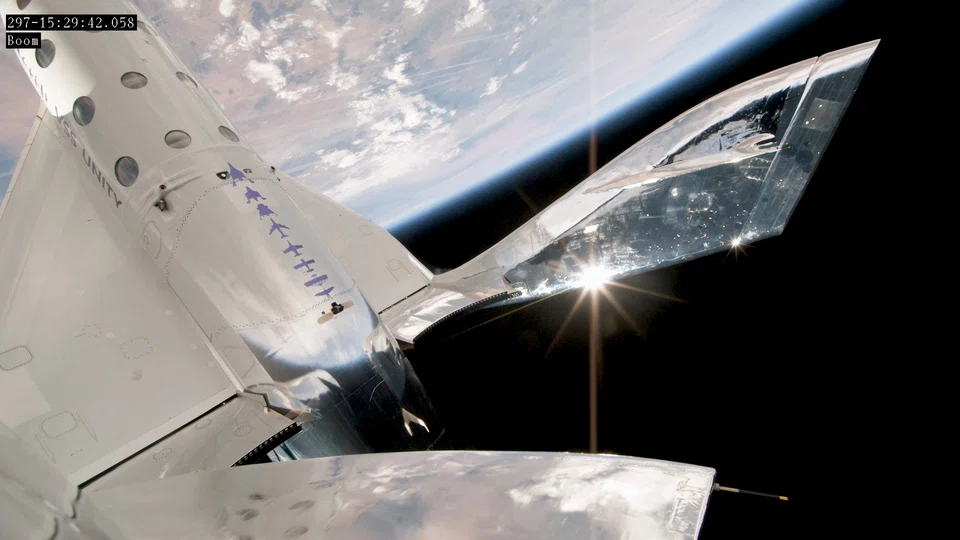
A mothership plane takes off, carrying the spaceship underneath. It releases the craft at a designated altitude after about 45 minutes of flight time. The spaceship then fires its rocket engine to get a boost for about a minute, sending it to a top speed of Mach 3 (about 3,700 kmh), or three times the speed of sound. The spacecraft reaches its apex beyond 80 km above Earth.
Once in sub-orbital space, passengers unstrap from their seats and float in zero gravity for about three minutes as they admire Earth, its curvature and the contrast between its brightness and the darkness of space. Thereafter, they return to their seats for the spaceship to re-enter Earth’s atmosphere, and land on the same runway from which the mothership took off.
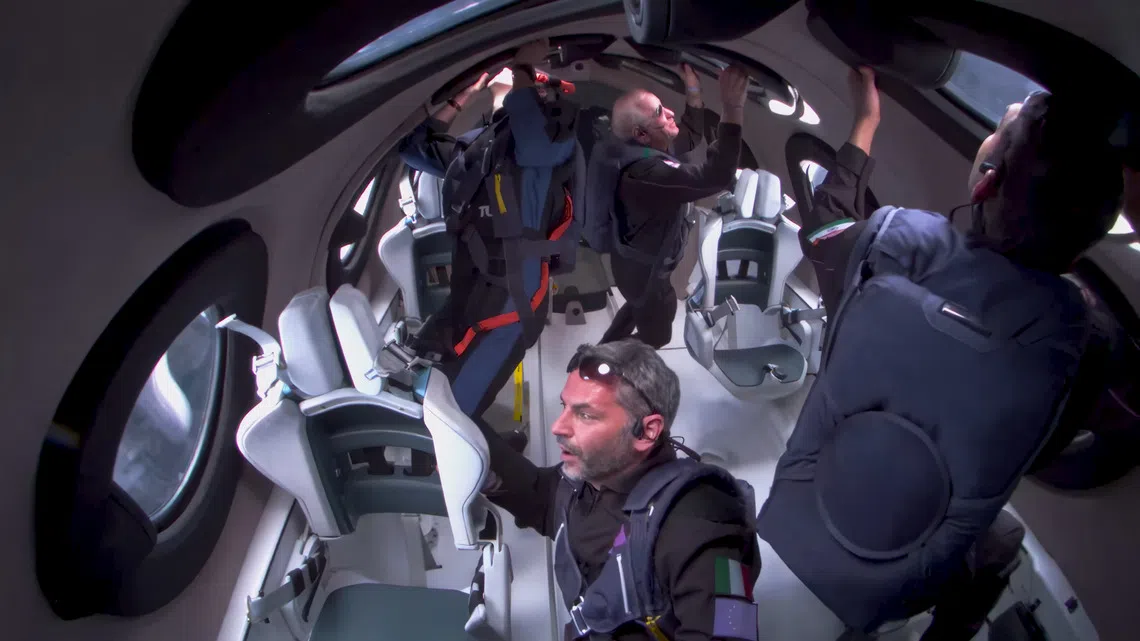
The entire voyage, from take-off to landing, lasts about an hour.
Astronaut instructor Colin Bennett, who was on the team in the roadshow, says: “Being in space is the most unnatural thing to do, yet the weightlessness is so natural and intuitive.”
Space tourism accelerates
With its initial fleet of two new Delta spaceships (each carrying six passengers) and one mothership, Virgin Galactic is expected to fly approximately 125 flights – or 750 passengers – each year.
Plans are to add two more spaceships and two motherships to the fleet, so the company can scale to 275 flights, or about 1,650 passengers a year.
Crane says: “Once we reach the future state of having an additional spaceport, we jump to approximately 550 flights, which equates to 3,300 passengers flying each year.”
Of the 1,000 seats currently available, 700 have already been reserved, with the largest number of bookings coming from the US, UK and Australia. In Asia, the Japanese are the biggest group making reservations. At least two Singaporeans who are Intriq Journey clients signed up last year; a few more indicated their interest this week.
James Willoughby, Virgin Galactic’s vice-president and general manager of customer operations, says: “Globally, we potentially have 300,000 customers for our flights, based on a wealth level of US$10 million and above.”
But this is just a conservative estimate, because it isn’t just the very wealthy who are keen on space travel.
“We have future astronauts who have mortgaged their home for the experience,” he adds.
Decoding Asia newsletter: your guide to navigating Asia in a new global order. Sign up here to get Decoding Asia newsletter. Delivered to your inbox. Free.
Copyright SPH Media. All rights reserved.