Living and working in the post-pandemic era
Architects and designers share ideas on how living, dining, shopping and vacationing may be like in the new normal.

IT has been more than two months since Singapore cautiously reopened on June 19 after the circuit breaker period. But has life really gone back to normal? Not quite, as those who have gone back to work at the office will tell you. As our lives and routines are upended by the Covid-19 pandemic - perhaps permanently - so too will our environment, be it our homes, restaurants, malls, hotels and the like. But, how, is the question that has yet to be answered.
Mike Lim, director of DP Design, says: "This is a good time for us to recalibrate and think about building an environment that puts the focus back on humanity, rather than design for looks."
With that in mind, BTLifestyle asks a group of architects and designers for their outlook on the environment of the future.
Home - more greenery and comfort
When cities around the world went into lockdown to stop the spread of Covid-19, working from home became the default mode. This is likely to continue.
With longer hours spent at home, homeowners are naturally thinking about how to make their spaces more comfortable.
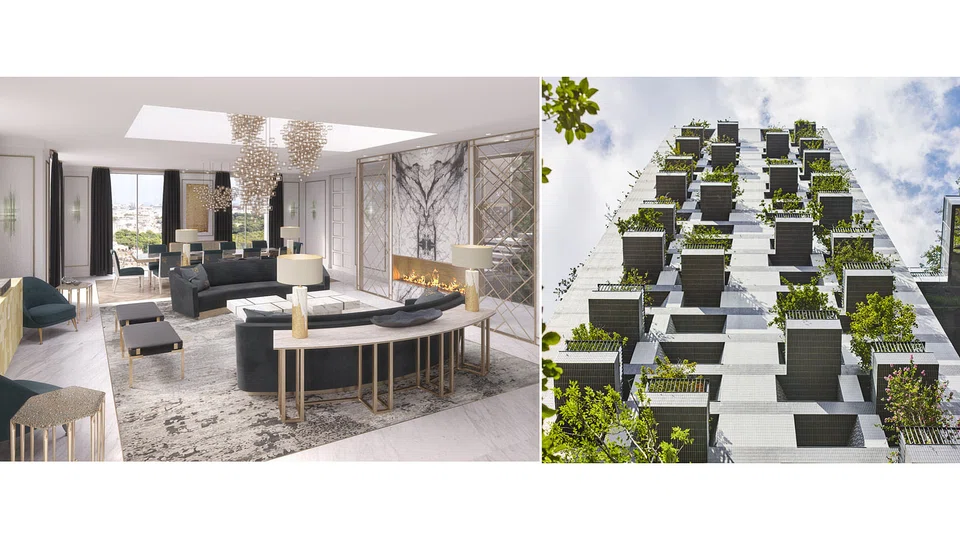
Award winning British interior designer Katharine Pooley says: "Many people have realised during the lockdown that they want to live a different way: they want to live in an interior that is environmentally friendly, uplifting, spacious and one that is closely linked with the exterior landscape and surroundings beyond."
She adds: "It has been a nightmare for many to spend so much time inside, a nightmare not quickly forgotten, and those with the funds to alter their habitats are sure to do as much as they can as quickly as possible to achieve radical change."
Her clients are now asking for home gyms, large open plan kitchens, outdoor dining spaces, pools, tennis courts, spas and home cinemas. "These are now the base expectations of what a good home life entails. Quite simply, clients don't trust that they will be able to easily and safely experience equivalent activities outside the home going forward - certainly not in the effortless way previously experienced."
Aside from creating spaces for leisure activities at home, the need for an effective home office is a trend that won't go away anytime soon, says David Calkins, regional managing principal of Asia Pacific and Middle East at Gensler, the world's top-earning interior design firm.
"As working from home gains acceptance and more roles are fulfilled in remote settings, the fundamental principles of workplace design that allow employees to focus, collaborate, learn and socialise, will still apply, but in a residential context," says Mr Calkins.
Apartments will continue to be small, but Mr Calkins says that designers and developers now need to consider making the home office a part of the layout. For example, rooms could come equipped with a retractable green screen background for video conferencing or a closet build-out option that includes space for a printer and office supplies.
Lee Wai Fong, a director at DP Architects and head of its Residential Typology Research Group, points out that many Singaporeans could work from home almost immediately without much trouble because the standard of housing in Singapore is high. "But as a side effect of Covid-19, we should consider how residential design can evolve."
An open plan home may not be conducive for privacy and concentration. He suggests that designers think about how to create bedrooms that are spacious enough to accommodate work desks.
Developers should also put thought into amenities that support households that are working from home, especially for larger families where privacy is an issue. "Apart from the typical gym, pools and tennis courts, there could be the introduction of a co-working space, with private work pods, and one for children in the estate for their home-based learning, and perhaps printing services and free WIFI for users," says Mr Lee.
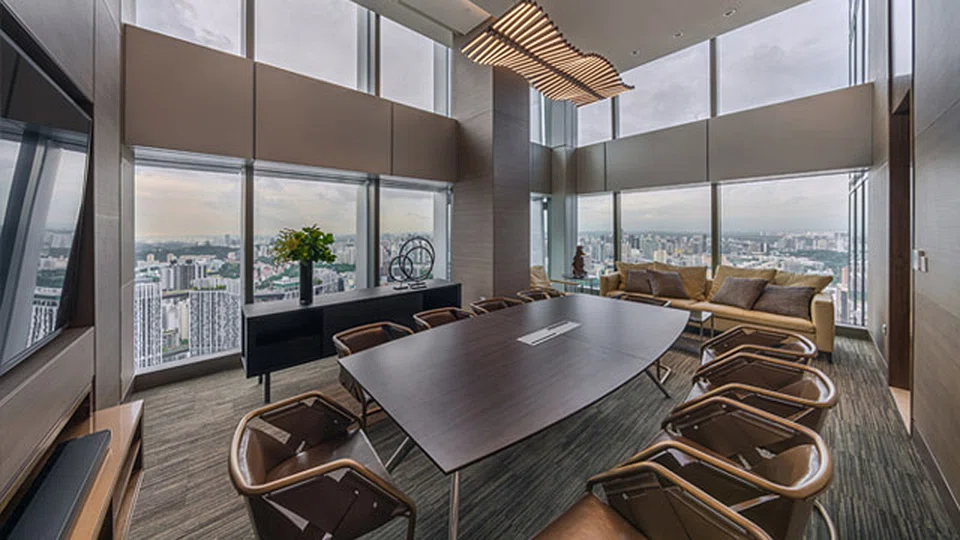
One development that is already offering its high net-worth residents an extended work from home experience is Guocoland's Wallich Residence by Skidmore, Owings & Merrill LLP. It has facilities such as a boardroom for formal business meetings, private dining rooms with a Western and Asian dining setting to host business associates, a theatrette for screenings, small-group casual discussions or team bonding activities, and a library.
Mr Lee says that while many condominiums have adequate landscaping on their grounds, developers may want to consider going beyond providing them for aesthetic reasons. "Perhaps the landscaping could be turned into active green spaces for, say, communal gardening."
While that idea is still new, one thing that's more certain is that homes will definitely be more green.
Richard Hassell, co-founder of Woha Architects, says: "Having access to greenery and seeing greenery from your home is good for mental health. People who have been under lockdown have, perhaps for the first time, become acutely aware of what it's like to not have access to fresh air and greenery."
The firm is known for having extensive planting both on the ground and in the form of skyrise greenery in its projects, such as One Moulmein in Singapore and more recently for Sky Green in Taichung, Taiwan. "Incorporating access to nature is something that has always been high on our priority list in every project that we do, but, yes, I think things like more private and communal green spaces will probably be given more emphasis in general," says Mr Hassell.
Dining out - shared kitchen and more private rooms
Even though cooking at home and ordering food to be delivered was much the norm during lockdown periods, dining out will be something that people look forward to.
Seeing how some restaurants have had to close down during Circuit Breaker, while others collaborated with each other to stay afloat, local design firm LAANK offers a novel idea to help smaller dining establishments stay afloat in tough times.
Its creative director Cherin Tan suggests that a few brands could come together to share a restaurant space, which will help lower the burden of high rent and staffing costs. "Three brands could share a 3,000 sq ft space, rather than have to deal with 1,000 sq ft on their own," she suggests. The brands should ideally synergise with each other rather than offer similar items, and they will share the restaurant frontage.
A show kitchen will be the heart of the restaurant, and there will be different types of seating offered, such as a chef's table, private dining rooms, and more open planned seating. Ms Tan adds that other features such as a delivery pick up point and a vegetable roof garden could also be added.
For existing restaurants, restaurateurs have been implementing new cleaning and disinfection processes to make F&B environments safe. "However, for a successful reopening, perceived safety is just as important as actual safety," says Jese Medina-Suarez, principal at Wilson Associates' London studio.
"Restaurants with high levels of privacy or space articulation, where diners have little or no visual contact with other guests boast a great advantage. Private dining rooms are an important asset in this new climate, nevertheless, it is often scarce in most restaurants. Designers can create design elements to screen different dining conditions, adapting layouts to prevent visual contact between groups, and allowing for seating arrangements that are flexible."
With social distancing requirements in place, designers are also finding ways to help their clients maximise the use of restaurant space.
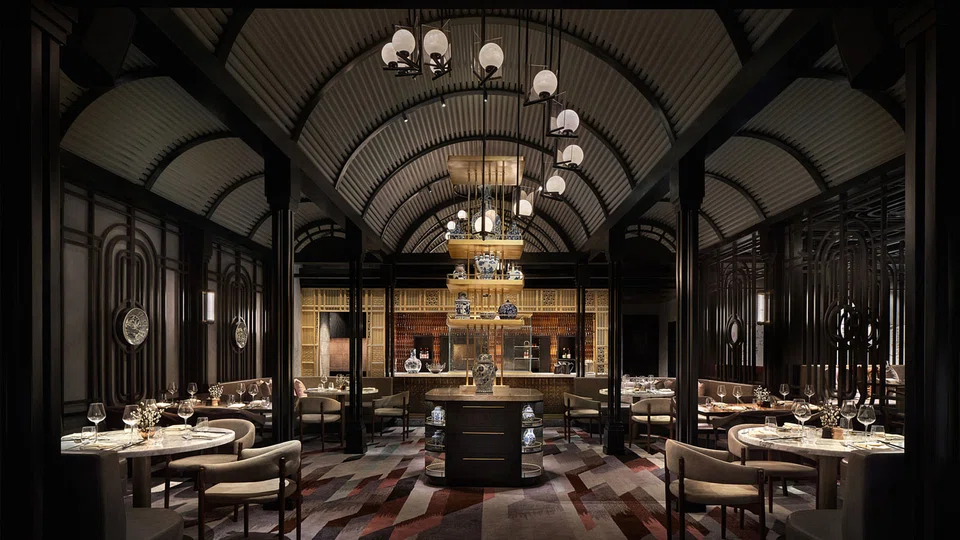
Global design studio EDG Design recently completed fitting out The Chinese National, a restaurant in The Swissotel Jakarta, that has 412 rooms. The restaurant needed to be large enough to seat all guests for breakfast, but not be under-utilised for the rest of the day.
To meet the requirements, the firm designed a complex of Chinese specialty venues that operated separately and offered different culinary experiences, yet were able to transition and come together as one, allowing guests to roam between the spaces seamlessly. There are many hidden panels in the space that open and close to allow venues to either connect or disconnect as needed.
Managing director Michael Goodman says: "It is vital to remember during this turbulent time that design should not shock or amaze. Rather, as designers, we must imagine and express how it feels to be a guest in the space we are creating, as opposed to focusing solely on how it looks."
Gensler's Mr Calkins believes that there might be an increase in ghost kitchens which, he says, may offer a path for struggling restaurants to survive.
"Ghost kitchens have become a go-to operational strategy as a response to rising food and rent costs and the proliferation of food-delivery platforms. Many home delivery meals come straight from a ghost kitchen, a professional food preparation and cooking facility set up for delivery-only meals," says Mr Calkins. "Repositioning a restaurant to a ghost kitchen is one way to maintain an income stream, keep valuable staff employed, and build trust with customers. This entry point could establish a brand and usher in the eventual conversion from delivery to dine-in."
Retail - enhancing the shopping experience
Online shopping isn't new, but it is likely to continue its popularity even as stores have reopened, which means tough times for the latter.
"Our clients lament the lack of foot traffic, even from stores that are in good locations," says LAANK's Ms Tan. "Even clients who have an online presence are not doing that well."
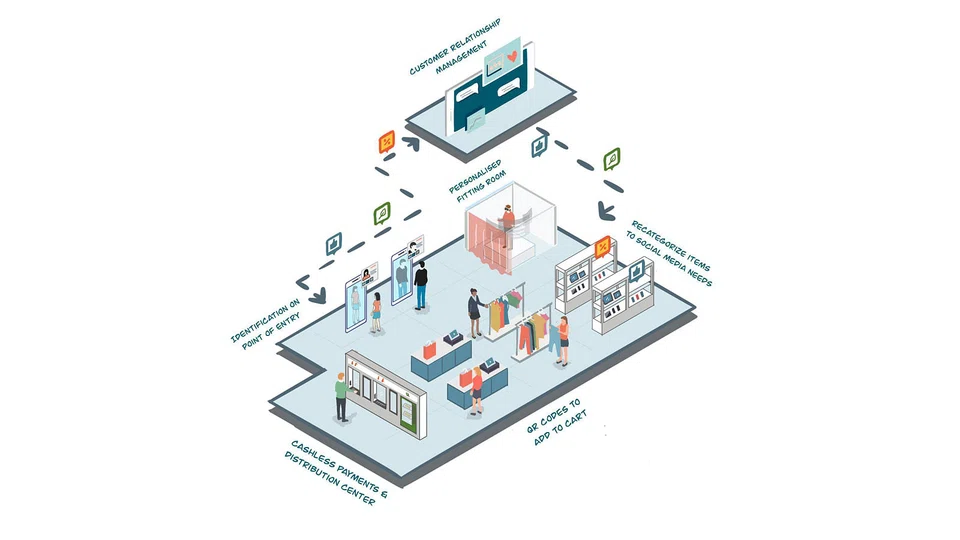
She believes that enhancing the shopping experience can entice shoppers to spend. For a start, self-checkout counters and delivery options onsite could become the norm. "You see these services at supermarkets, but not in retail stores yet," she says.
Rather than stores displaying their items according to what's new, Ms Tan suggests recategorising items according to what's popular on social media. "For example, if a certain style is trending, that should be prominently displayed to catch the shopper's eye," she says.
In fitting rooms, technology can be harnessed to show shoppers other outfit options that they should consider.
"Brands should also rethink the purpose of their stores, it is no longer enough to fill the shelves with products," says Ms Tan. She proposes that stores in the main shopping area hold events for better brand interaction, while the heartland branches can function as distribution centres or click and collect stores.
Another designer who believes that the online and offline shopping experience should be more seamless is Leong Hon Kit, co-founder of Wynk Collaborative.
Mr Leong says that, as a result of the pandemic, consumers have become more well versed in shopping online, but that doesn't mean retail spaces will become less important or smaller. "The post pandemic retail space will need to become more experiential, and must engage in a more meaningful way in the life of the consumer," he says. "The physical and online store experience must speak in a cohesive voice together with social media and other forms of customer engagement.
Retailers could perhaps take a page out of Love Bonito's book, whose Funan outlet is designed by Wynk Collaborative. The brand has an omni channel marketing approach that engages shoppers offline and online at the store.
"The intention is finding the right channels and touchpoints to connect with the customer to keep them interested and projecting a way of life that aligns with them," says Mr Leong.
DP Design's Mr Lim suggests that future malls could also be curated to meet target needs rather than cater to the generic shopper. "Most people would usually do their research online, and then go to the stores, knowing exactly what they want," he says.
"On the internet, products are listed according to product categories, so malls could take that similar approach," says Mr Lim, citing Sim Lim Square as an example.
Hotels - rethinking old approaches
With travel plans on hold for now, many of us are missing the experience of staying in a hotel, although doing a staycation comes close.
Gensler's Mr Calkins says that going forward, hotels can consider three ideas to meet new expectations and deliver an exceptional guest experience in a post pandemic era.
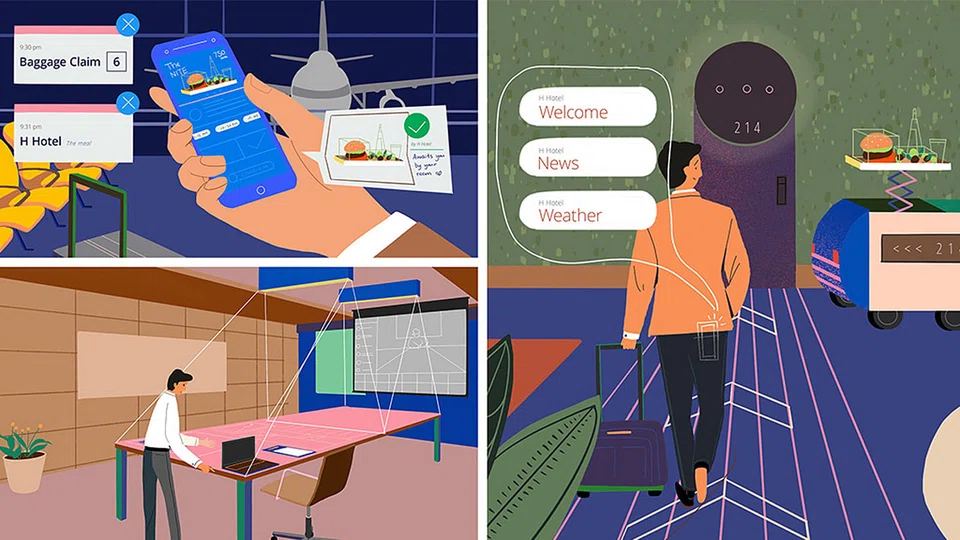
The first is to revive and rethink room service. Self-serve options and grab-and-go markets have reduced the demand for room service. But with a heightened concern over health and physical distancing, room service could provide an opportunity to care for guests. And instead of relying on manpower, hotels could utilise more robot butlers.
"In negotiating limited occupancies and limited operations, we have heard our clients take meal orders and delivery times at check-in, allowing them to understand and manage load and supply. This also extends the window of communication with guests, providing individual care, offering curated menus, and learning guest preference and applying loyalty knowledge," says Mr Calkins.
Secondly, while a large number of hotels are already offering touchless technology, that number will certainly increase. "Any digital experience in a hotel must be designed to deliver experience and convenience - when visitors arrive at their rooms, throughout the property, and within the hotel's loyalty app. The technology must also provide opportunities for guests to connect with the property to provide feedback and offer visibility for the management team for issue resolution," he says.
Lastly, hotels don't just cater to travellers but to events too, and that needs a relook. "Hotels can position themselves as remote offices or as virtual event hosts," says Mr Calkins. "They have an opportunity to serve as strategic partners with local office tenants and building managers."
When it comes to how hotel rooms will be designed, Woha's Mr Hassell says that will still be dependent on the space available and how to keep the hotel profitable. So it is not simply a matter of having more villas over highrise blocks.
"If guests are concerned about the close proximity to others, or the transmission of aerosols, hotels could be more transparent about things like their mechanical air systems," he suggests. "Post pandemic, guests will likely appreciate natural ventilation, so having windows that can be opened would be good, or having a balcony."
Jean-Michel Gathy, principal designer at Denniston, a well-known design firm in the hospitality industry, adds: "Basic rooms will give way to more studios and suites with kitchens and laundry to reduce housekeeping and room service interactions. Within five years, I predict that all these things will be standard in the hotel industry, especially at the highest end."
Decoding Asia newsletter: your guide to navigating Asia in a new global order. Sign up here to get Decoding Asia newsletter. Delivered to your inbox. Free.
Copyright SPH Media. All rights reserved.