Fifa’s World Cup sycophancy is dirtying the Beautiful Game
Sidling up to climate deniers and making deals with heavy polluters is a surefire way for the institution to turn football ugly
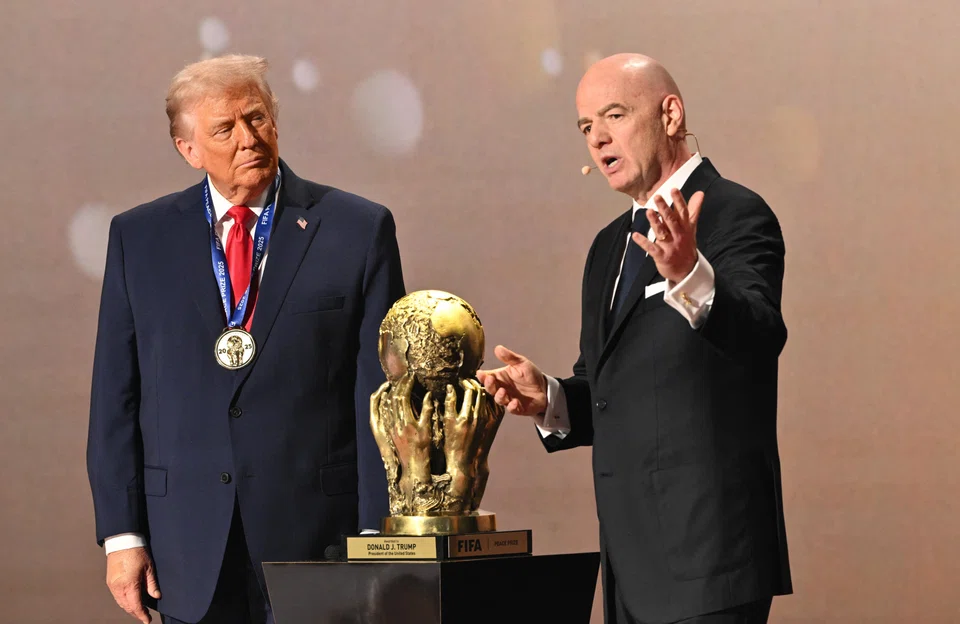
[WASHINGTON, DC] US President Donald Trump finally received his sought-after peace prize last week. Except it was not from the Nobel Foundation but from Fifa, an institution charged with overseeing penalty shootouts in football rather than geopolitics.
I am not much of a football fan (I prefer rugby) but how can this sycophancy to a world leader who has pulled his nation out of the Paris Agreement and calls climate change a “con job” serve either athletes or football fans?
The award was handed out at a glitzy draw event last Friday (Dec 5) for the 2026 World Cup, set to take place next summer across three countries – the United States, Canada and Mexico.
Fifa president Gianni Infantino seems to have invented the Fifa Peace Prize as part of a wider effort to ingratiate himself and his organisation with Trump.
Infantino needs to make sure the tournament, which could see as many as six million fans flying into North America, runs smoothly. And with 11 of the 16 host cities located in the US, Trump is a core piece of that puzzle.
But footballers and fans would surely thank him more for taking more note of a serious threat to the sport: climate change.
At the Fifa Club World Cup earlier this year, a heat dome settled over the eastern US – a weather phenomenon made at least three times more likely by fossil-fuel emissions, according to an analysis by research group Climate Central.
Temperatures of 37 degrees Celcius combined with high humidity to create “feels-like” conditions of about 45 deg C at some stadiums.
Such an environment is dangerous to simply exist in, let alone play 90 minutes of strenuous sport. Chelsea manager Enzo Maresca told the BBC that it was “impossible” to organise normal training sessions.

Crates of iced water were placed around the pitch and huge fans were set up to blow water spray at the exercising players. Multiple games were also suspended for hours due to extreme rainfall and lightning storms, prompting Maresca to call the situation a “joke” and suggest that the US “is not the right place to do this competition”.
During the tournament, Fifa lowered the threshold for extra cooling breaks to a wet-bulb globe temperature – a measure taking into account humidity, wind speed, sun angle and cloud cover – of 28 deg C.
But that was only because the International Federation of Professional Footballers intervened early on. It also contravenes guidance from the American College of Sports Medicine which suggests canceling games even for highly fit and acclimated participants at that temperature.
Fifa recently announced that for the upcoming World Cup, there will be a three-minute hydration break per half no matter what the temperature is at the time. That is a positive move, but it does not provide clarity on what happens if things get really really hot.
Experts are already concerned about the World Cup, as 14 out of 16 host cities are expected to be vulnerable to extreme heat during the tournament, while only three venues have retractable roofs and air conditioning. Two more offer roof shade.
In addition to the health concerns for both teams and spectators, the spectacle will likely just be worse. Matches being delayed or cancelled could wreak havoc with travel and accommodation plans.
Games played in hot weather will also be less energetic and interesting to watch. That is bad for Fifa, the sport and the people spending money and annual leave to attend the games.
Now that the draw has been announced, all the attention has moved to the schedules. Fifa will assign most afternoon games to air-conditioned stadiums or temperate cities, while other locations will have evening kick-offs.
These are sensible measures, but with the final scheduled to start at 3 pm at MetLife Stadium in New Jersey – an open venue which hosted multiple dangerously hot games last summer – critics have suggested the highly convenient timing for European TV fans suggests that Fifa is more concerned with protecting its commercial interests than the game’s attendees.
Fifa can try to adapt its tournament to the summer heat as best it can, but it is clearly contributing to the climate crisis.
The new trend of hosting events across countries – or even continents, as is set to happen in 2030 – is evidence of that.
Campaign group Scientists for Global Responsibility expects the 2026 event to generate more than nine million metric tonnes of CO2, the highest carbon footprint of any World Cup tournament. Travel, both international and inter-city, contributes 85 per cent of that.
Fifa has pledged to reduce emissions by 50 per cent by 2030 and achieve net zero by 2040. But this relies heavily on carbon offsetting. Carbon Market Watch found that the credits Fifa intended to use for the 2022 tournament in Qatar were of poor quality, and that the organisation’s own carbon accounting rested on dubious calculations.
At last Friday’s draw, Infantino called the 2026 World Cup “the greatest event that humanity will ever see”. But sidling up to climate deniers, making deals with heavy polluters and failing to tackle its own emissions is a surefire way for Fifa to turn the Beautiful Game ugly. BLOOMBERG
Decoding Asia newsletter: your guide to navigating Asia in a new global order. Sign up here to get Decoding Asia newsletter. Delivered to your inbox. Free.
Share with us your feedback on BT's products and services