For Lampard and Chelsea, an encore without the cheers
Blues fans have grown accustomed to seeing managers fired after falling victim to owner Roman Abramovich's ruthless impatience
London
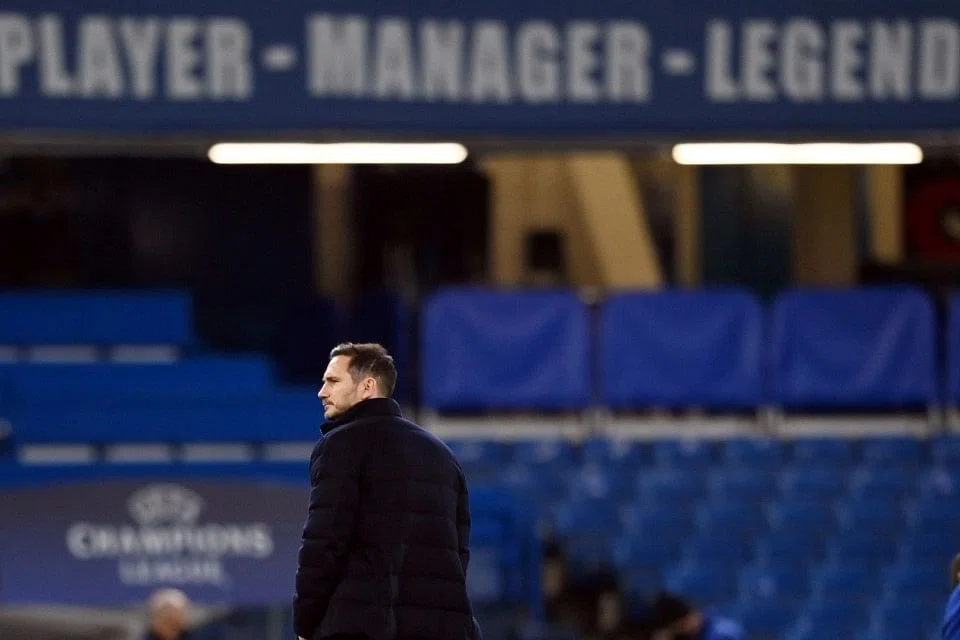
FRANK Lampard had known about the banner for a couple of weeks. As Chelsea's winter had turned bleak, as whispers that Lampard, its inexperienced coach, might be drifting toward the edge grew louder, word reached him that a group of fans - known as We Are the Shed, after the club's Stamford Bridge stadium's most famous stand - had decided to offer a token of its faith.
The fans had designed a flag in his honour, and intended to hang it from the stadium for the first time during last Sunday's FA Cup game at home to Luton Town.
"In Frank We Trust," it read, white letters on a blue field. There were stylised images of him celebrating in the club's colours, both as a player and a manager. And underneath, three simple words: "Then. Now. Forever."
Lampard was, he said, touched by the gesture. "I don't know if emotional is the right word," he said, but he was certainly "appreciative" to see such proof of the two-way bond he had shared with the club's fans for the better part of two decades. That was Sunday afternoon. He was fired the next morning.
Lampard was not the first manager at Roman Abramovich's Chelsea to come under what seemed, on the surface, to be an undue, premature sort of pressure.
He is not the first to be unceremoniously dispatched as soon as the club sensed the first curling tendril of looming disappointment in the air. Nor, almost certainly, will he - or his probable replacement, Thomas Tuchel - be the last.
Some of those who have gone before Lampard have done so with sympathy, perceived as victims of Abramovich's ruthless impatience: Carlo Ancelotti, Antonio Conte, Jose Mourinho, the first time around.
Others have found their farewells a little colder, their departures interpreted as inevitable and self-inflicted: Andre Villas-Boas, Luiz Felipe Scolari, Mourinho, the second time around.
But none - not even Mourinho, the greatest manager in the club's history - have retained the support of the fans quite so unanimously as Lampard, the rookie coach who took a young team to fourth in the English Premier League (EPL) in his first, and only, full season at the club, but then, after the largest transfer expenditure of the Abramovich era, steered a lavishly gifted, well-tooled squad into ninth place.
Demonstration of loyalty
The banner provides the most eloquent explanation of that loyalty. Not just through the image of Lampard the player, the most productive goalscorer in Chelsea history, a multiple winner of the EPL and the FA Cup, a cornerstone of the team that turned the club into London's first-ever European champions, or the reference to man and team's shared past, but the fact that he knew the fans were planning it, too.
He had been told the banner was coming by, as he put it, "the people directly involved" in making it.
Lampard's association with the Blues (Chelsea's nickname) runs long and deep enough that he has deep-seated, well-established connections with Chelsea's fans. That would be an advantage anywhere, but it is particularly precious at Chelsea. Not for the manager - that Lampard was fired so soon after he was given such public backing illustrates, quite neatly, how little power fans have - but for the public itself.
Chelsea's fans have grown sufficiently accustomed to seeing managers come and go that, at times, they can harness Abramovich's susceptibility to the slightest pressure to their own ends. Maurizio Sarri, who preceded Lampard, was hardly an unmitigated success, but his only season at Stamford Bridge was no overwhelming failure:
His team finished third in the EPL and won the Europa League. And yet, months earlier, some fans had been agitating for his dismissal. They had never taken to him, never bought into his style of play, and they knew that, at Chelsea, it does not take much to tip the balance.
Lampard was, perhaps, the clearest example yet of football's brief but ongoing belief that every club has within the ranks of its alumni some visionary who can do for them what Pep Guardiola did for Barcelona.
Lampard had coached for only a season at Derby County, doing a fair but unspectacular job, when he was approached by Abramovich and pinpointed as the man to oversee a great reset, one that would rest on the Terracotta Army of players waiting in the club's academy and would, at last, give rise to a style of play that was distinctively Chelsea.
The problem with the Guardiola paradigm is that football uses it to draw the wrong conclusion. The lesson from the story of how the Barcelona academy graduate forged the greatest club team in history is not that any articulate former player, steeped in the values of a listing but willing superclub and given access to formidably talented teenagers, can conquer the world.
It is, instead, the opposite. As his playing career wound down, Guardiola sought out all those coaches who had inspired him the most. He travelled to meet Marcelo Bielsa. He went to play in Mexico for six months to study under Juanma Lillo, now his assistant. He realised that who he had been as a player was not directly related to who he wanted to be as a coach.
Lampard had not undergone that same process when Abramovich came calling. In his defence, it is possible that he simply did not have time. He had not, like Guardiola, set out to separate who he had been as a player from who he would be as a manager. He had not devoted the final few years of his former career to fine-tuning his beliefs, style and approach. He saw it, not as a career change, but rather an organic continuation.
Lampard assumed - and Chelsea assumed too - that the player celebrating on the left of the banner would naturally bleed into the manager celebrating on the right. Then would lead to now, and now would lead to forever. This season, however, both club and manager have learned that it does not quite work that way. NYTIMES
Decoding Asia newsletter: your guide to navigating Asia in a new global order. Sign up here to get Decoding Asia newsletter. Delivered to your inbox. Free.
Share with us your feedback on BT's products and services