

A Gerhard Richter show finds a home for now
 Add BT as a preferred source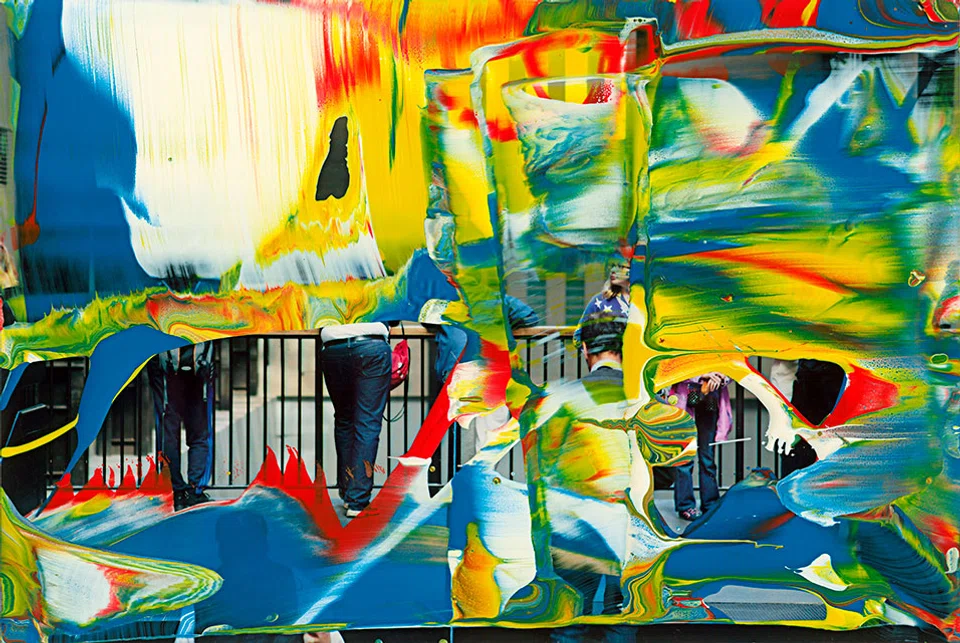
DeeperDive is a beta AI feature. Refer to full articles for the facts.
FOUR large abstract paintings made with layered streaks of black, gray, red and green are the centrepiece of a new Gerhard Richter exhibition that opens on Saturday at the Neue Nationalgalerie in Berlin. In the corners of the gallery hang four photographs from the Nazi death camp at Birkenau that show prisoners moving corpses from a heap.
Those four paintings form a cycle called “Birkenau” that Richter began in 2014 as figurative renderings of the photos. “But I realised it wasn’t working at all,” the artist said in 2016, in a rare newspaper interview with the Frankfurter Allgemeine Zeitung. “So I scraped it off and painted again until I had four abstract images.”
The “Birkenau” cycle has since become something of a German national treasure. It represents the climax of Richter’s quest for a creative response to the Holocaust, and a conclusion to decades of wrestling with the question of how much horror and brutality art can, or should, show.
Copies of the paintings were installed in Germany’s Parliament in 2017, and the originals were featured in an exhibition that opened at the Met Breuer in New York in March 2020 but shut down just eight days later, because of the coronavirus pandemic. The paintings were also exhibited at the National Museum of Modern Art in Japan last year.
But they are unlikely to travel far again, according to Joachim Jäger, the deputy director of the Neue Nationalgalerie. Richter says he is determined that “Birkenau” should never be sold. To guard against that, the Gerhard Richter Art Foundation has given them, along with dozens of other works, to the Neue Nationalgalerie, one of Berlin’s highest-profile exhibition spaces.
Those works will be on display in the exhibition “Gerhard Richter: 100 Works for Berlin” until 2026. After the completion of a new modern art museum in Berlin, designed by Swiss architecture firm Herzog & de Meuron, they are set to occupy a designated gallery on that building’s upper floor. But construction is already nearly three times over budget, and the project’s terms are shifting. The artist’s foundation is taking a wait-and-see approach: All the works are on a long-term loan that may later be made permanent.
Navigate Asia in
a new global order
Get the insights delivered to your inbox.
Richter is not expected to attend the show’s official opening, Jäger said. “He is well, but at 91 you have to take good care of yourself,” he said. The artist was, however, closely involved in the planning.
The plans for the new museum that will eventually house these works are still evolving. Due for completion in 2027, it is now just a big hole in the ground next to the Neue Nationalgalerie – a very expensive hole. The latest Finance Ministry estimates put the final cost for the project at 550 million euros (S$798.4 million). The initial estimate was 200 million euros.
Jäger said the artist’s foundation had been wary of donating the works outright while the “museum landscape is in flux,” and so they were given as a long-term loan, the terms of which will be reviewed at an unspecified point in the future, with a view to becoming a permanent arrangement.
The Neue Nationalgalerie’s director, Klaus Biesenbach – a former MoMA chief curator-at-large and director of the Museum of Contemporary Art in Los Angeles – is closely involved in the planning for the new museum. In an interview, he said the institution, which was announced in 2013 as “the Museum of the 20th Century,” was now coming together under the working title “Berlin Modern.” When completed, it will display Berlin’s vast store of 20th-century art, which has outgrown its current home in the Neue Nationalgalerie.
Berliners were underwhelmed when Herzog & de Meuron’s design for the museum was announced as the winner in 2016. The unassuming, low brick building was compared to a barn, a depot and a covered market, and the design came under fire for its projected carbon footprint.
“Construction in Germany is quite slow,” Biesenbach said. “We are building with a certain time delay, and values change. I think sustainability is a value that drastically changed.” He said the design had been amended to reduce the building’s environmental impact: The windows will be smaller, and solar panels on the roof will generate about 10% of the museum’s power.
He said he wanted the new museum to have an inclusive ethos, in line with recent changes he has made at the Neue Nationalgalerie. Admission there is free on Thursday evenings, a policy that Biesenbach said had drawn thousands of extra visitors, and last summer the museum hosted a “sundowner bar” on its terrace with music and drinks.
“All of a sudden, we were not the ivory tower,” Biesenbach said. “We were a house for everyone.”
He added that, in an effort to attract return visitors to the Richter exhibition over its three-year run, he planned to organise a series of supplementary events, which could include a collaboration between Richter and Estonian composer Arvo Pärt.
“In every museum, you want a place that you recognise and come back to, a place where you can have a moment of epiphany, a moment of contemplation,” Biesenbach said. He added that he hoped the Richter show would do that. “It’s complex enough.” NYTimes
Decoding Asia newsletter: your guide to navigating Asia in a new global order. Sign up here to get Decoding Asia newsletter. Delivered to your inbox. Free.
Share with us your feedback on BT's products and services
TRENDING NOW

Autobahn Rent A Car directors declared bankrupt over S$50 million each owed to DBS

Amazon’s MGM Studios gains creative control over ‘James Bond’ franchise

UOB’s Wee Ee Cheong says S$4.9 billion Citi deal ‘paying off’ as Asean push accelerates
In taxing wealth, how far can Singapore push property owners?

