
Great Dane Peter Schmeichel still giving back to football
Goalkeepers need to have the best tools and greatest variety of skills to succeed in this role, says retired Man United shotstopper
 Add BT as a preferred source
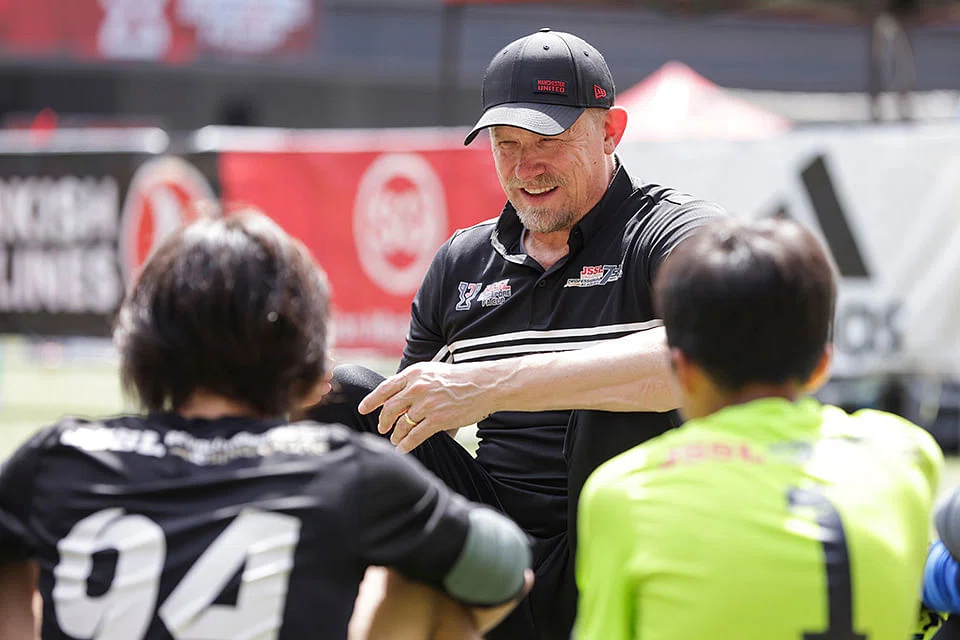
WHENEVER football fans get into a debate about the most successful goalkeeper to ever play in the English Premier League (EPL), one name that invariably ranks high on their lists is Peter Schmeichel.
He plied his trade for 7 different clubs in a 22-year professional career, but it was his 9-year stint at Manchester United where he made his name as one of the world's best shotstoppers.
In his final game for the Red Devils in May 1999, he captained the team to a dramatic injury-time comeback victory over Germany's Bayern Munich in the European Cup final. That win sealed Manchester United's famous "treble" that season, as the club also won the EPL trophy and the FA Cup.
Schmeichel, who won 24 trophies and retired in 2003, also played 129 times for Denmark and was part of the squad that clinched the European Championship in 1992.
The Great Dane, as he is often called, was in town recently as the guest-of-honour at the first JSSL Singapore FA Cup, a 4-a-side tournament for players aged between 12 and 17. BT Weekend caught up with the 58-year-old at Our Tampines Hub where the 3-day tournament was held, and this is an edited excerpt of the lively conversation.
How different is football today, compared to when you were an active player 30 or even 40 years ago?
Navigate Asia in
a new global order
Get the insights delivered to your inbox.
The sport has changed a lot. Back in my time, there were no mobile phones or social media, but these have changed the world that we live in. Today, people are very focused on projecting their lives online, showing what they have and the material things like whether they have the latest handbag or the newest pair of boots.
There's so much money at the top end of football and it attracts a lot of people who shouldn't be there and taking a lot of money out of the game that could be used at grassroots level.
Kids should be playing football because they enjoy it and not be under pressure that they must always make it to the elite level. Football should be a social event that happens 2 or 3 times a week, and something that kids should look forward to because they are having fun with their friends.
It's good that this FA Cup tournament could happen and youngsters can finally get together and play team sports again.
You can see the kids being happy on a football pitch. It's been a difficult time for them due to Covid-19 and not being able to play or train for nearly 2 years. I remember when I was 15 and I was out of action for 6 months because of a hip injury. That was the worst 6 months of my life, and I'm thinking about these kids and it's 2 whole years for them.
What's not-so-great is that the stands here are all empty, there are no parents and no spectators. A crowd is what this tournament really needed.
Do you feel that goalkeepers get the credit and recognition they deserve?
Absolutely, yes. The position has evolved a lot, it's definitely more popular and more kids want to be a goalkeeper. This is unlike in my time when someone who wasn't able to play outfield would be forced to play in goal.
It's a position on the team where you need to have a big toolbox and the greatest variety of skills. You need to be a playmaker when the ball is in your half, and you need to be a defender too and stop the ball when it comes at you.
At Euro 2020, it was a goalkeeper - Italy's Gianluigi Donnarumma - who was named Player of the Tournament. That's quite something, isn't it?
It's brilliant that he was recognised. He was just 17 when he broke into the first team at AC Milan, and when someone can do that, it helps raise the profile of goalkeepers enormously. I had to fight the biases that goalkeepers reach their prime only when they are, say, 27. These days, the best goalkeepers are getting younger. In Donnarumma's case, he has shown it can be done and that gives confidence to young aspiring goalkeepers.
Do you still watch a lot of football?
I do. My wife isn't too happy about it, though. (laughs) She was not with me during my career and when she first met me, she didn't know anything about football. But she knows it's my job (as a pundit) and my passion. I watch a lot of football. I watch every Leicester City game (where my son, Kasper, is the first-team goalkeeper), and I also follow the Denmark team closely.
You've been retired for over 18 years. How do you stay fit?
Before Covid, I had a really good routine when I was training at the gym, and then the fitness centres had to shut for a very long time in Denmark. When they reopened, I was in the habit of not going at all. It was so difficult to force myself to go back, but I had to. Other than that, I do a lot of mountain biking and that's my main cardio. Where I live, there are the woods and I like to jump on the bike and ride for hours.
Decoding Asia newsletter: your guide to navigating Asia in a new global order. Sign up here to get Decoding Asia newsletter. Delivered to your inbox. Free.
Copyright SPH Media. All rights reserved.

