

Singapore workers experiencing rising anxiety; signs of fallout from pressure to use AI
Over a quarter of employees are considering leaving their jobs
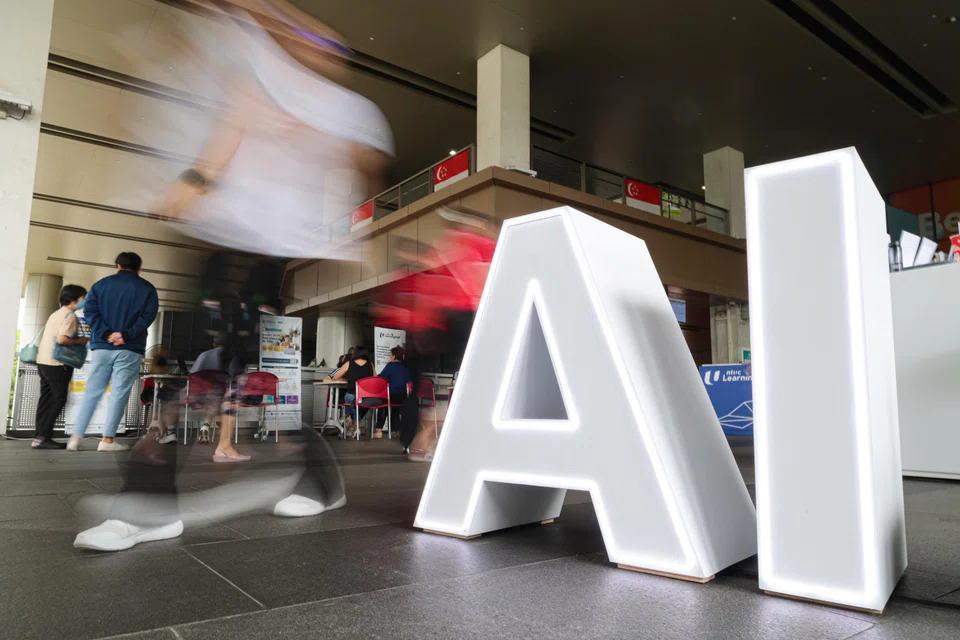
[SINGAPORE] Since peaking in June 2025, the mental health of Singapore workers has remained at persistently low levels, with the latest score showing rising anxiety, isolation and depression.
Meanwhile, those whose employers actively discourage the use of artificial intelligence at work have the lowest mental health score.
The findings are based on a study by health technology services provider Telus Health, which surveyed 1,000 people between Feb 25 and Mar 9.
The respondents lived in Singapore and were either employed at the time of the online survey, or employed within the prior six months.
Launched in April 2022, a higher score on the Telus Mental Health Index means better mental health, with a score of zero to 49 for distressed, 50 to 79 for strained and 80 to 100 for optimal mental health.
The report shows the national mental health score at 62, flat since September 2025.
Meanwhile, the sub-scores for work productivity (53) and anxiety (53.4) have been the weakest for close to four years. They are followed by isolation (54.6) and depression (55.5).
“The figures suggest Singapore’s workforce is experiencing organisational change fatigue without adequate support structures,” Haider Amir, director of Asia, global business development at Telus Health, tells The Business Times.
Productivity also dropped alongside employees’ mental health declines, with 41 per cent of workers flagging the issue.

On the other hand, six in 10 workers who describe their organisation’s culture as supportive of their well-being have the best mental health score (66.2).
They also lose 23 days fewer of productivity annually compared with those who perceive their organisation as unsupportive.
AI: Another trend to stay ahead of?
When it comes to AI, 61 per cent of respondents say their employers encourage its use at work, 31 per cent are neutral, 5 per cent are not encouraged to or provided such tools and 3 per cent are discouraged from using AI.
The lowest mental health score (52.2) is among workers whose employers discourage the use of AI – more than 11 points lower than those whose employers encourage it (63.7).
Ironically, it is the 5 per cent who are not encouraged to use or are provided AI tools who have the highest mental health score (64.3).
That’s because AI’s arrival comes on the heels of a workforce that’s long been anxious about keeping up, says Amir.
“For a country as technologically evolved as Singapore, it can feel like another trend to stay ahead of. From that lens, the 5 per cent with no AI in their jobs is the one group under no pressure to keep pace with it and therefore reports a stronger score in the index.”
While Singapore’s traditional workplace strengths of discipline, execution and clear hierarchies have served it well for decades, an AI-driven era thrives on a slightly different skill set, including experimental agility, he says.
Cultivating an open, high-trust environment is where organisations can build a distinct competitive advantage.
“For multinationals, it’s maintaining a culture of psychological safety even during periods of global restructuring. For local firms, it’s backing their home-grown foundation with more formalised wellness infrastructure. Employees watch both, and when the broader discourse surrounds trading people for machines, the fear hits hardest on those with the least financial cushion.”
Given that the introduction of AI is still new, longer-term observation is also needed to see the impact on different groups of workers.
“What is strikingly obvious from the data is that those who discourage the use of AI seem to have a drastically lower score. It’s imperative that organisations in this category be aware of this.”
The study also found that over half of workers are considering leaving their jobs or are uncertain about staying.
The 26 per cent of workers contemplating resignation had the worst mental health score (51.5), nearly 19 points lower and lost 21 more days in annual productivity compared to those not considering leaving.
As for the 27 per cent uncertain about staying; they lost 12 more days per year and scored nearly 15 points lower on the index than workers who are staying.
The primary reason for considering a departure is better career opportunities, followed by improved benefits and higher compensation.
Respondents working for companies with two to 50 employees have the highest mental health score (65.6) with the self-employed and sole proprietors registering the lowest (56).
Decoding Asia newsletter: your guide to navigating Asia in a new global order. Sign up here to get Decoding Asia newsletter. Delivered to your inbox. Free.
Copyright SPH Media. All rights reserved.






