

A heartfelt cinematic missive to Singapore
7 Letters, an anthology of Singapore tales by seven local filmmakers is a poignant showcase of individual styles that memorably make up a collective whole.

THERE'S no place like home and there's nothing like a big birthday bash - and a movie that evokes a strong sense of what it means to be Singaporean - to prove it. To celebrate 50 years of nationhood, seven local filmmakers have pooled their talents to make 7 Letters, an anthology of Singapore tales that hits home, with feeling.
7 Letters makes a powerful case for the short-film format, compelling filmmakers to make a creative statement in 15 to 20 minutes and dispensing with unnecessary exposition or self-indulgent scenes. The result is a poignant showcase of individual styles that memorably make up a collective whole.
The nostalgic nature of several segments (bolstered by black-and-white scenes and an evocative soundtrack) will strike a familiar chord with local viewers of a certain vintage, but the film stands up to scrutiny from non-Singaporeans as well.
The deceptively simple brief - to pen a love letter to Singapore on the occasion of an important birthday - meant in effect that each director, working independently on a limited budget, started with a blank canvas. The result, according to Royston Tan, the project's curator and one of the seven featured directors, is "a labour of love from the film community".
Classic pontianak (ghostly vampire women) movies - a staple of Singapore's film industry in the 1950s and 60s - are the inspiration for the opening segment Cinema, Eric Khoo's contribution to 7 Letters. At its core is a haunting song by Nadiah M Din, who plays a beautiful actress/spirit hunted by a group of jittery villagers. It crosses over into a film-within-a-film setting, throws in a celebrity cameo and pays tribute to a cross-section of industry pioneers from the golden age of Singapore cinema.
Jack Neo goes back to the kampung days of 1975 for That Girl, a dialect-heavy piece starring an ensemble of young actors and promoting a simple message about value systems, silent sacrifices and the choices we make in life. Neo's homey comedic style, so characteristic of his full-length features and a firm favourite with heartlanders, is on full display here in this story about a "borrowed" 10-dollar bill.
The Flame is K Rajagopal's take on the 1971 British military pullout from Singapore the impact it has on one family. It chronicles an emotional morning in a household and the confrontation between a father (T Sasitharan) - who is adamant about migrating to the UK - and a son (N Vighnes), who sees a future in Singapore. Do they stay or do they go? The film, shot in black-and-white, encapsulates the experience of many local families with ties to the British military.
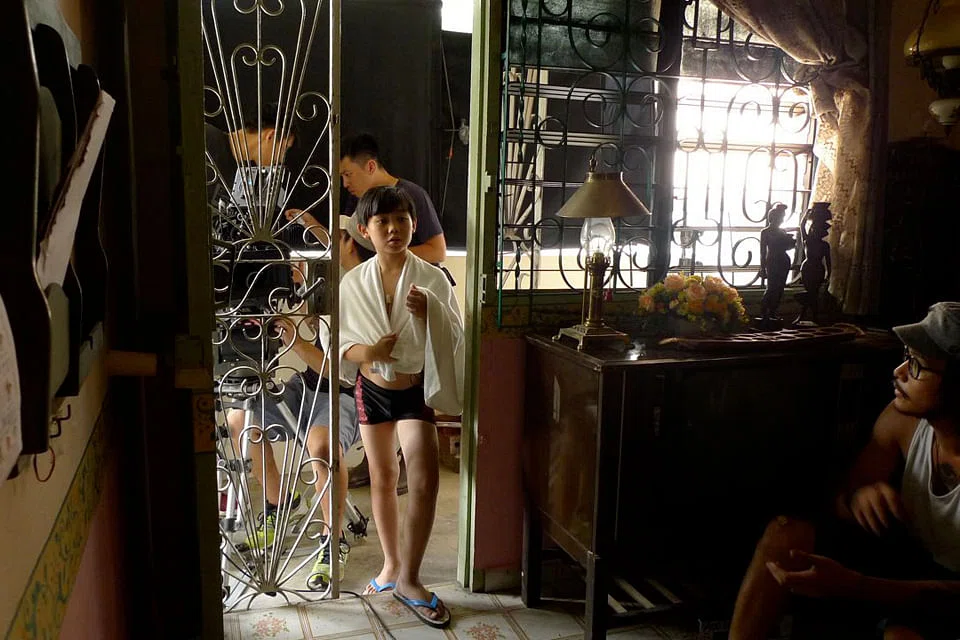
Royston Tan's Bunga Sayang - the title comes from a composition by Dick Lee, who knows a thing or two about Home - is a simple tale of neighbourliness between a young boy (Ray Tan Liang Yu) and a kueh-making grandma (J Rosmini) bridging the generation gap and bonding through food and music. For good measure, there's a candy-coloured fantasy music video sequence to ponder.
Documentary filmmaker Tan Pin Pin's first foray into dramatic features is Pineapple Town, about a couple's (Lydia Look and Nickson Cheng) cross-border search for their adopted daughter's birth mother. There are obvious parallels to Singapore history but Tan resists the urge to pile on the allegorical references. "We are what we know," she signs off at the end of her story.
An elderly Malay man (JA Halim) journeys by train to Singapore in search of an old friend in Parting, by Boo Junfeng. There are hints of a long-ago romantic connection but the man's memory is failing, and all he has to go on is an old photograph. The trail leads to Tanjong Pagar railway station, where he comes face to face with the past. The audience, on the other hand, gets to experience the magic of the movies.
The final instalment of 7 Letters is Kelvin Tong's Grandma Positioning System (GPS), a touching tale about a trip to the family cemetery in Johor. The rigours of modern-day life weigh heavily on all except grandmother (Zhang Jin Hua) who takes the time to chat to her deceased husband about fast-changing Singapore. A subsequent visit reveals the impact she had on her young grandson (Rey Phua).
7 Letters is sincere, eloquent and often deeply poignant - a unique and heartfelt cinematic missive to Singapore. The movie confirms that the art of local filmmaking is in capable hands. As for the stories they tell here, perhaps Dick Lee said (or sang) it best: "This is home, truly."
Rating: B
7 Letters is the opening film this weekend at the newly-refurbished Capitol Theatre. Tickets have been snapped up but additional screenings will be held at the National Museum's Gallery Theatre on Aug 8, 9 and 10. Tickets will be available at the museum's front desk on Aug 1 and 2. Check facebook.com/7Letters.sg for info.
Share with us your feedback on BT's products and services
TRENDING NOW

He built the Vingroup empire. Now South-east Asia’s richest man is handing some key roles to his sons

32 companies, 6 individuals bag accolades at Singapore Corporate Awards 2026

Can a first-time homebuyer couple earning S$18,000 a month afford a new EC unit?

Floods compound Philippine growth woes from public-works scandal

