
From Hermes lamps to Dior chairs, luxury brands are pushing into furniture and home decor
It’s a chair, it’s a rug, it’s homeware galore from luxury fashion brands at the world’s most important design event
Corinne Kerk
AT THE recently concluded Milan Design Week, whose main event is the Salone del Mobile – the world’s most prestigious home furnishing and design fair – luxury fashion brands were abuzz with activity.
Bottega Veneta, perhaps hinting at its intention to penetrate the home category, shut its flagship store on Milan’s Via Montenapoleone so master architect and design pioneer Gaetano Pesce could turn it into an art installation featuring two limited-edition handbags he designed.
Meanwhile, from Hermes and Loewe to Fendi and Dior, hallowed names in fashion were holding activations and exhibitions, working to carve out more territory that’s ripe for the taking.
And why not?
According to Market Data Forecast, the home decor market is estimated to be worth some US$727.6 billion in 2022 and expected to reach US$939.7 billion by 2028 – a compounded annual growth rate of 6.8 per cent. Besides, the lifestyle sector offers plenty of opportunities to build and strengthen brand value and loyalty.
“It’s a very lucrative market,” Kapil R Tuli, professor of marketing and director of the Retail Centre of Excellence at the Singapore Management University, says of the furniture and homeware sector.
While almost all the top-tier luxury fashion brands have entered the segment over the years, they are poised to expand further, says Prof Tuli, pointing out that notwithstanding a bumper 2022, brands still need to look at where future growth will come from.
“Many of the brands are now part of publicly-listed companies, so there is pressure on them to show growth in revenues,” he notes. “After all, how many bags can people buy?”
Luxury brands can expand into different categories successfully because they are positioned around a dream and a certain lifestyle, says Sonja Prokopec, academic director of the Essec Academy of Luxury and professor of marketing at Essec Business School, Asia-Pacific.
“As consumer interests change and evolve into different categories, luxury brands can also extend into the new spaces, as these are part of the consumer lifestyle,” she says, adding that furniture is one of the first things to catch the eye when one enters a home or office. “And the market is flourishing.”
While the broader section of consumers may lack awareness about high-end furniture producers such as B&B Italia, luxury fashion houses like Hermes are very well-known, with a brand name appeal, says Prof Tuli.
“So if I say I have Hermes furniture at home, I don’t need to tell anyone what it is, and even if someone doesn’t know that Hermes – or, for that matter, Louis Vuitton or Dior – manufactures furniture, there is instant recognition.”
Another draw is the pure intrigue of owning lifestyle products from a luxury fashion brand.
But while a big chunk of the ultra-high-net-worth segment doesn’t mind spending on such items for their authenticity and exclusivity, the brands’ challenge is whether they can maintain the discipline they have built in their core products and deliver that same level of craftsmanship, quality and aura of exclusivity in interiors – and make the topline work for them.
“I won’t be surprised if, in another couple of years, you see the profile of these brands’ furniture products becoming a little more prominent, though not proliferating,” Prof Tuli says.
And the brands best-placed to penetrate this market are those with a strong visual identity and codes that can extend into furniture as well, says Prof Prokopec, citing Dior as an example of one with a rich brand universe and strong codes.
So, fashion or furniture?
The answer for the world’s top maisons is increasingly clear – both.
Here is a taste of what went down at the world’s largest furnishing and design event.
Fendi
This was the first luxury fashion house to launch a home line back in 1987, and its Fendi Casa brand is a fixture at Milan Design Week (check out its collaboration with Danish lighting manufacturer Louis Poulsen to release five iconic PH lamps reimagined in Fendi’s style, or the new Ottavia chair by Italian designer Cristina Celestino).
This year, however, Fendi also unveiled its first home decor and lifestyle accessories collection – a move that will make it more accessible to those who aspire to acquire the brand’s homeware, but aren’t quite ready yet to digest a piece of furniture.
Leveraging its codes and logos, the Italian brand produced a range of tableware, glasses, leather boxes, trays, candle holders, home textiles and even table games. Safe to say it’s off to a good start.
Hermes
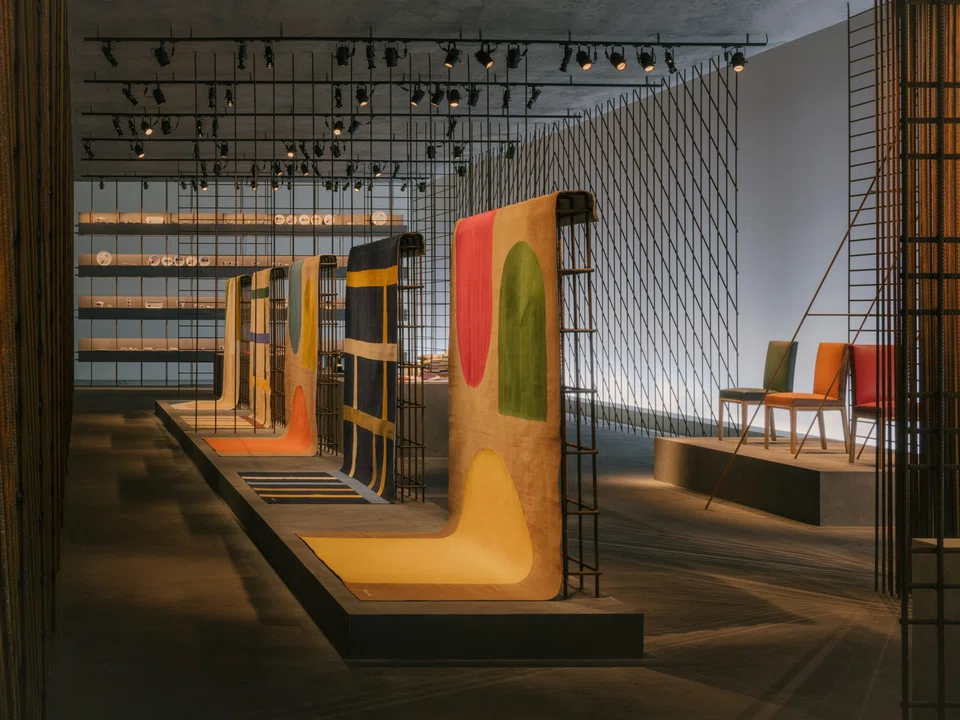
The French maison has opted for minimalism this year, with the staging of its home collection reduced to a geometric framework of iron rods and concrete. The product range, however, is less inhibited.
A 1930s armchair in leather and wood is reinterpreted with a light touch by leading British industrial designer Jasper Morrison, a sofa shows off a clean silhouette, minimalist lamps are made of blown glass and hand-embroidered rugs sport unique textile signatures.
The emphasis on organic materials can be seen through the use of bronze, glass, wood and leather, and muted colours allow motifs inspired by the Hermes archives to shine. That, of course, is a nod to the maison’s equestrian heritage, with references to horses, harnesses and jockeys’ silks on items ranging from porcelain tableware and leather boxes to rugs and blankets.
No horsing around here.
Loewe
The Spanish luxury house already has a range of candles, soaps, home scents and throws in its interiors category, and has added chairs to its presentation at Milan Design Week 2023.
These are highly whimsical pieces, though. Specifically, the humble stick chair is transformed through the act of weaving and embellishment by artisans. The woven decorations create soft sculptural protrusions of materials such as leather, raffia, shearling and felt in 30 chairs, of which 22 are antique pieces.
Loewe sees these creations as “a language that fosters manual labour and human invention as authentically progressive tools” – rather comforting words, coming in the age of ChatGPT and other generative artificial intelligence.
Dior
The late French designer Christian Dior chose to line fashion shows with the Louis XVI-style Medallion chair decades ago.
It was reinvented last year by French industrial designer and architect Philippe Starck in his Miss Dior collection. This year, the two French names have collaborated again to present a complete collection, including the new Monsieur Dior armchair in Starck’s signature reductive style, but in a range of materials and colours.
The pieces are made in Italy and accompanied by elegant “little brothers and sisters, such as various tables of different sizes, and stools’’, says the maison. Ah yes, a family you can welcome into your home.
Decoding Asia newsletter: your guide to navigating Asia in a new global order. Sign up here to get Decoding Asia newsletter. Delivered to your inbox. Free.
Copyright SPH Media. All rights reserved.
TRENDING NOW
Grab CEO’s wife Chloe Tong on life with Anthony Tan and finding her purpose
Three ex-employees of Envy group join Ng Yu Zhi in bankruptcy
He built the Vingroup empire. Now South-east Asia’s richest man is handing some key roles to his sons
If AI has a one-in-five chance of destroying us, what do we do with the remaining four?



