How AI is powering the lifestyle sector
Six companies are leveraging AI to create innovative products and services


WHEN Hypotenuse AI was founded in 2020 by ex-Amazon researcher Joshua Wong, very few people were talking about artificial intelligence (AI). People generally did not understand how Hypotenuse could use AI to rapidly create product descriptions and social media posts for thousands of objects, saving e-commerce sites countless hours of manual work.
“Our sales cycles were dragging. We had to educate people on what AI was, how it worked and what it could do. An investor even called our intersection of AI and content ‘boring’,” recalls Wong.
Then, ChatGPT came along in 2022, attracting 100 million users in two months, and 200 million users in less than two years. Soon, everyone understood the usefulness of AI, and demand for Hypotenuse’s services rapidly ballooned. “Today, the landscape is unrecognisable,” says Wong. “We see thousands of new sign-ups on our platform every day, and have some of the biggest global e-commerce brands using our technology.”
Across the lifestyle sector, AI is rapidly becoming an essential tool, driving down costs for everything from marketing and product design to training and customer service. Contrary to criticism that AI is “derivative” and “unoriginal”, it is proving to be quite the opposite – creating personalised experiences and efficient interactions for anyone willing to embrace it.
At the recent TechLaw.Fest 2024, forum participants marvelled at an AI-generated avatar of actor Li Nanxing appearing on-screen to endorse a product. This avatar was created by idoLive, which has dozens of celebrity avatars in its roster – including Gurmit Singh and Evelyn Tan – handling endorsements without needing to be physically present.
According to idoLive founder Kevin Zhang, the technology can save companies “as much as 90 per cent of the usual costs of hiring celebrities”.

Elsewhere, creative agencies such as Giant Cookie have been able to win “most pitches we compete for” using AI to refine their concepts and ideas. Adam Colyer, co-founder of Giant Cookie, says: “Artificial Intelligence won’t replace humans – it still requires people with taste and criteria to decide if something generated by AI is good or bad. But it can turbocharge the whole creative process and give humans superpowers we didn’t have before.”
We look at six companies that are leveraging AI, not just for efficiency but also to create innovative products and services that resonate with businesses and consumers.
idoLive
Creates celebrity avatars to endorse products at a fraction of the usual price


One of the most talked about moments at the recent TechLaw.Fest at Marina Bay Sands was when actor Li Nanxing showed up on a giant screen touting a product. Though it was clear to everyone that he was not the real person – the “uncanny valley” effect was somewhat evident from his waxy features – the AI-generated avatar still retained much of the actor’s starry charisma.

The avatar is created by idoLive, which has in its roster dozens of stars and influencers. Many of them have agreed to have their visual and vocal likeness replicated by AI technology so that they can be used in promotional content, without actually having to be there. In return, they are paid a fee – lower than their usual rates but still substantial.
Kevin Zhang, founder of idoLive, says companies that use these digital avatars can save anywhere between 50 and 90 per cent of the usual costs of hiring celebrities. idoLive has already filmed these celebrities against a green screen in different outfits, so all a company has to do is select the desired avatar and customise the content to fit their campaign. This streamlined process allows for quick turnaround times and flexibility in messaging.
For now, the avatars are “unable to dance or move around too much” but Zhang reckons that will change in a few year’s time as the technology advances. Companies that have used idoLive’s services include Certis and Toshiba.
Hypotenuse AI
Rapidly generates product descriptions, blog posts and ad copy for thousands of products on e-commerce sites
In Singapore’s AI landscape, Hypotenuse AI is often held up as a success story. Previously, most e-commerce brands had to carry out several steps to generate a product description on their page. Hypotenuse’s platform provides integrations to automatically pull in the necessary product data these companies have, clean up their data for them, generate the content using AI, and have a review workflow to make it easy for teams and human reviewers to check through the content quickly. It can even generate blog pieces and social media posts on these products.
Founder Joshua Wong says: “A common issue with AI-generated content, such as an e-mail or blog article, is that people are first impressed by its fluency, but when needing to actually use it, they will shy away from using it because it doesn’t actually sound like them… But we’ve trained our bespoke AI models to match their writing style and brand voice in a way that’s much more personal to them. We’ve also built in fact checking capabilities (to solve the issue of machine ‘hallucination’), making us much more accurate and natural sounding than a standard AI model.”
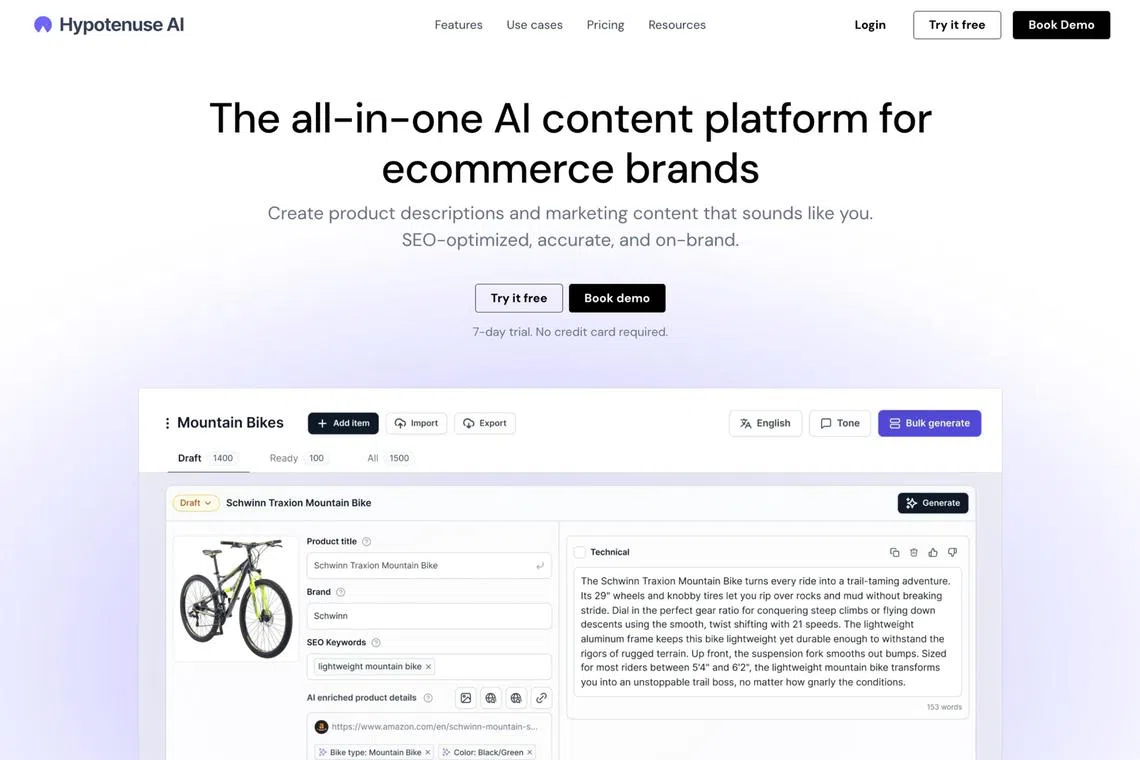
He adds: “Our AI continually learns from new content that’s written. This is akin to having a writer who’s been with your company for 10 years, having read through your best pieces of writing, and picking up this intuition of how it should be written.” Clients have seen dramatic improvements in how they manage their products, enrich their data, analyse their performance and create their content.
Giant Cookie
A cutting-edge creative and production agency that delivers winning concepts using AI
Giant Cookie uses AI to brainstorm and refine creative concepts, helping its team produce a wide array of marketing ideas and experiences more quickly and efficiently. The incorporation of AI into its workflow helps it offer higher-quality work and improve turnaround times, making it more competitive.
Co-founder Adam Colyer says: “We sometimes get very complex briefs, which are 20 pages long with a lot of inputs. So we’ve trained a GPT bot to basically understand the way we process these briefs, such that we’re now able to send back a counter brief with actionable points to the client immediately, and get them to approve it and say: Yes, that’s what we want.”

In the next stage, the creative department starts identifying what the storyline should be, the strategy behind it and the objectives. Once that is understood, generative AI is used to create potential concepts. “In the past, we created mood boards. But with AI, we’re able to generate mood videos with different scenes and how people are interacting with the space, with activations, with what sort of lighting, and so on… In under a week, we are able to send the client a pretty cool video that illustrates the general look and feel that we’re aiming for and proposing.”
Using this workflow, Giant Cookie has managed to “increase our pitch success rate tremendously”. Past clients include Pepsi and Mahou-San Miguel Group. But Colyer insists that AI is not a substitute for human talent, adding: “What it does is enhance the skills the user has. So if you put rubbish in, you get rubbish out. But if you prompt the AI with great ideas and refine them with skills you already have, you’ll get great results.”
Trakomatic
Tracking on-site consumer behaviour via video analytics
Founded in 2013, Trakomatic specialises in video analytics and intelligent sensor solutions. It observes how consumers interact within a physical environment, then turns that data into actionable insights to drive spatial and product optimisation. Its capabilities include facial recognition, demographic analysis, people counting and business visualisation tools. Past clients – such as shopping malls, luxury stores and tourist attractions – have used its services to make data-driven decisions.
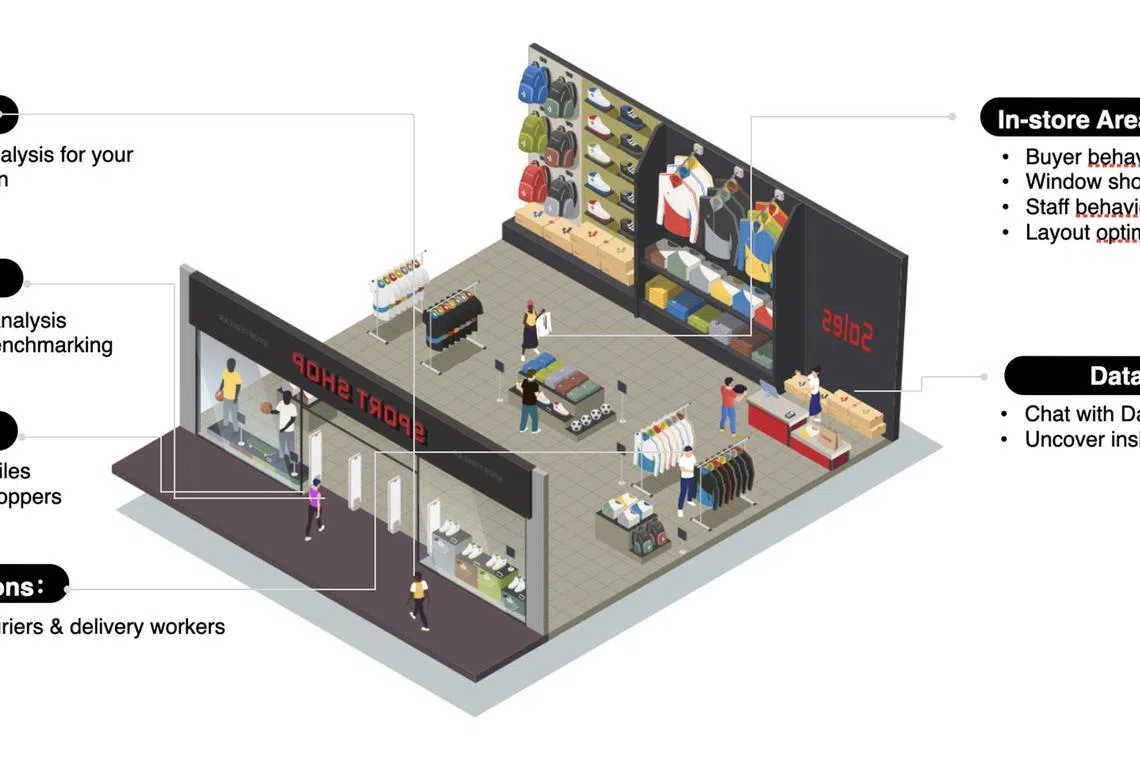
Trakomatic CEO Allen Lin says: “As a tech company, we’ve been able to improve our services tremendously using ChatGPT. Internally, we’re able to troubleshoot and debug a code base pretty quickly. (In the past, this would have taken us hours.) We also use ChatGPT to clarify our messaging as a company.
“Externally, AI has helped us strengthen our core offering, which is helping companies capture useful data so that they can make an insightful business decision – or synthesise the data they already have to make such decisions. For some companies, these data sets are sitting in silos. You’d need very experienced data analysts with years of domain knowledge to be able to make sense of it.”
However, with the help of Trakomatic’s AI-powered platform, “even a junior data analyst can ask the system to identify the patterns and correlations and derive potential solutions,” says Lin, adding: “AI helps synthesise and simplify the data enormously, so our clients can take action more quickly.”
Pand.ai
Developing intelligent chatbots, particularly for the financial sector
Pand.ai specialises in building custom AI applications (including chatbots, voicebots and e-mail bots) for enterprises using a proprietary AI agentic platform that was developed in-house. While many of its clients are financial institutions such as CIMB, Allianz and Bangkok Bank, its technology is sector agnostic and used by companies in various industries such as retail chains, law firms and real estate developers. CEO Chuang Shin Wee says: “Recently, we built a Generative AI-powered chatbot on WhatsApp for an online retailer that sells breastfeeding solutions to customers in Singapore. The chatbot helps the business owner answer product inquiries, track delivery status, and even sell goods directly through WhatsApp conversations – saving her valuable time and manpower.”

Founded in 2016, Pand.ai (which mean “clever” in Malay) hit profitability in just 18 months. Since then, Pand.ai has received notable funding from sources such as Bangkok Bank’s corporate venture capital arm, Bualuang Ventures, to fuel its expansion across South-east Asia. In 2023, it released its AI platform 4.0, leveraging Generative AI capabilities to further personalise customer engagement.
“Larger companies are very progressive and willing to experiment with AI,” observes Chuang. “However, we believe the greatest market potential lies with SMEs – especially in rapidly ageing economies like Singapore, which faces difficulty in hiring and retaining talent. SMEs are often not prepared to adopt AI, but we offer tailored quotes, onboarding support and a pilot programme to help them integrate AI into their operations seamlessly.”
Noodle Factory
Making training and learning fun and friendly
Inspired by the simplicity of making a cup of noodles, educational tech startup Noodle Factory created an AI-powered learning assistant platform called Walter, which allows educators and organisations to create AI learning buddies or mentors effortlessly – no coding required.
Each organisation receives its own secure, privacy-focused platform, where they can upload their materials and content to build a tailored AI knowledge base. The AI then engages the end users in various roles, whether as a personalised assistant, tutor, learning buddy or mentor, in any language.
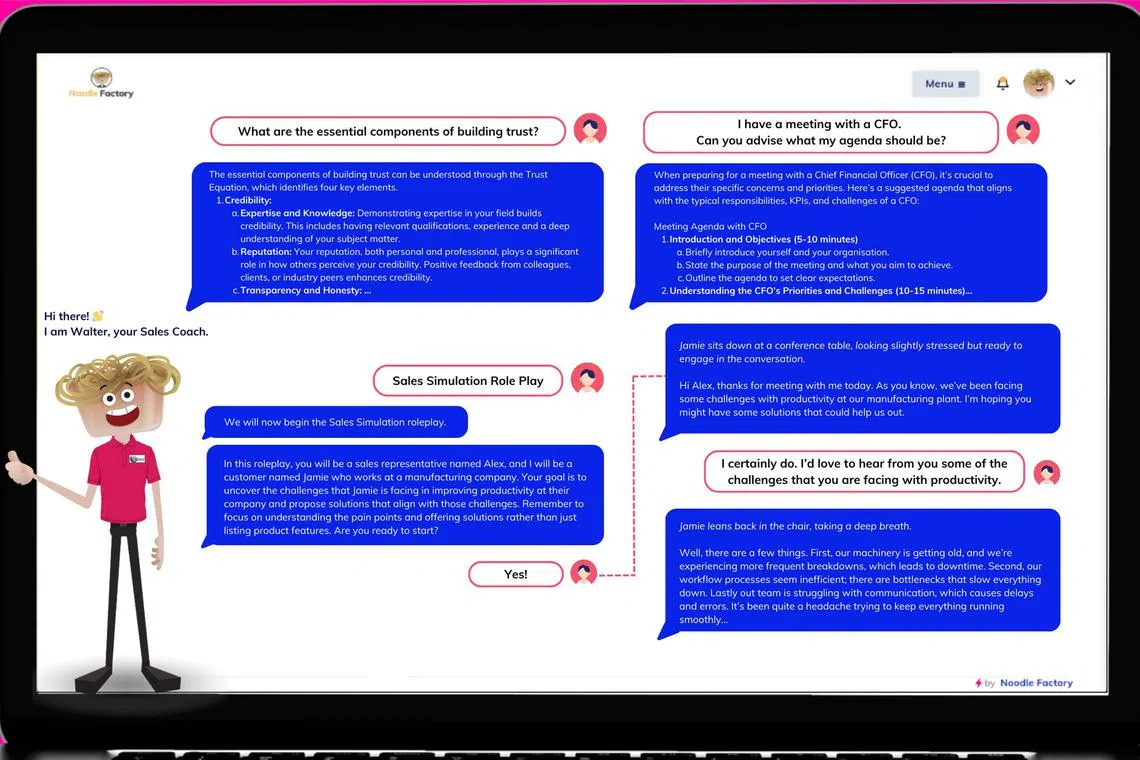
Because organisations have full control over the knowledge base and interaction styles, Walter can be adapted for diverse environments. It has been used for training, coaching, onboarding and sales enablement for a variety of clients, from corporate training company Navarro & Associates, to educational institutions such as Republic Polytechnic and Ngee Ann Polytechnic.
Co-founder Jim Wagstaff says: “Any organisation needs to be agile, and employees must be upskilled, constantly learning and evolving. Traditional learning methods take too long, are not tailored to specific needs, and can’t keep up with a rapidly changing environment. We built Noodle Factory to address all this.”
Decoding Asia newsletter: your guide to navigating Asia in a new global order. Sign up here to get Decoding Asia newsletter. Delivered to your inbox. Free.
Copyright SPH Media. All rights reserved.