How Shahzad Ismaily became musicians’ favourite musician
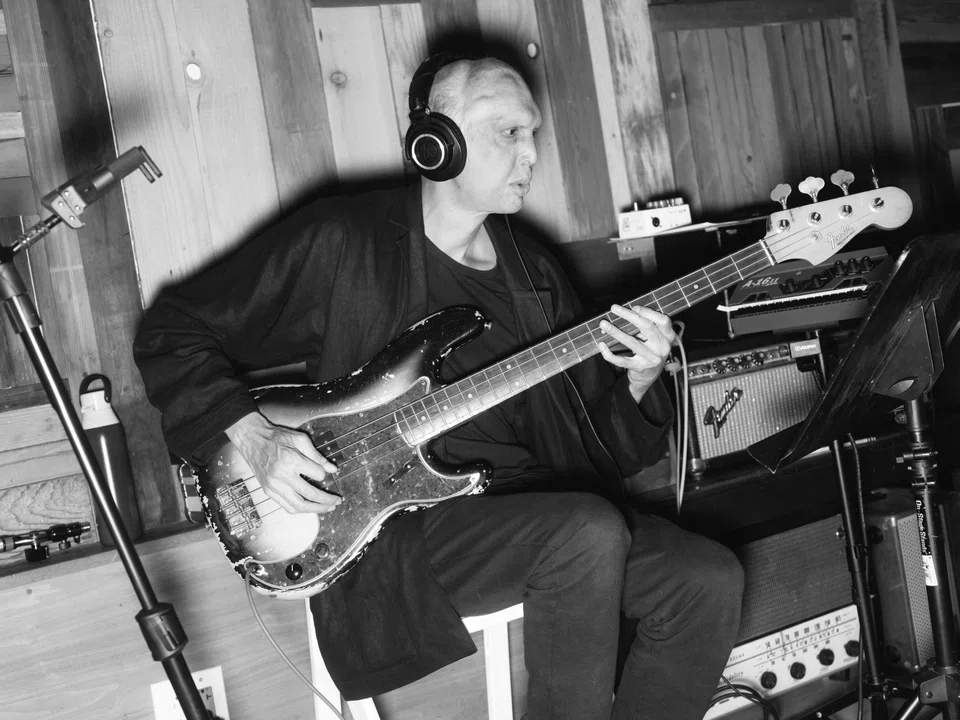
SHAHZAD Ismaily cannot regulate his body temperature. He was born without sweat glands, or at least, not very many.
When he was a month old, his parents rushed him to the hospital because he was beyond feverish and struggling to breathe. They learnt their only child had ectodermal dysplasias, a rare genetic disorder that produces abnormalities at the body’s surface, including fingernails and teeth.
Five decades later, Ismaily has become one of music’s most in-demand collaborators, flitting like a mischievous butterfly through genres as diverse as honeyed folk, rambunctious free jazz and spectral meditations sung in Urdu. He does not think these facts are unrelated.
“Since I move with the temperatures of the outside world so readily, is it possible that I have an extra sensitivity to the tone of the world around me?” Ismaily, 51, recently wondered by phone from a tour stop in the Netherlands, as he briefly warmed himself in his hotel room’s bedside bathtub, during one of several extended interviews. “The hardest part of playing music with people is a kind of non-verbal, total empathetic awareness of how another person feels, how a room feels. I’m moving with the world around me. I’m not a sealed object.”
Though he has never released a solo album, Ismaily has played on or produced nearly 400 records since moving to New York in February 2000, including work by Bonnie “Prince” Billy and Yoko Ono. His Brooklyn studio, Figure 8, remains an affordable and inclusive hub for experimental musicians, even as Ismaily becomes a marquee session player.
This year alone, his subtle keyboards lit the darkened corners of Feist’s Multitudes; his elastic bass provided the combustible matter inside Connection, a rock record from Ceramic Dog, his trio with iconoclastic guitarist Marc Ribot; and his prismatic keyboards and askance rhythms shaped Love in Exile, the acclaimed debut from his improvisational group with singer Arooj Aftab and pianist Vijay Iyer. But summarising exactly what Ismaily does – let alone, how he is so good at it – can feel a little like bottling wind.
“If you listen to my last record, you could not know he’s on it, because he’s not the most present musician,” Sam Amidon, a soft-voiced singer who has worked with Ismaily for nearly 20 years, said by phone. “But every moment he was in the room, he brought out the most beautiful stuff in other people through his energy. He’s just sneakily there.”
For Ismaily, the invitation to play may be the most important part. “Since 30, I have been asked to walk into a room and be myself musically – an incredibly intense, intensely fortunate situation,” he said. “My preferred way to work is to walk into a room and feel, intuitively, what we should do today.”
The self-confidence to play the part of himself did not come easily for Ismaily. Soon after that early emergency room visit, surgeons split his prematurely fused skull, adding space for it to expand as he aged. The scar cuts horizontally across his head, a reminder of his tenuous health as a child. Intense allergies and asthma often caused him to wake up in panics about catching his next breath. For several months, he was blind.

Music soon revealed the world he has spent his lifetime since exploring. His home was very quiet, with no instruments or even a stereo. Still, when Ismaily was 2, he began to crave the act of making sound. He specifically wanted rhythm, banging spoons against hot radiator coils until his parents relented and bought a tiny Muppets drum kit. A high school marching band was the source of his only childhood friends, offering respite from judgment.
He shipped off for a lifesaving stint at Bard College at Simon’s Rock in Massachusetts, which he called “a school of misfits, of 300 oddballs”. He headed to Arizona to join friends in bands and, ultimately, study biochemistry; too busy playing music to attend class, he stopped one credit short of his master’s. Playing in bands there, he realised he could get just enough shows to pay his meagre bills. Making the same scenario work in New York, however, presented new challenges, and Ismaily filled every ostensible day off with an extra recording session or one-off concert. The over-commitment kept him afloat; it also cost him romantic partnerships and rankled bandmates. But after almost two decades together in Ceramic Dog, which is Ismaily’s longest-running relationship, Ribot understands the need.
“It’s not a coincidence, the challenges Shahzad had growing up and the way he plays rock. It’s about being forced into confrontation with mortality,” Ribot said in a phone interview. “He’s the most natural-born anarchist I ever met, because he has the natural desire to exceed whatever limit he’s standing next to.”
Ismaily worries, though, that he still lacks the conviction – or “artistic depth,” as he called it – to put something permanently on record that takes his own name. For a decade, he has run a record label that shares a name with his studio. The imprint specialises in first albums by veteran collaborators and role players, the musicians who make albums by the more famous better. Ismaily knows that description encapsulates so much of his work. He hopes someday to be brave enough to own that mantle for himself, to make his own record in his own studio for his own label.
“It’s crazy to be 51 and still have so much unresolved trauma. That’s keeping me from making a record,” Ismaily said, still energetic after nearly five hours of conversation about that very trauma. “It still feels like a non-mountaineer casually driving past the bottom of Mount Everest, but I would be so excited about that outcome.” NYTIMES
Decoding Asia newsletter: your guide to navigating Asia in a new global order. Sign up here to get Decoding Asia newsletter. Delivered to your inbox. Free.
Share with us your feedback on BT's products and services