
In Orlando, 25 Basquiats come under the magnifying glass
Found by a treasure-hunting picker, the artworks are met with scepticism and a stony public silence from several curators
 Add BT as a preferred source
New York
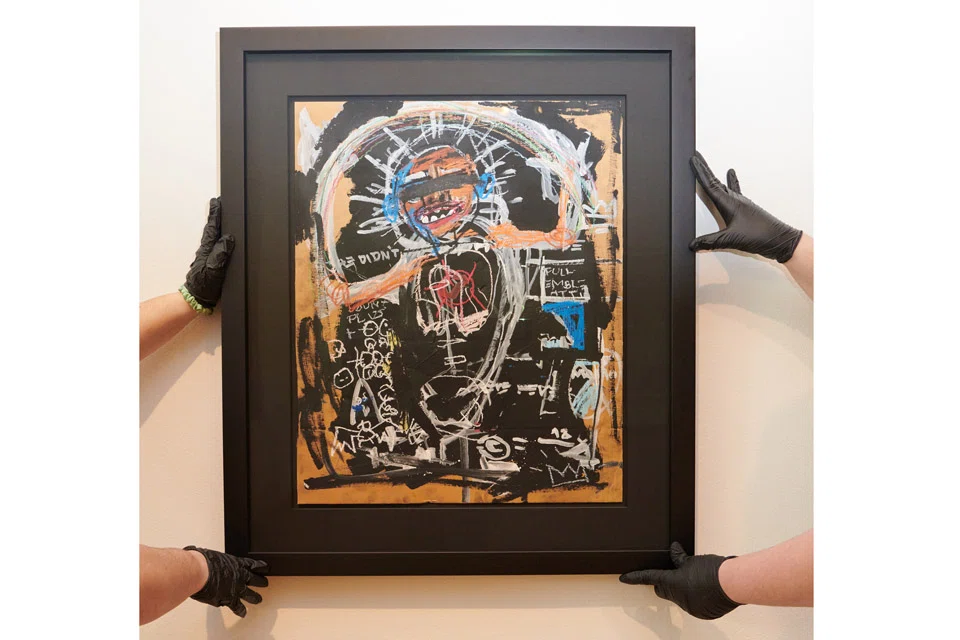
IT SEEMS like a story too good to be true, and for some in the art world, it is. Last weekend, 25 Jean-Michel Basquiat paintings were publicly unveiled at the Orlando Museum of Art in Florida before several thousand VIPs.
All of the paintings were said by the museum to have been created in late 1982 while Basquiat, 22, was living and working out of a studio space beneath Larry Gagosian's home in Venice, California, preparing fresh canvases for a show at the art dealer's Los Angeles gallery.
According to the Orlando Museum of Art director and chief executive, Aaron De Groft, the vibrant artworks - layers of mixed media painted and drawn onto slabs of scavenged cardboard ranging in size from a 10-inch square featuring one of the artist's iconic crowns to a nearly 5-foot-high disembodied head - were sold by Basquiat directly to television screenwriter Thad Mumford.
The price? A quick US$5,000 in cash, about US$14,000 today, paid without Gagosian's knowledge.
The 25 artworks then disappeared for 3 decades, the museum said, only resurfacing in 2012 after Mumford failed to pay the bill on his Los Angeles storage unit, and its contents - the Basquiats tucked in amid baseball memorabilia and TV industry ephemera - were auctioned off.
Navigate Asia in
a new global order
Get the insights delivered to your inbox.
William Force, a treasure-hunting picker, and Lee Mangin, his financial backer, who both scour small auctions for mislabelled items, saw photos of the colourful cardboards and eventually snagged the lot, for about US$15,000.
It certainly sounds like a tale straight out of Hollywood or perhaps a script by the Emmy Award-winning Mumford. Indeed, Gagosian, in a response to this reporter about the 1982 creation of these Basquiats, said he "finds the scenario of the story highly unlikely".
Gagosian's concerns were echoed by several curators known to write widely on Basquiat's work, who have greeted the Orlando museum's show with a stony public silence.
De Groft, the museum director, bristled at such scepticism. "My reputation is at stake as well," he said. "And I've absolutely no doubt these are Basquiats."
Beyond his own trained eye - he has a doctorate in art history from Florida State University - he cited a battery of reports commissioned by the artworks' current owners.
These include a 2017 forensic investigation by handwriting expert James Blanco, which identified the signatures that appear on many of the paintings as being Basquiat's; a 2017 analysis by University of Maryland associate professor of art Jordana Moore Saggese, author of Reading Basquiat: Exploring Ambivalence in American Art, in which she too attributed the paintings to Basquiat; and signed 2018-19 statements from curator Diego Cortez, an early supporter of the artist and founding member of his estate's now-dissolved authentication committee, which declared each of the paintings to be genuine Basquiats.
In light of the imprimatur Cortez's name carries with historians, his certifications were accompanied by photographs showing the curator mid-signature.
But the foremost proof in De Groft's mind was a short poem by Mumford in 1982 commemorating the artworks' creation and the meeting that the owners say occurred between Basquiat, then an artist on the rise, and Mumford, then one of the few Black screenwriters working within network TV and riding high as a producer and writer for the top-rated M*A*S*H.
Lines from the poem seem to refer both to Mumford's '70s work voicing a "Dr. Thad" for Sesame Street, his upcoming script for the M*A*S*H series finale, the "25 paintings bringing riches," and the two men's shared spirit as "no longer outsiders, Industry insiders golden crowns receiving … We film, we write, we film, we paint."
It is said to have been written and typed up by Mumford, then initialed in oilstick by Basquiat (and confirmed as genuine by Blanco).
The poem was not in Mumford's storage locker contents, said Mangin, but was handed to him by Mumford in 2012. After buying the paintings, Mangin said he and Force tracked down the screenwriter, who told them over lunch how he had bought the Basquiats in 1982 as an investment on the recommendation of a friend.
"The poem is almost like a receipt; it refers to the works; it refers to the inscriptions in the works; it refers to the time," De Groft said. "I've absolutely no doubt."
Before his death in 1988 from a drug overdose, Basquiat is believed to have made approximately 2,100 artworks, from small drawings to a paint-adorned refrigerator door, according to the Brooklyn Museum.
Could these slices of cardboard have been among them?
While it's certainly difficult to imagine Gagosian, living just one floor above Basquiat and keeping close tabs on his studio progress, or Basquiat's gallery-employed studio assistant and de facto chauffeur, John Seed, not noticing the creation and sale of 25 detailed paintings on canvas, those painted on cardboard are more easily concealable.
More than just professional reputations now rest on the question of these paintings' true background. The value of Basquiat's work has soared: In 2017 one of his paintings sold for US$110.5 million at Sotheby's - the current auction high for an American artwork.
If the 25 Mumford-purchased paintings are authenticated as actual Basquiats, Putnam Fine Art and Antique Appraisals puts their total worth at close to US$100 million.
An official verdict on this whodunit by the Basquiat estate is now impossible - it closed its authentication committee in 2012 in the aftermath of a lawsuit over Basquiat artworks initially deemed fake.
Yet without such a stamp of estate approval or an established provenance, major auction houses and heavyweight art dealers are reluctant to handle such works.
Despite several years of being quietly shopped around the secondary art market, these Basquiats have to date found no takers, said the owners. The Orlando museum showing could help dispel that market wariness, lending them a new air of institutional legitimacy.
Sotheby's declined to comment on the authenticity of these paintings. Several art world professionals were similarly gun-shy, citing the experience of the estate's authentication committee and their fear that publicly weighing in could embroil them in a lawsuit with the paintings' current owners.
One dealer who personally worked with Basquiat and saw photographs of the paintings in the Orlando museum said: "The way Basquiat places elements in the composition has an interior logic which is missing in these images."
One clue to the paintings' authenticity may lie with the cardboard on which Basquiat would have applied his layers of paint, crayon and oilstick. Mangin said he consulted several paper experts to confirm its age but was told that the composition of cardboard from the 1980s was impossible to differentiate from that of recent years.
Yet flip over one of the works, and you will find that it was painted on the back of a shipping box with a clearly visible company imprint: "Align top of FedEx Shipping Label here."
According to Lindon Leader, an independent brand expert consulted by The Times, who was shown a photo of the cardboard, the typeface in the imprint was not used by Federal Express before 1994. He should know: That was the year he personally redesigned the company's logo and its typefaces while working as senior design director at the Landor Associates advertising firm.
"It appears to be set in the Univers 67 Bold Condensed," Leader said of the label's distinctive purplish font. In 1982, "they were not using Univers at that time."
So the piece of cardboard could not have been produced until 12 years after Basquiat supposedly painted on it and 6 years after the artist's death.
According to a person close to the Orlando museum, who asked to remain anonymous because they were not authorised to reveal internal discussions, its curatorial staff expressed their concern to De Groft that the FedEx text did not seem to be from 1982. "This show raised red flags for them," the person said, but the director brushed off their concerns.
Asked about his staff's reaction this week, De Groft insisted, "The cardboard is legit." He added, "I believe deeply these are authentic Basquiats. I can't answer the question on FedEx; there's an anomaly there."
But he said the evidence provided by the artworks' owners - from the Basquiat-signed poem to the Cortez report - was credible. NYTIMES
Decoding Asia newsletter: your guide to navigating Asia in a new global order. Sign up here to get Decoding Asia newsletter. Delivered to your inbox. Free.
Share with us your feedback on BT's products and services

