Inclusive hiring is more of a boon than bane
Companies must think long-term when it comes to hiring inclusively.
Singapore
ADOPTING an inclusive hiring model can influence employees to be more compassionate, proactive and inclusive, which can translate into higher financial performance for companies, said Elijah Wee, a management professor from the Foster School of Business at the University of Washington, in a keynote speech on Wednesday.
The speech addressed key preliminary findings from a research project by Prof Wee and Pan Pacific Hotels Group (PPHG) that investigated the ripple effects of an inclusive hiring policy on current employees.
However, he said inclusive hiring policies will need to be accompanied by experiential and reflection activities to help other members in the organisation understand the implications and meaning of the policy in their daily work. This will then help employees to better view disability as a strength and an added value to the workplace.
Gainful employment
Inclusive hiring policies that include hiring associates with disabilities will introduce significant changes and additional adjustments to the workplace, said Prof Wee. However, this can ultimately improve employee and organisational-level outcomes.
Wee Wei Ling, executive director (asset and lifestyle) of PPHG, agrees. Inclusive hiring is part of PPHG's strategy, and the group participates in a structured programme with SG Enable that helps persons with disabilities find employment in the workplace.
From 2016, the school-to-work-transition programme has helped students from special education (SPED) schools in Singapore find employment through internships and training programmes.
Currently, 16 persons with disabilities have found full- or part-time employment with PPHG Singapore, with 12 more undergoing training.
"These are good employees who turn up on time, follow instructions well and hardly take leave," she said, adding that companies just need more patience to discover their talents.
Untapped talent pool
Each onboarding process takes about six months to a year, according to Ms Wee. PPHG helps to redesign job tasks to be more specific, and with skill-matching. Persons with disabilities will also need to familiarise themselves with their co-workers and working environment.
This, however, will pay off in the long run, she added.
"Hiring inclusively has proven to be an economically viable model, it is more of whether companies have the heart to take the first step," said Ms Wee, adding that sometimes, persons with disabilities can do the job better than other employees because they are very precise with instructions.
Ms Wee said she sees persons with disabilities as an "untapped talent pool", where they can help fill shortages in manpower and contribute to the team effectively.
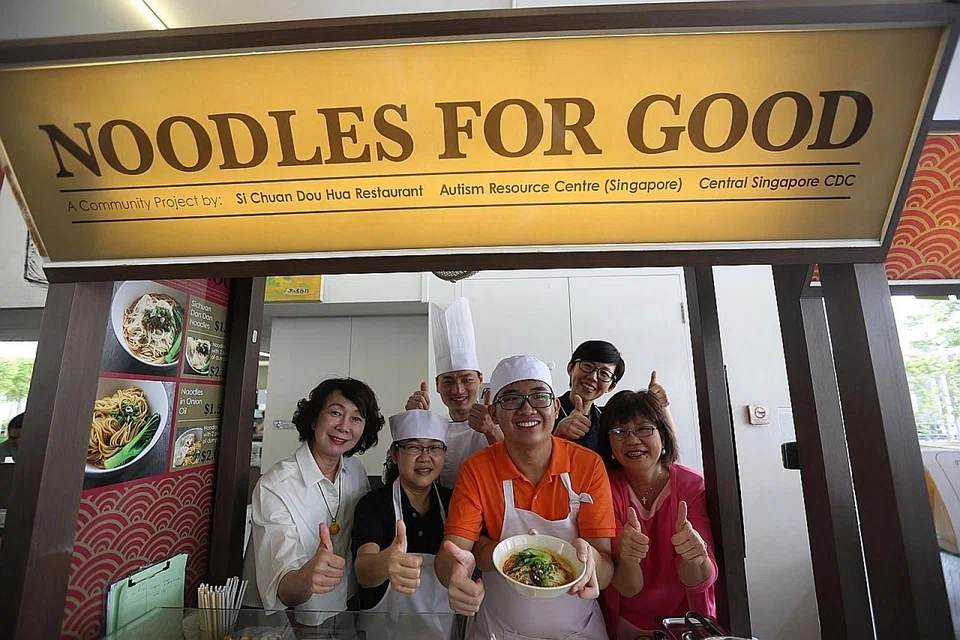
PPHG also works with the Autism Resource Centre (ARC) and Central Singapore Community Development Council to enable indirect hiring through skills-teaching programmes.
One example is 19-year-old Lau Chun Seng, who works with his mother to operate a kiosk out of Catholic High School selling Sichuan dan dan noodles.
Mr Lau has an autism spectrum disorder, and was trained by the master dim sum chef at PPHG's Si Chuan Dou Hua restaurant and ARC's job coach, who reframed noodle-making steps into autism-friendly instructions.
Today, because of Mr Lau's consistency and ability to follow precise instructions, the noodles are always taken out from boiling water at the exact time, and are cooked perfectly. The mother-and-son duo copes with a daily recess crowd of up to 1,200 students.
Chan Mee Fong, Mr Lau's mother, said: "Of course there will be challenges and hardships. "But to all parents with special needs children out there, persevere on and the rewards will come."
Share with us your feedback on BT's products and services