Italy buys famed Etruscan tomb, displays it in Rome museum
The series of celebrated frescoes, which were painted between 340 and 320 BC, combine scenes from Greek mythology with episodes from Etruscan history
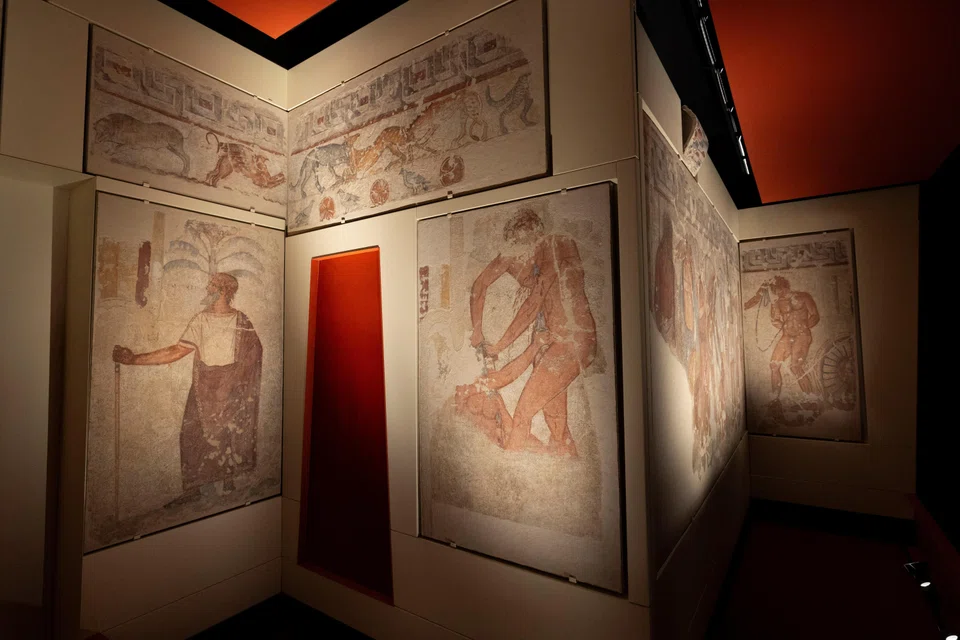
[ROME] One of the most important surviving pieces of ancient Etruscan artwork went on permanent display at Rome’s National Etruscan Museum of Villa Giulia on Tuesday (Jul 1), after the state stepped in to buy the frescoed tomb.
Named after the archaeologist who unearthed it in 1857, the Francois Tomb was a richly decorated burial chamber in the ancient city of Vulci, a centre of power for the Etruscan civilisation, just north of Rome.
The Italian state spent 15 million euros (US$17 million) on a series of celebrated frescoes found in the central hall of the tomb, which were painted between 340 and 320 BC, combining scenes from Greek mythology with episodes from Etruscan history.
“The Francois Tomb is one of the great treasures of archaeology, in particular, of Etruscan culture. It tells the story of families, heroes, gods, and warriors of the Etruscan time,” said Luana Toniolo, head of the Villa Giulia museum.
“What is also very important is that we can see images of the Greek myth that are described by Homer, reinterpreted in an Etruscan way,” Toniolo told Reuters.
Deadly rivalry
The Etruscans dominated large swathes of central Italy before the rise of ancient Rome and helped shape early Roman religion, culture and urban life.
The Francois Tomb offers a rare glimpse of the conflict between the local foes, with one of the frescoes showing Etruscan heroes slaughtering enemies identified by inscriptions as men from Rome and other rival cities.
Among the best-known scenes are the sacrifice of Trojan prisoners by Achilles and the liberation of an Etruscan nobleman by Mastarna, a warrior whom the Roman emperor Claudius later identified as Servius Tullius, the sixth king of Rome.
“This is the only portrait of a Roman king that we actually have,” said Toniolo.
The tomb was found on land that belonged to the aristocratic Torlonia family and the frescoes remained largely out of sight in their private collection until now.
“This is our cultural heritage. This is very important for our roots, for our country... and it has to belong to the state,” said Toniolo.
While the paintings were kept by the Torlonia family and their heirs, many of the tomb’s treasures, including Greek vases, jewellery and Etruscan bronzes, were given at the time as payment to the archaeologists and their backers.
Over the following years, these artefacts were sold off, scattering the tomb’s contents among major global institutions, including the Louvre in Paris and the British Museum in London.
To mark the new exhibition, European museums have loaned Villa Giulia these artefacts which are now being shown alongside the frescoes for the first time in more than 160 years.
“When we said we were buying the Francois Tomb, everybody, every museum was so happy to participate in this project. It was really a great international collaboration,” said Toniolo. REUTERS
Decoding Asia newsletter: your guide to navigating Asia in a new global order. Sign up here to get Decoding Asia newsletter. Delivered to your inbox. Free.
Share with us your feedback on BT's products and services