

It's (almost) business as usual at the Salzburg Festival
 Add BT as a preferred source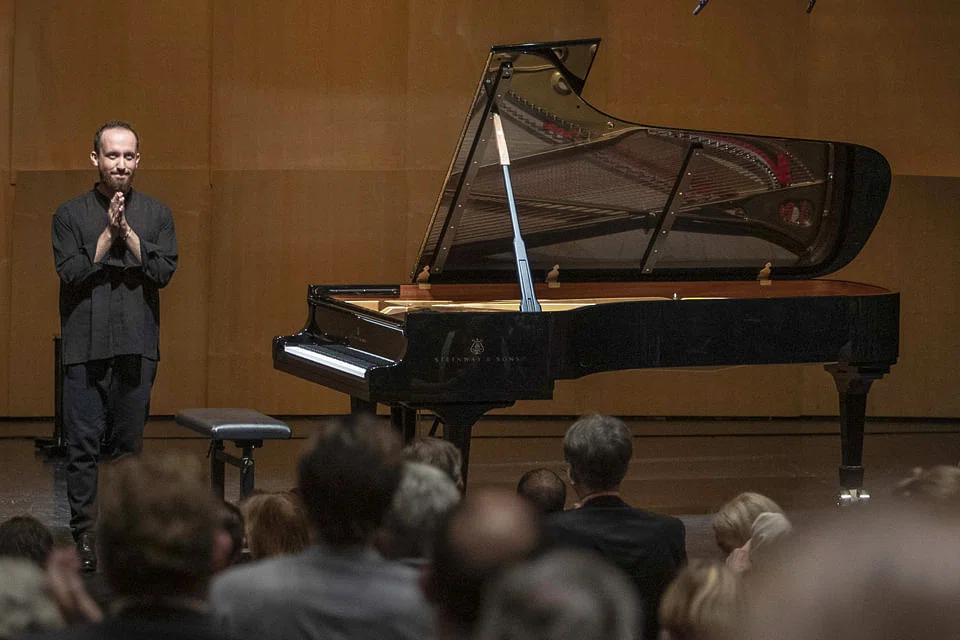
DeeperDive is a beta AI feature. Refer to full articles for the facts.
Salzburg, Austria
A VISIT to the Salzburg Festival has been a summer tradition for Jos Baeck for nearly half a century.
"This year we said that even with Corona we're coming to Salzburg," said Baeck, 71, on a recent afternoon in this city's historic centre. He had travelled from Belgium with a friend who has been attending the festival even longer.
"The festival is very important to us," said Baeck. "You need to admire Helga Rabl-Stadler," Baeck said, referring to the festival's longtime president. "She persevered."
As cultural events worldwide were called off because of the coronavirus pandemic, the Salzburg Festival surprised many onlookers in late May by announcing that it would go ahead with a scaled-down programme to celebrate its centennial. The festival, which runs through Aug 30, started with new productions of operas by Mozart and Richard Strauss, plus the world premiere of a play by the Austrian writer Peter Handke, who won the 2019 Nobel Prize in literature.
Visitors from 78 countries made up the festival's audience in 2019, according to a festival spokeswoman; this year's edition is smaller and less international in scope. Americans, Russians and visitors from many Asian countries, who usually make up a significant portion of the audience, are largely absent, because they are barred from entering the European Union or would have to quarantine on arrival.
Navigate Asia in
a new global order
Get the insights delivered to your inbox.
But while the 2020 Salzburg Festival may not have such a global audience, it has commanded the world's attention by forging ahead against all odds.
New regulations notwithstanding - including compulsory masks, half-full theatres and no intermissions - it often felt like business as usual: a bustling festival for a wealthy and elegant audience amid the grandeur of the Alpine landscape.
"Salzburg is like a rock in turbulent waters," said Frank Sellentin, 57, who has attended the festival since 1993. He added that the event could serve as a model for cultural activities in Berlin, where he works. "Art must remain a part of life. If circumstances demand that it be presented differently, you need to at least try to figure out what that could look like."
There was something gently surreal to the combination of opulent evening gowns and surgical masks. According to an announcement before each performance, masks can be removed while the show is in progress, although keeping your face covered at all times is recommended. Many audience members kept their masks on.
Even with a drastically reduced number of tickets - 80,000 instead of 242,000 - very few performances are sold out. In the festival venues, every other seat is left free. At one performance, a woman was furious that she could not sit alongside her partner. "This is a mistake", she hissed before trying unsuccessfully to pry open the roped-off seat.
On Saturday, in 90-degree heat, the festival opened with a new production of Elektra. Richard Strauss's one-act 1909 opera was given a visually bold and psychologically probing staging by the Polish director Krzysztof Warlikowski.
At the centre of this Elektra were two remarkable Lithuanian sopranos. Ausrine Stundyte, making her festival and role debut in the punishing lead, was an uncommonly vulnerable Elektra; Asmik Grigorian, whose sensational Salome here in 2018 shot her to instant stardom, co-starred as her sister, Chrysothemis.
Along with conductor Franz Welser-Möst, who has led the Cleveland Orchestra for the past 18 years, Warlikowski successfully explored the hidden layers in these characters. Instead of a shrill harpy, Stundyte's Elektra was a broken, often insecure, figure. Grigorian's character, by contrast, was surprisingly tough. In a twist by Warlikowski, Chrysothemis assisted her brother Orest in killing their mother and her lover and then washed the bodies for burial.
Regular coronavirus tests a routine for the musicians
Immediately after the premiere, all 110 performers in the Vienna Philharmonic, which had been accompanying Elektra, took tests for the coronavirus, a process they are undertaking regularly during their stay in Salzburg. All tested negative, according to Welser-Möst, who explained in an interview that his experience working at the festival has been instructive as he looks ahead to his next season in Cleveland.
Elektra was one of seven operas originally announced for the festival's centennial this year (the other six have been postponed until next summer) and the production was well underway when the scaled-down 2020 festival got the go-ahead. Things looked wildly different for the festival's second opera premiere, a hastily assembled Così Fan Tutte that came together in just one month.
Christof Loy, the director, worked with the conductor Joana Mallwitz to prepare a shortened version of the score that would work as an intermission-less performance. Sunday night's premiere clocked in at little more than two hours.
Loy's minimal production played out on a stark white set, but the direction was thoughtful and robust. Make no mistake: This was a fully staged production, one that both looked and sounded remarkable. Nothing felt like a compromise.
"We are here and things work," said Igor Levit, the German pianist who is performing a complete cycle of Beethoven's 32 sonatas throughout the festival.
"Every single human being in the hall knows the risk and responsibility that they have," Levit said. He had tackled the wide-ranging programme with characteristic technical brilliance and emotional engagement. "This can work in a society that takes the minimum of responsibility," Levit said, praising Germany and Austria's approach to handling the virus and taking aim at the United States for its bungled response.
He added that the Salzburg Festival was "a very privileged environment", which seems beyond dispute. Still, the situation here, as in the world at large, remains highly uncertain. On Monday, Markus Hinterhäuser, the festival's artistic director, seemed still to be holding his breath. There's no guarantee that the festival will make it to the end of August, he said in an interview: A flare-up of the virus could stop it in its tracks. "But without exaggeration", he added, "this weekend is already written in the history of the Salzburg Festival."
"Nobody believed that this was possible," he said. It's hard to disagree. NYTIMES
Decoding Asia newsletter: your guide to navigating Asia in a new global order. Sign up here to get Decoding Asia newsletter. Delivered to your inbox. Free.
Share with us your feedback on BT's products and services
TRENDING NOW
From 1MDB to ‘corporate mafia’: Is Malaysia facing a new governance test?
Higher costs, lower returns: Why are Singaporeans still betting on real estate?
South-east Asian markets account for 8.8% of global capital inflows from 2021 to 2024: report

Richard Eu on how core values, customers keep Singapore’s TCM chain Eu Yan Sang relevant

