

It’s raining boxes: Amazon drones overwhelm a Texas suburb
Drone deliveries are a welcome convenience for some but an invasion for others
[TEXAS] The sound came out of nowhere.
It began as an unnerving high-pitched hum, like a mosquito flying around a dark room at bedtime, and it grew louder as it drew closer. A family lounging in a backyard pool in Richardson, Texas, just north of Dallas, couldn’t help but notice it.
“There’s another one coming this way!” shouted Eric Anderson from his pool float, pointing to an area above a tall line of trees. His nine-year-old daughter, Isla, removed her swim goggles for a clearer look at what could be a scene from science fiction.
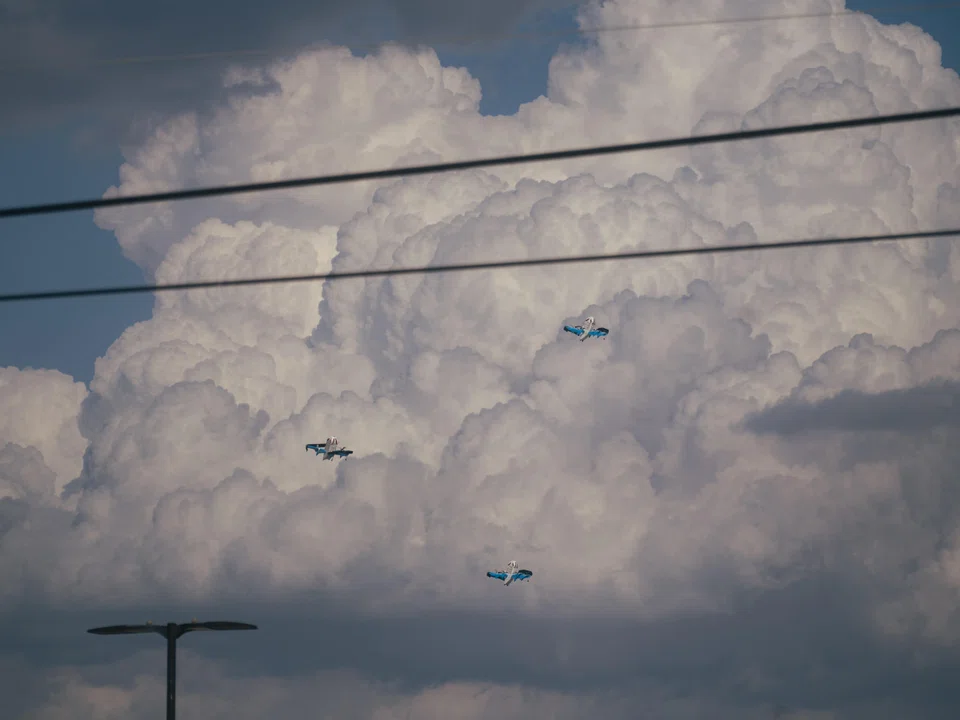
Within a minute or so, an 83-pound drone with six blue arms and whirring propellers appeared in a corner of the sky before zipping over nearby houses, looking like a cross between a mechanical dragonfly and an X-wing fighter, and buzzing like a battalion of bees.
The drone’s mission: delivering an Amazon package.
The single cardboard box of cargo held a maximum of 2.3 kg and was loaded into the drone at Amazon’s distribution centre less than a mile from the backyard pool. It could have been bound for anywhere within a 12 km radius of takeoff.
Richardson city officials gave Amazon zoning approval to start the drone delivery service in December as part of the company’s nascent Prime Air programme. It promises customers tens of thousands of items – nail trimmers for pets, ankle bracelets, handcrafted, razor-tipped bread lames for scoring sourdough – in as little as 30 minutes. The delivery could be free or cost up to US$4.99.
The Federal Aviation Administration (FAA), which governs US airspace, gave Amazon clearance to fly its drones.
Now, many other parts of the United States can expect their own drone deliveries, a welcome convenience for some, but an invasion for others.

Last month, Amazon announced that Prime Air deliveries would expand to 500 US towns and cities by the end of the year. Other companies are also using drone deliveries, and the FAA has forecast that by 2030, the number could explode to more than 3.5 million, up from the current number of 897,000 registered drones.
“What’s happening in Richardson is about to happen all over the country, and people are finally going to believe us that having all these drones flying around is actually a big, big problem,” said Scott Bratcher, who is the president of his homeowners’ association in a Richardson neighbourhood that residents have called a drone highway.
He added: “The government and the FAA have failed us.”
The agency said that it would soon be issuing new rules for drone flight. But in July, after studying the environmental impact of commercial delivery drones such as Amazon’s, the agency decided that they did not pose a “significant impact”.
For some people, the futuristic novelty of the airborne deliveries has been something to celebrate. They have shared their delivery videos online, cheering as their packages are plopped, bounced and sometimes slid onto their yards and driveways.
Lindsay Hamilton, a spokesperson for Amazon, said on Friday (Sep 18) that the customer response to the deliveries has been “overwhelmingly positive” and “so far this year, fewer than 1 per cent” of inquiries into the programme have been related to noise. She compared the drone noise to a window fan on low, and said that during delivery, it is quieter than a passing car.
But in the Richardson neighbourhoods near the Amazon distribution centre, any joy about the innovation has been muted by the sound of dozens of drones, if not more than a hundred of them, flying by every day, sometimes so loud that they sound like flying lawnmowers.
Under city regulations, deliveries can operate from 7 am until 8 pm, and Amazon has assured residents that the drones would fly outbound at an average of 225 feet. The maximum they can fly, according to the FAA, is 400 feet.
For those people living closest to the Amazon flight paths, the ever-droning deliveries pose the most serious threat to their private and peaceful life.
“We hear them zoom, zoom, zoom, back and forth from morning until past dinnertime,” said Nikki Anderson, whose extended family spotted the drone – and many more – one Friday this month. She has long prized the serenity of her backyard, with its undulating pool and birds chirping from landscaping that included a shrub sculpted into the shape of a giant heart.
Now the drones have ruined that, Anderson said. She can hear them from inside, even with the television on, and especially on weekends, when deliveries seem to pick up.
During delivery, Amazon’s drones descend to about 13 feet above the ground and hover as the package tumbles out of an open door and onto a customer’s property – often with all the care of a bouncer tossing a rabble-rouser from a bar.
One online video shows an Amazon drone dropping a package into a pool. Another caught one smashing into an apartment building and crashing near a sidewalk. A recent video showed a drone atop a grassy median of a road in Baton Rouge, Louisiana, sitting there like a lost puppy.
Amazon said its programme is always improving, and Hamilton added that the company had adjusted its operations based on feedback from residents.
Kristi Graham, an administrator for a music education company, was one resident who complained to Amazon, upset about drones flying over her backyard, where her family swims and barbecues.
After her complaint, she said Amazon did change the route – to the front of her house.
She is now part of a neighbourhood group fighting the company, but the appeal of fast delivery remains strong. Last May, Graham’s daughter ordered deli ham from Walmart using a coupon for drone delivery. She had been in a rush to make a sandwich.
Graham had only one thing to say: “How could you?”
She and some of her neighbours, including Anderson, are now sending e-mails to officials of other cities, including El Paso, Texas, and Richmond, Virginia, where Amazon’s drones are about to descend. Don’t trust Amazon’s claims, they say.
The drones, they write, “have been a disaster for the City of Richardson”.
Graham and others are also concerned with security.
According to Hamilton, Amazon’s drones use multiple cameras and sensors for navigation. The images are stored on encrypted drives that only authorised personnel can access later, she said, adding that the data is solely used to improve safety and customer service.
Brian Rowe, an executive in tech and cybersecurity, has shown up to City Council meetings to complain. He has considered many methods of clearing the drones above his home, even looking into commercial anti-drone technology. But that technology, mostly for military use, costs tens of thousands of dollars, he said.
“What can we do?” Rowe said.
He senses other problems looming. Nearly two weeks ago, a company began testing air taxis in the Dallas-Fort Worth area.
They look like Amazon drones, but are much, much bigger. NYTIMES
Decoding Asia newsletter: your guide to navigating Asia in a new global order. Sign up here to get Decoding Asia newsletter. Delivered to your inbox. Free.
Share with us your feedback on BT's products and services
TRENDING NOW

Companies still in search of AI use cases with worthwhile ROI, says Broadcom’s CEO

Malaysian king buys stake in Singapore-listed mining firm expanding into rare earths

Once staunchly pro-China, Malaysian Chinese businesses are now distancing themselves from Beijing
Singapore’s wealth management success should extend to everyday families

