

Japanese potters challenge wabi-sabi aesthetic at new exhibition
One looks to the vastness of the universe for inspiration, the other turns to small miracles in nature

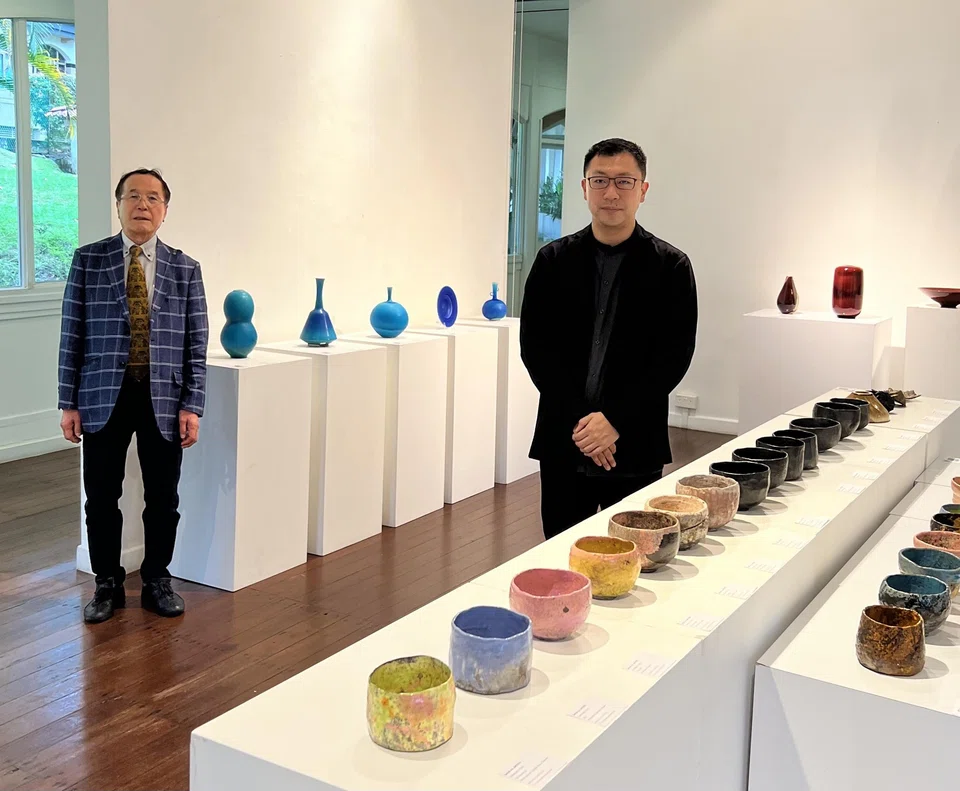
WHEN Yukiharu Furuno’s wife died in 2003, the well-known Japanese ceramicist plunged into depression. He didn’t touch his potter’s wheel for a year – until a fan spoke with him and shook him out of his funk. She said: ‘You can’t make the world spin in the other direction. You have to accept it is going only one way’.”
Something in her words tugged at him. He thought about the vastness of the universe and the possibility of his wife waiting for him in heaven or some other celestial dimension. He thought of the immense blue sky and the deep blue ocean which she loved.
He soon returned to his studio and started working again. But something had radically changed. Before his wife’s death, his ceramics were glazed in ashen colours such as browns, greys and muddy yellows. Furuno, who owns a farm, frequently experimented with plants and vegetables that were burnt to create the substances used in the glazing process.
But after losing his wife, he fell out of love with that palette. Instead, he became obsessed with the many hues of blue, which he associates with places where his wife’s soul might reside. “Everything I do now is a way of reaching out to her beyond this life,” says Furuno, who recently turned 80. “Everything I do is dedicated to her.”
It’s not hard to tell his pieces from those of fellow ceramicist Takanao Todo at the two-person exhibition at the Japanese Creative Centre on Nassim Road. His pieces are, of course, blue – but they’re also moulded into shapes that evoke cosmological associations. A plate with multiple rings resembles a solar system. A tulip vase with varying shades of blue recalls an evening sky.
The exhibition is titled Post-Wabi. It is a challenge to the much-vaunted Japanese aesthetic of wabi-sabi, or the “perfectly imperfect”. According to the principles of wabi-sabi, beauty can be found in things that are simple, unadorned, asymmetrical, rough and even strange-looking – qualities that are all around us.
Furuno sees it as going beyond these principles to embrace “the profound unknowability” of the universe: “If wabi-sabi is about finding the beauty in what is lacking, I’ve found beauty in the immense emptiness of the heavenly skies.”
In contrast, his compatriot Todo appears to have a more traditional interpretation of wabi-sabi. His tea bowls and sake cups seem to bristle with defiant imperfections. But Todo, 39, says it isn’t so straightforward.
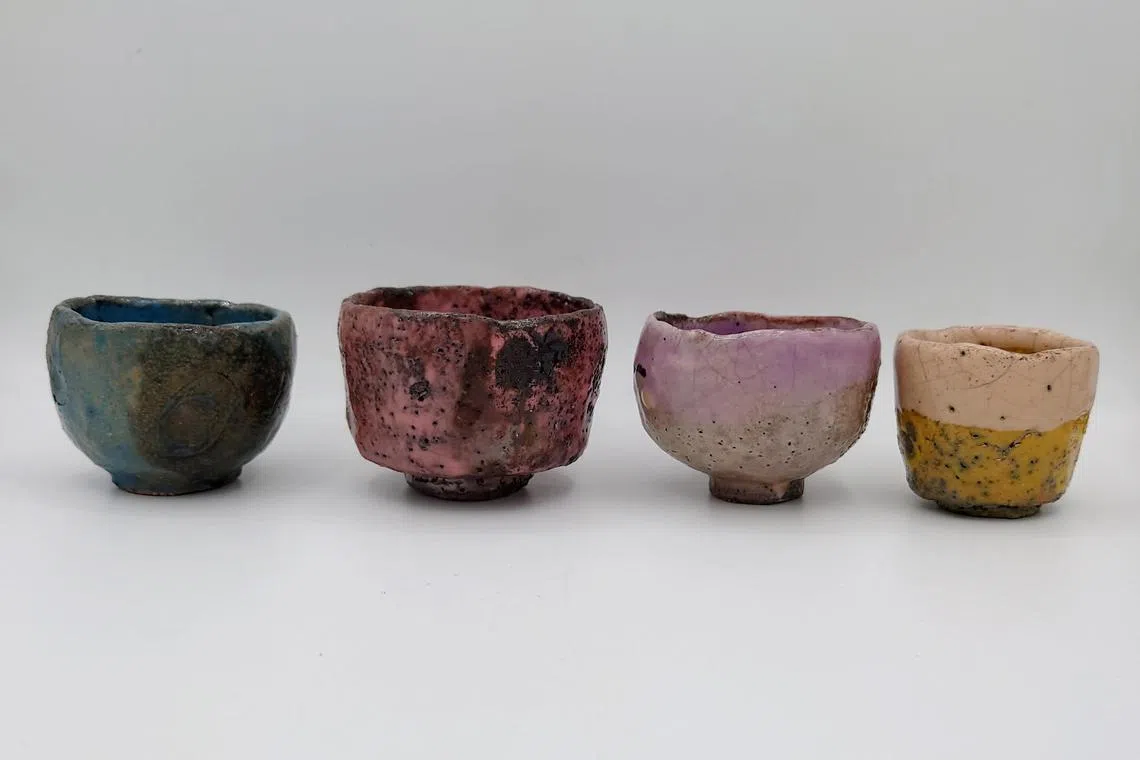
“Whereas Furuno-san talks about the beyond, my work talks more about the places nearby, but which we don’t pay attention to. I am interested in the beauty of ordinary creatures, such as fish, frogs, birds and insects. They often have colours that are uniquely coordinated with their environment, a reflection of their symbiotic relationship with nature.

“Nature provides many instances of perfect geometry, such as the Fibonacci sequence in a snail’s shell, or the fractal patterns of leaves. But I prefer to focus on how living things co-exist with nature, rather than these perfect geometrical orders. What you find in my works are seemingly imperfect forms with collisions of colours, but which are calibrated to reflect the natural phenomena around us.”
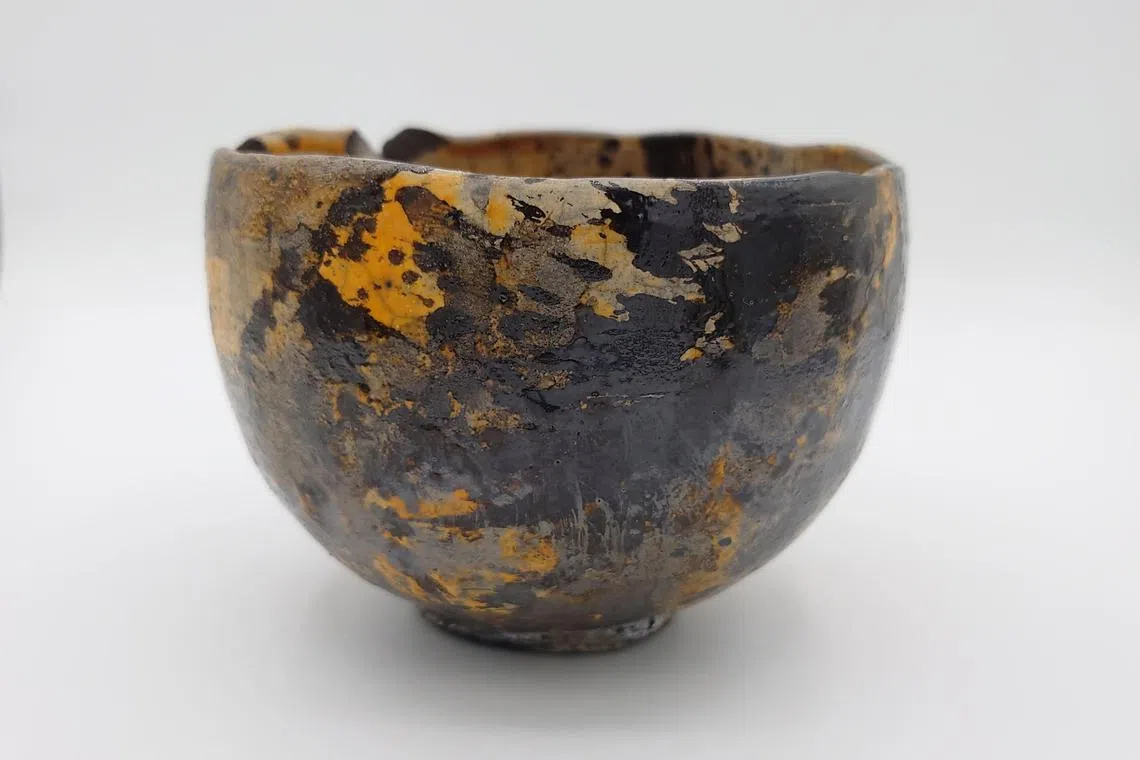
Post-Wabi is on show at Japan Creative Centre at 4 Nassim Road from now till Feb 4.
Decoding Asia newsletter: your guide to navigating Asia in a new global order. Sign up here to get Decoding Asia newsletter. Delivered to your inbox. Free.
Copyright SPH Media. All rights reserved.
TRENDING NOW
Easy to rent out, hard to sell: Are buyers losing interest in Singapore’s one-bedroom condos?

GovTech retrenches another 38 staff in second round of layoffs

Stocks to watch: Seatrium, CapitaLand Investment, Keppel DC Reit, Suntec Reit, CLCT, TSH Resources
World’s largest offshore wind platform by Seatrium consortium on track to be completed by 2028

