

Keeping the 9/11 Memorial pools clean
The challenge is not so much the physical work, but the repetition, says the man who has been on the job for 14 years
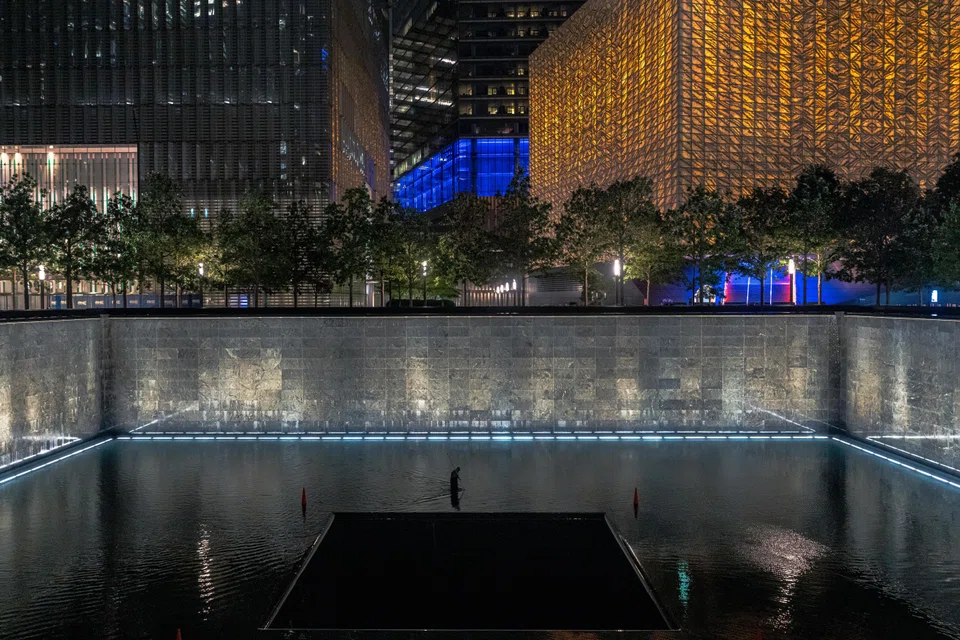
[NEW YORK] Jim Maroon begins his nightly work shift by putting on a rubber wading suit and stepping into some of the most symbolically weighted water in America.
Five nights a week, from 11 pm to 6 am, Maroon, 54, cleans the reflecting pools at the 9/11 Memorial. Since he started in 2012, soon after the pools and surrounding park opened to the public, he has maintained a site that is both a world-class tourist attraction and the location of a mass tragedy.
It is a heavy responsibility, Maroon said.
“These people lost family here,” he said on a summer shift, gearing up for the 25th anniversary of the Sep 11 attacks. “You always want to put on a good display for them and not have them say, ‘My husband died here and this should be a beautiful place, but this guy is not doing his job.’”
The two memorial pools, each about an acre in size, cover the footprint of the twin towers, dropping 30 feet down from street level, with a square void in the center that drops another roughly 20 feet. The water that rushes down the pools’ black granite sides constitutes the largest human-made waterfall in North America.
Maroon worked out the maths. Each pool takes 44 trips pushing a vacuum in one direction and 44 trips back.
He works with a colleague who brushes behind him, and another who works the vacuum’s pump. But his is not a job for someone who minds being alone.
“I think that’s a perk of the job,” he said. “You don’t have to see the boss. You do your own thing. You just do it well, and they leave you alone. I wouldn’t say I’m antisocial, but I’m happy alone, too.”
The site has special meaning for Maroon. His father worked at the World Trade Center, and growing up, he spent a lot of time there.
On Sep 11, 2001, he had a job a few hundred yards from the towers, and he was heading there as the first plane hit. He remembers the sound of the impact, then later the sight of people jumping from high windows.
On his job, he tries not to dwell on that memory. But each year around the anniversary he cannot avoid it, especially when he sees the names of the dead inscribed on parapets around the pools. “If I thought about it every day, I’d be heartbroken,” he said.
As workers at the reflecting pool in Washington, DC, have learned this summer, algae can do a number on a pool. At the 9/11 Memorial, chemists treat the water with an algicide called bromine to keep it in check, and Maroon clears any growth from the stone underneath.
What else is in the pools? Coins, soda cans, children’s toys, the occasional camera, Maroon said. But mostly he vacuums up leaves from the memorial park’s roughly 400 trees.
About five years ago he found a turtle the size of a lunchbox. “Maybe a bird grabbed it from somewhere and tried to crack its shell and wound up dropping him in the pool,” Maroon speculated. Workers at the memorial gave it a home in their offices. They named it Lucky. “It’ll probably outlast us all,” he said.
The coins all go to the memorial, he said.
During Maroon’s shift, with the visitors gone and the water off, there is an eerie quiet in the pools, broken only by the vacuum’s whir and the occasional disembodied voice from one of the security guards above, echoing around the dark chambers.
After 14 years of cleaning the pools – no one does it if he’s out sick or on vacation, Maroon said – he said the challenge was not so much the physical work, but the repetition. You go up, you go back, day after day after day.
“It’s not the first time you do the pool,” he said. “It’s when you do it 1,000 times.
“It’s like Groundhog Day. I guess it’s good and bad. Like for me, I have no problem with it.
“I don’t know if I’m loyal, persistent, stubborn. That’s why, 14 years later, I’m still here. And you know, I don’t plan on leaving unless my body breaks down.”
As the morning sun slanted into the pools, it was time for Maroon to peel off his wading suit and go home to Staten Island. In two hours, the crowd would start to arrive. None of the visitors will see Maroon or learn his name. But in some small, telling way, his work will be part of their experience. NYTIMES
Decoding Asia newsletter: your guide to navigating Asia in a new global order. Sign up here to get Decoding Asia newsletter. Delivered to your inbox. Free.
Share with us your feedback on BT's products and services
TRENDING NOW

Government to bring forward raising of retirement age, give employers more financial support to create flexi-load jobs
Former minister Maliki Osman, Revolut chairman join Asia Gulf Holdings advisory board

Is Manila Asia’s new dining hot spot?
Simba at risk of losing operating licence over spectrum misuse

