Kim Lim: Sculpting space and silence
Late artist’s retrospective is one of the most beautiful art shows of 2024

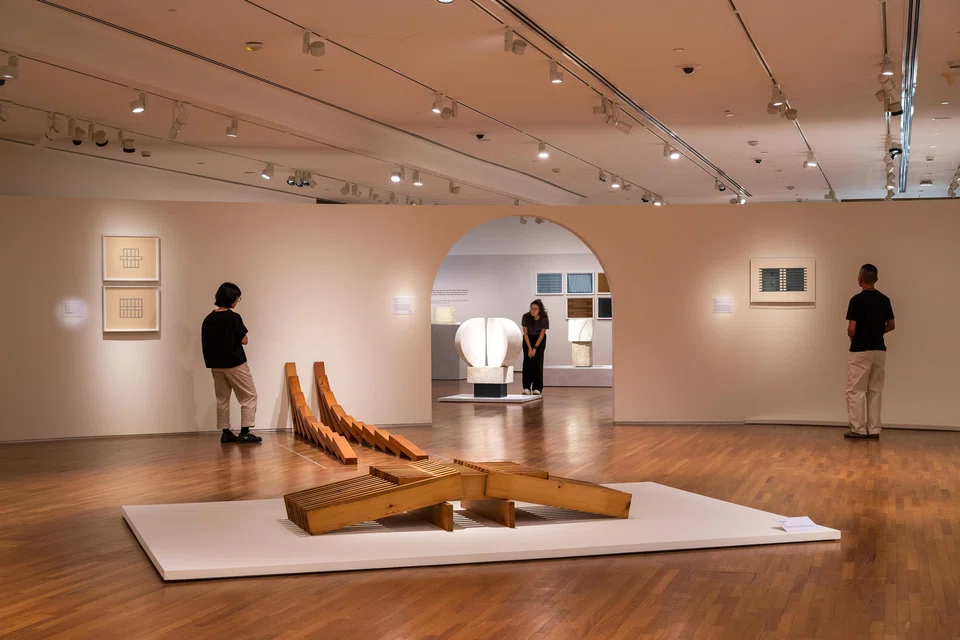
WALKING into Kim Lim’s landmark exhibition at National Gallery Singapore feels like entering a retreat that requests stillness and contemplation. It is a quiet, almost solemn space where the very simplicity of the works pulls you in, asking for a kind of slow reflection that is rare in today’s world.
Lim’s minimalism – particularly her use of natural materials and modular forms – creates a sense of calmness, while provoking a dialogue between the viewer, the materials, their forms and the space around them.
The gallery’s object placement, with its precise lighting and generous spaces in between, makes room for silence and interpretation. It successfully frames her works not just as art but a genuinely immersive experience – without the fancy, interactive, enveloping technology that passes for “immersive” these days.
For some, this is a beautiful show that invites repeat visits, because it guarantees the most elegant kind of sanctuary an art-loving introvert could dream of.
Kim Lim: The Space Between is the most comprehensive museum survey of the late artist to date. It features more than 150 works, including sculptures and prints produced over four decades, as well as photographs, sketches and maquettes.
Curated by Dr Adele Tan and Joleen Loh, the show is distinguished by precision and restraint, belying the many years it took to research and mount, and the logistics involved in persuading dozens of collectors and institutions to loan what they have in their collections for the exhibition. (Nearly 80 per cent of the works are on loan.)
The show is divided into four sections, each tracing a different phase of creativity, from the earliest wood carvings to the majestic marble sculptures of the later years. Yet each piece of the exhibition feels elemental, as if it was always part of the space. They are so subtle and natural, there’s seemingly no demarcation between where the art stops and the viewer begins.
They reflect a certain purity of form and material, inspired by Lim’s sojourns in many lands, from Japan and Indonesia to Egypt and Turkey, to distill what is rudimentary in the visual cultures of different peoples.
Privileged upbringing
Lim was born in 1936 in Singapore to a wealthy family. She was the daughter of famous barrister Lim Koon Teck and descendant of merchant and philanthropist Tan Tock Seng. So privileged was she, she got to study art in London at age 17 – first at St Martin’s School of Art, and then the Slade. In 1960, she graduated from the Slade and married fellow sculptor William Turnbull, eventually settling in North Camden, London.
Although her talent was obvious to anyone with taste and discernment, she was not duly recognised because she was Asian and a woman. But with time and changing attitudes, she’s finally being acknowledged for her contributions to 20th century minimalism.
While the show has been segmented to narrate the evolution of her practice, many of the pieces themselves carry no obvious storyline or emotion – just raw materials arranged in grids, lines, blocks or stacks, creating a rhythm and movement through what’s visible (material and form) and absent (negative space).
Some of her works are clearly inspired by her travels. Early works such as Samurai (1961), Pegasus (1962) and Centaur II (1963) bear narratives of iconic, mythological figures. But her best works, such as Padma III (1985) and Kudah (1989), may be the ones with little or no storytelling or visual drama – merely materials interacting with space and silence, speaking for themselves instead of letting the artist speak for them.
Their minimalism allows viewers to project their own personal thoughts and emotions onto them, unfiltered and unhindered. In a world full of noise, Lim reminds us that sometimes, less really is more.
Kim Lim: The Space Between runs at National Gallery Singapore from Sep 27, 2024, to Feb 2, 2025.
Decoding Asia newsletter: your guide to navigating Asia in a new global order. Sign up here to get Decoding Asia newsletter. Delivered to your inbox. Free.
Copyright SPH Media. All rights reserved.
TRENDING NOW
Grab CEO’s wife Chloe Tong on life with Anthony Tan and finding her purpose
He built the Vingroup empire. Now South-east Asia’s richest man is handing some key roles to his sons
Singapore’s S$80 million vertical farm must pass the 50-cent test to succeed
Data centre energy demand from Asean telcos not a ‘big risk’, says industry group