
Lessons from Covid-19 on the plight of vulnerable groups
We must continue to help and engage them even after the pandemic ends.
 Add BT as a preferred source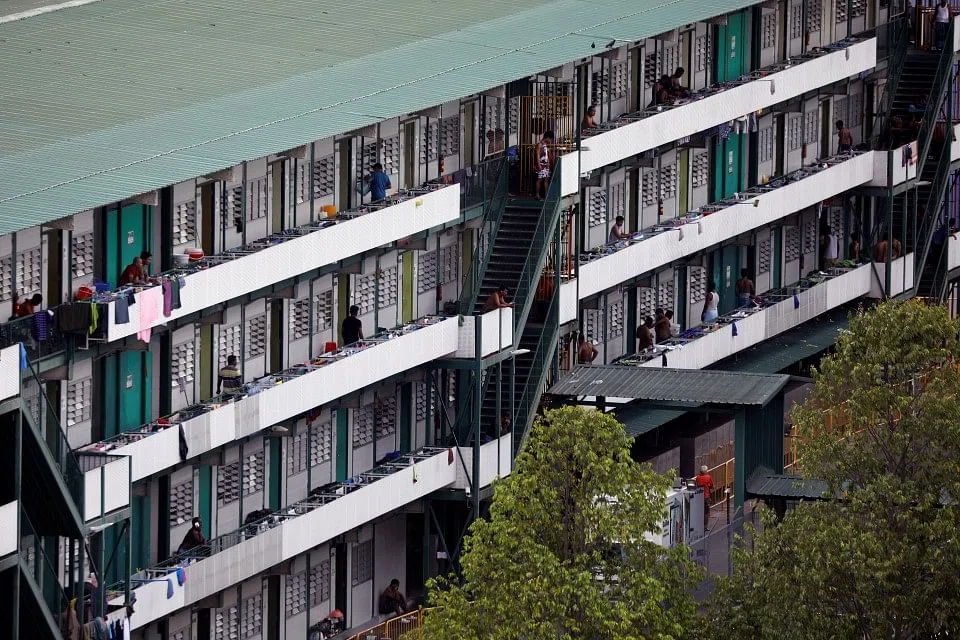
TO TAKE a leaf from a Buddhist sutta on five subjects for contemplation as a reminder of the transience and fragility of life, five points of contemplation have arisen during this month, in the ongoing Covid-19 circuit breaker period.
The first is the plight of foreign workers that has come forward to public consciousness like never before. Suddenly, the lives of these men, who share with us "the sight of the stars and the warmth of the sun", are no longer as "incomprehensible, wavering and misty" as how novelist Joseph Conrad described the human condition.
The second is a noted rise in reports of domestic abuse and violence. History repeats itself: experts in the field have noted such trends when crises such as a pandemic or economic recession takes place or when restriction of movement is imposed upon society. Just one day after the circuit breaker took effect on April 8, The Straits Times ran a report on the rise of domestic violence and abuse.
The third: a tweet that has been making the rounds on social media - as you binge watch your 13th entire series or read a book or fall asleep to music, remember that in the darkest days when everything stopped, you turned to artists.
The fourth is the caption "someone partied, someone died" on a meme, adapted from an infographic of the links between Covid-19 clusters in Singapore.
And the fifth, a question which has been uppermost on the minds of all: What counts as an essential service and what does not? What is essential, what is not?
Navigate Asia in
a new global order
Get the insights delivered to your inbox.
For the first two-and-a-half months of this year, I was stationed in Jakarta, consulting for an arts centre that is unique in the region. It comprised a museum dedicated solely to the work of famed Indonesian artist Hendra Gunawan (1918-1983), a theatre and gallery space.
In 2014, it was the first theatre in Indonesia to present a Broadway musical, Beauty And The Beast. My organisation was advising on programming and place-making strategies for the centre. Much was being planned, including possibilities of Singapore-Indonesia collaborations in the field of arts and culture.
By the time I left in mid-March, the sudden surge in the number of reported cases of Covid-19 had made an impact on the social and economic life of the city. Jakarta had closed all museums and tourist attractions to contain the spread of the virus. By the month's end, looking at the uncertain economic climate ahead, my client told us, with sadness, over the phone: "The arts is probably a third priority." We understood.
Lessons
Since then, many lessons - whether articulated in print, online or social media have emerged. These reflections share one commonality: they point towards a need for a change in the way we once were and in the way we are living now.
These lessons can perhaps best be summed up in award-winning novelist Arundhati Roy's article in The Financial Times on the impact of Covid-19 in India. Roy likened this pandemic to a portal, a "gateway between one world and the next" through which we can either walk through dragging "our data banks and dead ideas" or we can walk through "with little baggage, ready to imagine another world".
Covid-19 is a reminder of how inter-dependent and inter-connected all our lives are. It is not a state of inter-dependency or inter-connectedness that has just arisen. It is a condition that has been there all this while: it just took a virus to awaken us to it.
As the meme says: "Someone partied, someone died". One's relation to another is no longer the proverbial six degrees of separation: sometimes it is just two degrees.
Over the past week, my parent company, The RICE Company Ltd (TRCL), an arts and culture organisation which seeks to build an arts eco-system through arts education for the less privileged, launched an initiative to engage Singapore's vulnerable children and youths through online arts, culture and lifestyle e-learning platforms during this circuit-breaker period.
The original intent of this initiative, #Engage, was to allow the organisation's beneficiaries to continue their curriculum training uninterrupted, and also to reach out to the general public who may be in need of such engagement activities during this period.
It has since been extended to support schools that remain open for vulnerable students who might not have the necessary digital resources at home or might require face-to-face support. #Engage also allows the livelihoods of trainers to carry on without disruption during this period.
Social issues that arise in times of crisis are not someone else's problem. If we have the ability, even if it is just to draw, to sing or to dance, and if we can use that ability to keep a vulnerable young person engaged long enough to draw, to sing and to dance with us, then every moment that person is engaged is one more moment he or she is away from potential harm.
A portal
With staying home the new norm, creative or artistic activities have become the portal (to riff off Roy) to a personal Utopia, a reminder of what once was and can be, an affirmation that we are not alone.
Over the Easter weekend, two live-streamed concerts drew millions of viewers online: "God of Cantopop" Sam Hui's solo concert in Hong Kong and tenor Andrea Bocelli's solo performance from an empty Milan cathedral. To date, Bocelli's "Music for Hope" performance has been watched over 20 million times. Churches in Italy remains closed and prayers by Pope Francis on Easter were live-streamed.
Here, a two-minute long video of a performance of Dick Lee's Home, filmed by Singapore dentistry student and violinist Jaz Loh while she was serving a Stay Home Notice, made the rounds on social media - her tribute to workers fighting Covid-19.
In Jakarta, my former colleagues at Ciputra Artpreneur keep the spirits of their audience uplifted through social media. The team continues to upload colourful posts on the development of theatre in Indonesia and the paintings of Hendra Gunawan. Hendra was once incarcerated as a political detainee for 17 years. He passed his time in prison making art on scraps of canvas that were made available to him.
The healing fountain
Reports of livelihoods of freelancers in the creative industries (or for that matter, all industries that are not regarded as "essential services") being affected are legion, the distress clear and present.
Some of our "work" or "business" may not be able to directly save lives or better the living conditions of others. This realisation might just trouble the conscience. Or it can lead to action: to make us reimagine and rethink that which we have been doing, so as to be ready for the next world that will emerge.
To engage another through an online platform now may be the norm. But this is just a means. When the present movement restrictions are lifted, we have to continue with that engagement, whether it be for the purpose of keeping at-risk youths and children engaged or simply to cheer others on.
We have to keep that engagement going with an even greater urgency than before so that when the next pandemic comes, history would not repeat itself.
The poet W H Auden (1907-1973) once wrote that "poetry makes nothing happen/ ... it survives / A way of happening, a mouth". Auden concludes that poem by telling us that "In the deserts of the heart / Let the healing fountain start,/ In the prison of his days, / Teach the free man how to praise".
Decoding Asia newsletter: your guide to navigating Asia in a new global order. Sign up here to get Decoding Asia newsletter. Delivered to your inbox. Free.
Share with us your feedback on BT's products and services

