

Lessons from plants and poop during bush walks
Such atypical African excursions help shed light on flora-fauna interdependence in our modern world
SAY the word "safari", and it's game drives that immediately come to mind: jouncing in a jeep through African plains, gawking at the stretch of unending wilderness, marvelling at the majesty of the Big Five (lions, leopards, rhinoceroses, elephants and buffaloes).
But having just returned from my first safari - my husband and I visited South Africa's Sabi Sands region - I'd wager that the real magic is not in the game drives, but in the bush walks. For these, we left the security of our land rover and explored the savannah on foot, with nothing but our trusty local ranger and his rifle.
While the under-appreciative dismiss bush walks as mere plant and poop spectacles - for avoiding excrement is a futile task in the wild - they are missing the point. The truth is, there is no fauna without flora; animals only form half of the story.
Take, for example, the push-pull relationship between giraffes and acacia trees, the tall, canopied beauties pictured in just about every African sunset (including The Lion King's opening number).
Giraffes love acacia leaves so much, they eat up to 30kg of the foliage daily. At this point, you're probably thinking: "Wow, 30kg is a lot of leaves; how are there any acacia trees left at all?"
First, acacia trees sport thick, spiky thorns that make grazing tricky. In fact, the root of "acacia" is the Greek word "ak", which means "be sharp, rise to a point, pierce". Some acacia species grow knife-like thorns that span up to 10cm in length, making a formidable defence against the most hungry of herbivores.

Giraffes, however, are unfazed by the spikes. With their 50cm prehensile tongues - which allow them to grasp objects the way human hands can - giraffes are able to avoid acacia thorns and pluck off only the delicious leaves.
But that doesn't mean it's game-over for the trees. To protect themselves from over-grazing giraffes, acacias have a second, remarkable line of defence: the ability to release tannins within minutes. The increased tannin levels turn the once-delectable leaves into a bitter, mealy mess, forcing the giraffes to move on. (At the behest of our ranger, I tried an acacia leaf. It tasted ten times more intense than raw bittergourd, and made my mouth awfully dry.)
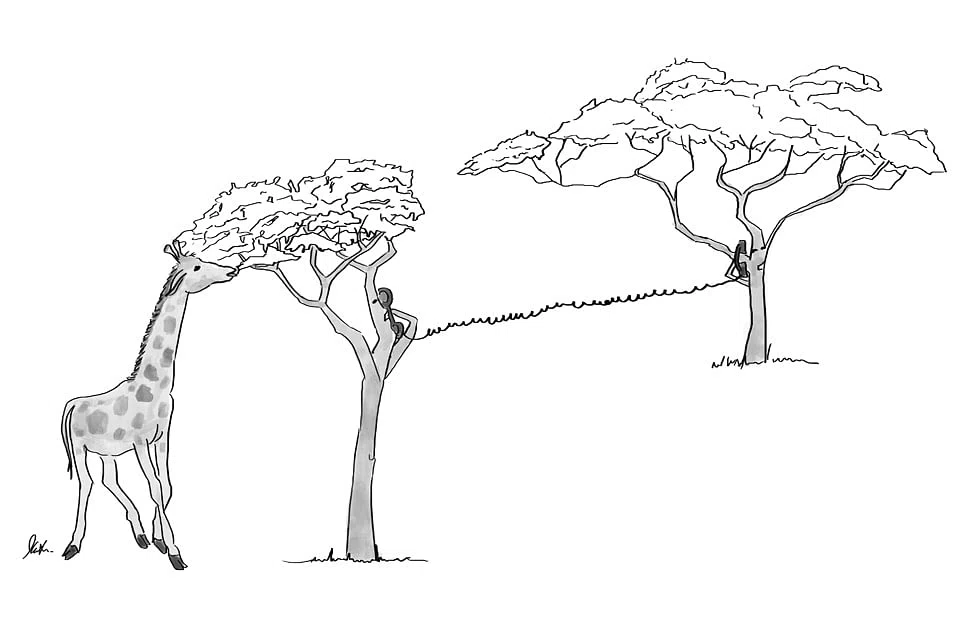
The brilliant self-protecting mechanisms don't stop there. Sensing that other acacias may now be in danger, the over-grazed tree then emits ethylene - a plant hormone - into the air, which acts as an alarm signal to trees up to 45m downwind. The wafting ethylene forewarns other acacias, prompting them to up their tannin levels too. This helps them guard against any wandering giraffes even before the hungry animals get there.
Remember, you heard it here first: Trees can talk.
Interestingly, giraffes eventually wisened up to this evolutionary arms race, and learnt over time to feed upwind - allowing them to graze on acacias that hadn't yet caught wind (literally) of the warning. Some believe this is why the collective noun for giraffes - at least colloquially - is "journey", as in, "a journey of giraffes".
The bush walks also gave me a newfound understanding of poop. For instance, I now know how to tell the difference between antelope, elephant and hyena poo. A bizarre skill, to be sure, but a skill nonetheless.
Antelope poo is small and pellet-like. When completely dry, and therefore devoid of any more bacteria, it's used in poo-spitting competitions. I'm not making this up; there's a world championship held annually, and the world record allegedly stands at a distance of 15.56m.
Elephant poo is distinct not only because of its sheer size, but also because it's highly fibrous. As elephants can only metabolise less than half of what they eat, their waste - comprising softened leaves, fruits and twigs - often make nutritious homes for various insects, including beetles and scorpions.
Hyena poo, meanwhile, is unmistakeable. It's rambutan-sized and a dazzling white colour, thanks to its high calcium content. As scavengers, hyenas are able to digest unusual delicacies that most other animals can't, including bones.
What use are bright white droppings, you ask? Well, just ask tortoises, which depend on hyena droppings. Because calcium is essential for their shell and skeletal development, and since they can't process bones themselves, tortoises feast on hyena poo. It's an indirect but efficient way for them to get the nourishment they need.
These are bits of trivia I would never have picked up had I not gone on bush walks. After all, when you're ensconced in a jeep on a game drive, you're in a different frame of mind entirely - tracking elusive cheetahs, scouting leopards in trees. It's unlikely you're going to pause and peer at hyena poop or strain to listen to talking trees.
And that's precisely what makes bush walks so special. There's truly no better way to accept that the circle of life is real, and not just some kumbaya nonsense that Disney fabricated.
It's a lesson this urbanite is glad she learnt, and one she'll never forget.
Share with us your feedback on BT's products and services
TRENDING NOW

South-east Asia has lost Nvidia’s best salesman

‘If there’s a price to be paid, so be it’: George Yeo says Singapore must safeguard its reputation

Demand, tech capabilities position Apac and AI as Skyscanner’s next growth frontiers: CEO Bryan Batista

CapitaLand, Far East, Sing Holdings team up for S$1.8 billion bid at S$910 psf ppr for Jurong Lake District site

