

Lien Foundation invests S$3.9 million in Innovation Collective by 3 social service agencies
Allkin, Care Corner, Fei Yue Community Services will have dedicated innovation teams
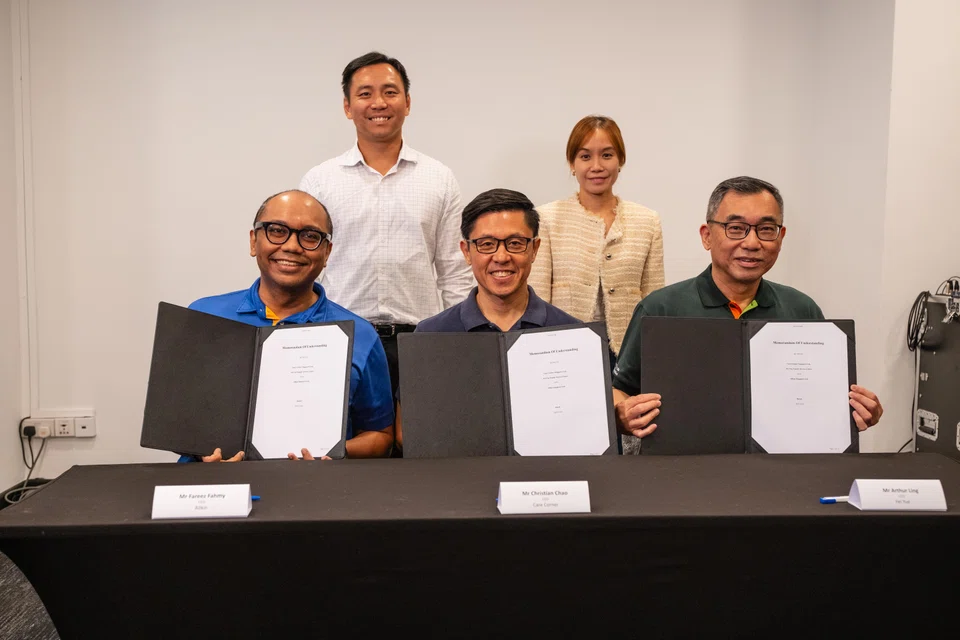
[SINGAPORE] Allkin Singapore, Care Corner Singapore and Fei Yue Community Services on Tuesday (Jul 28) launched the Innovation Collective, backed by a S$3.9 million investment from Lien Foundation over three years.
The sector-led collaboration is to help social service agencies (SSAs) build innovation capabilities. It comprises three dedicated innovation teams, each housed within one SSA.
About S$3.1 million will be allocated to manpower, while the remaining amount will be used to support the innovation process – prototyping tools, user research, leadership workshops and external consultancies.
Luo Ren, programme director of Lien Foundation, said: “The bulk of the funding goes towards hiring experienced talent into the innovation teams – software engineering, design and product management – capabilities most SSAs currently do not have in-house.”
Allkin and Fei Yue will receive support for two hires each, while Care Corner will hire three people. In total, Allkin and Fei Yue will have three people in their teams; Care Corner will have four.
“To encourage long-term sustainability, each SSA self-funds one headcount from the outset. This rises to two in (the third year), as Lien Foundation’s contribution steps down,” she added.
The teams will co-develop solutions with social work professionals while building a culture in their SSA that encourages experimentation and collaboration, the parties noted.
Although the three SSAs will work together on joint projects tackling common challenges, they will still develop their own innovation capabilities – these solutions can be shared within the collective.
“In every case, the test is the same: the project must address a shared challenge, benefit more than one agency, and be able to scale,” Christian Chao, CEO of Care Corner, noted.

Allkin CEO Fareez Fahmy said design thinking will help the SSA better understand its clients’ needs before developing solutions.
“Technology development enables us to build accessible, scalable tools that address these needs, while product management ensures these solutions are (continually) refined to deliver meaningful outcomes and remain aligned with organisational goals,” he added.
Meanwhile, Arthur Ling, CEO of Fei Yue, said artificial intelligence and digital innovation help to “augment professional practice, improve operational efficiency and enable more personalised interventions”.
A new model of collaboration
At the launch, Senior Minister of State for Social and Family Development Goh Pei Ming, who was the guest of honour, said: “By innovating together rather than separately, the collective can identify common service gaps, co-develop practical solutions and scale them across the agencies’ combined networks of care.”
Under this new partnership, the SSAs – which collectively serve 154,000 clients across Singapore – can reduce duplicated efforts and costs while focusing on common priorities and serving more people.
Chao said: “Our goal is not to build three stronger organisations, but to help build a stronger sector for the communities we serve.
“In the near term, that means delivering joint solutions to shared problems – making the client’s journey more seamless, using data to plan more preventively, and freeing up our practitioners’ time for what matters most: the relationship with the people they serve.”
The parties highlighted a growing need to move beyond traditional service boundaries and towards more regionally coordinated models of care delivery, which involves higher levels of collaboration and innovation.
Luo said: “Most funding goes to services, and headcounts are tied to strict budget requirements… but it often leaves little room to look at unmet needs outside of existing services, or to build capabilities internally to adapt.”
Clients often navigate multiple challenges at once – from chronic health problems and mental health concerns to financial instability.
Chao said: “These are not separate problems to be handed off to separate agencies – they are one interconnected reality. Yet too often, the family has to navigate a relay race between providers, repeating their story at each handover.”
Fareez added: “Such models of care enable agencies to optimise use of resources, expertise and capabilities, which not only strengthens operational sustainability, but also allows practitioners to focus more on the human aspects of care, such as relationship building and person-centred support.”
The long-term goal of the collective is to build lasting capability, particularly for when the funding cycle ends.
Joint projects
So far, two joint flagship projects have been identified.
The first is an integrated case intake and triage solution that allows practitioners to have a holistic, real-time view of each client’s profile and historical data across agencies, enabling them to respond more quickly and effectively.
Ling said: “(This) solution seeks to simplify this journey by creating a more coordinated approach to assessment, referral and service matching.”
The second involves regional data analytics, with the Innovation Collective building standardised data structures across agencies to provide a regionwide understanding of clients and their needs.
“Regional data analytics can help uncover unmet needs, service gaps and emerging trends that may not be visible from the perspectives of a single agency, enabling more proactive planning and more coordinated responses for clients and community,” he added.
Ling said Fei Yue is particularly interested in addressing operational pain points, enabling more coordinated care for clients, and strengthening preventive and upstream interventions.
The three agencies said they hope the Innovation Collective sparks a sector-wide movement, where other SSAs can engage in similar collaborative efforts.
“I’m hoping that over time, some of these (design and tech) capabilities become part and parcel of daily mainstream funding, because we can demonstrate that there is an important role for such capabilities to be supported,” Chao added.
While public funding often works within defined parameters, Luo noted that the resources needed to test approaches to solve complex problems have to come from elsewhere.
“Philanthropy can play a role to enable organisations to experiment and take risks. Here, it is to build the internal culture and expertise for SSAs to develop agility and respond to evolving needs,” she said.
The three SSAs signed a memorandum of understanding at YWCA Singapore on the second day of Care Corner’s Learning Festival and Ideathon 2026.
Decoding Asia newsletter: your guide to navigating Asia in a new global order. Sign up here to get Decoding Asia newsletter. Delivered to your inbox. Free.
Copyright SPH Media. All rights reserved.
TRENDING NOW

Once staunchly pro-China, Malaysian Chinese businesses are now distancing themselves from Beijing

Stocks to watch: HPL, Aims Apac Reit, Zico, Advanced Systems Automation, ComfortDelGro
‘How many will survive?’: Bubble fears arise as China’s humanoid robotics face reality check

Smaller board lots can’t fix a market run by three banks

