

Luxury water is luring drinkers who have lost their thirst for alcohol
The market for premium-priced bottles and cans of still, sparkling and flavoured sparkling water is booming
WHEN diners at Gwen, an upscale restaurant in Los Angeles, began seeking more non-alcoholic beverage options about three years ago, Martin Riese, a certified water sommelier, came up with a wine-like menu for water.
The options include Vichy Catalan, a sparkling water from Spain, at US$13 a bottle, and Castle Rock, a US$12 bottle of still water sourced from spring water from California. (The restaurant serves filtered tap water from Los Angeles for free.)
Last year, the restaurant made nearly US$100,000 in revenues from water sales. Drew Lucido, the general manager of Gwen, has never had so many people trying to sell him water, he said.
“We had a Japanese company that is trying to push into the US market,” he said. “That blew my mind, coming all the way from Japan to sell me water.”
Bottled water is hot. No, not the water sold in mass retailers or grocery stores for US$4 or US$8 for a 12 or 24-pack of bottles.
The market for premium-priced bottles and cans of still, sparkling and flavoured sparkling water is booming. Analysts at Grand View Research expect the market for higher-priced waters to nearly double to US$45.2 billion by 2033.

Alcohol consumption in the US, by comparison, has declined over the past several years as people have turned to a variety of non-alcoholic beverages.
Overall consumption of beer, wine, spirits and ready-to-drink mixes fell 5 per cent in 2025, according to IWSR, a company that tracks the industry.
Riese, who tastes and judges waters around the world, is enthusiastic about hydration.

He explained that water from a spring in Europe contains a mix of minerals, salts, metals and ions that is different from that of water from Arkansas.
A water with a low minerality, for instance, can pair well with salads or sushi, Riese said.
“New Zealand sauvignon blanc tastes different than one created in California,” he said, comparing water to wine.
“It’s the same grape, but it tastes different because it was raised in soils with different compositions.” Fine-water drinkers can discern the variation and are willing to pay for it, he said.
A host of newcomers are clamouring to get into the premium water arena, a space long occupied by brands like Fiji, Perrier, Evian and Voss.
The new brands are leaning on clever marketing, unusual flavors or even razzle-dazzle science to capture the attention of Generation Z or younger consumers.
“If you talk to the big clubs in Miami, the kids are drinking more water than ever,” said Peter Carr, who spent much of his career in the beer and spirits industry at companies like Bacardi and Diageo.
Now, he is the CEO of Air Water Ventures, a startup that uses special generators to draw humidity from the air to produce water.
The cans and bottles of A1R water, priced from US$3 to US$7, are sold at various Miami hotels and clubs, and at Miami Heat games and Inter Miami soccer matches.
“We’re trying to tap into the premium water consumer,” Carr said. “Someone who is into health and shops at Whole Foods, who cares about fitness.”
It is not just affluent customers. Premium water brands are increasingly marketed to younger consumers, leaning into the concept that the products are part of a specific luxury experience or lifestyle.
“Grocery prices are going up, yet premium-priced items are still doing well,” said Scott Dicker, the head of research and insights at Spins, a research firm. “The big picture is that people want more from their beverages.”
For years, the distinctive cobalt-blue glass bottles of Saratoga Spring Water typically graced white-linen-covered tables at upscale restaurants.
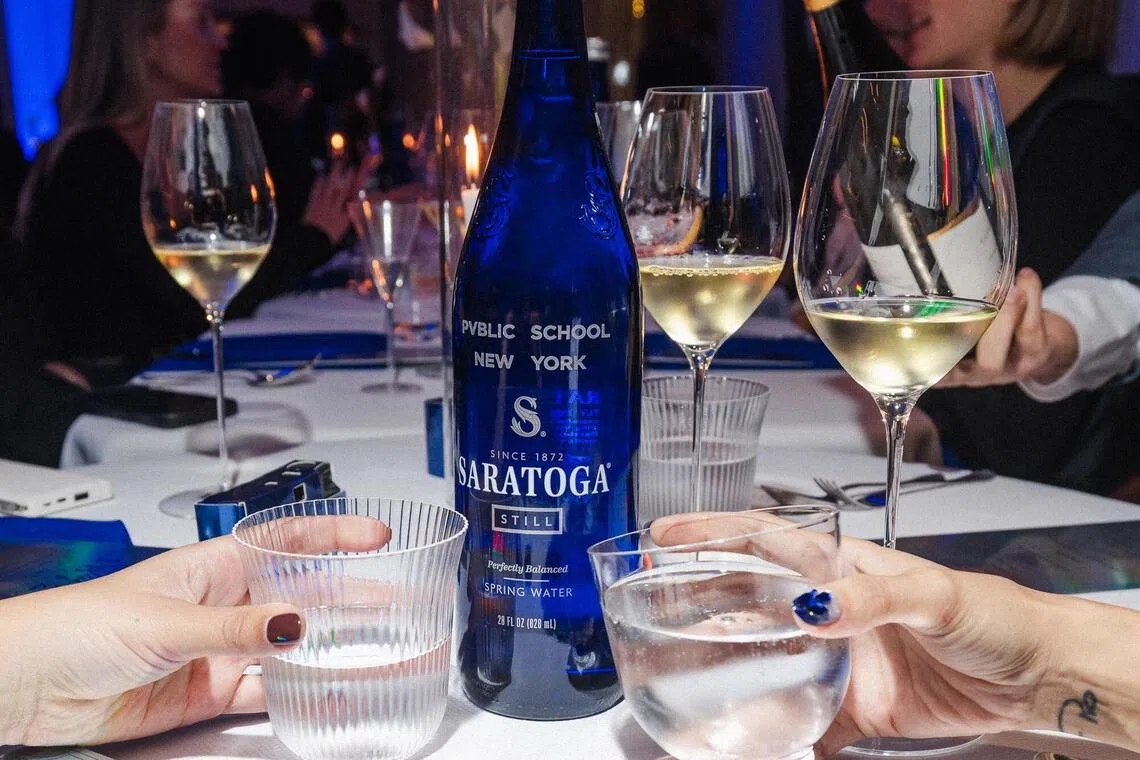
But then, fitness influencer Ashton Hall began posting videos of himself doing push-ups next to a bottle of Saratoga, which can cost US$2 to US$4.
As part of an early morning ritual, he filled a glass bowl with ice, lemons and Saratoga water, and stuck his face in it. Repeatedly.
The videos spread on social media, introducing Saratoga to a new, younger audience.
Sales soared for Saratoga’s owner, Primo Brands. The company tried but did not reach a partnership agreement with Hall. It formed marketing relationships with bicycle motocross athlete Nigel Sylvester and Women’s National Basketball Association star Skylar Diggins instead.
“When we started to partner with people who reached younger consumers, they readily came into the brand,” said Kheri Tillman, chief marketing officer at Primo Brands.
“We found a way to make a high-end water really approachable for those moments and for those consumers.”
Revenue from its premium brands, Saratoga and Mountain Valley Spring Water, was up nearly 32 per cent for the year through September compared with a year earlier. Shares of the company have surged nearly 50 per cent in 2026.
Zach Knipe, 47, said he became “addicted” to Saratoga sparkling water years ago when he worked at an upscale steakhouse.
While Knipe, now an account manager for an orthopaedic surgical company who lives in Hershey, Pennsylvania, buys a variety of sparkling water in cans and bottles these days, Saratoga remains a favourite.
“The sparkling water stays colder in the glass bottles,” Knipe said. “I have a bottle of it in my fridge right now.”
The category of “water” is evolving well beyond still and sparkling.
Brands are adding protein, fiber and even collagen to water to increase its functionality. Others are blurring the line between water and other beverages, including sodas.
It has been eight years since Liquid Death invigorated the water category through its tallboy aluminium cans featuring skull images, which were marketed through parody ads showing kids “shotgunning” the water.
The bulk of the company’s sales comes from its fast-growing soda-flavoured sparkling waters. There is Mt Death, designed to taste like Mountain Dew, and Doctor Death, which mimics Dr Pepper. Tallboy sizes contain no caffeine, and have 20 calories and 4 grams of sugar.
Killer Cola, however, has not been a big hit, admits Mike Cessario, the founder and CEO of Liquid Death. “People go crazy about Coke or Pepsi,” he said. “That flavour was polarising.”
Cessario is not worried about the new entrants in the premium space.
“What differentiates us, as more brands come along, is that we’re one of the only plain water brands that’s getting young people, ages 5 to 16, excited to drink water,” he said.
New brands are focusing on the premium space because they need the higher prices to cover their costs, Cessario said.
Mass-market water brands like Aquafina, which is owned by PepsiCo, or Dasani, which is owned by Coca-Cola, sell at lower prices, hoping to make money through volume.
But, new companies have to “create a cool brand to justify the premium or a water with minute functional differences between your water and someone else’s”, Cessario said.
Sauna Water, a line of botanical sparkling “wellness” waters, is targeting consumers who go to saunas, explained Jeff Vondenkamp, who separated the water business from his brewery in Walker, Minnesota, about a year ago.
While he suggested that his Nordic Spruce and Forest Fields water be priced around US$4 a can, some retailers have charged more than US$7, he said. He is also trying to expand into grocery chains, where Sauna Water is likely to be priced closer to US$3.50 a can, he said.
“We went in with a very specific target for this brand, very high-end,” Vondenkamp said. While he initially targeted saunas, he said, the company has been doing a brisk business selling cans to bars, where the botanical-flavoured waters are an alternative to alcohol like gin, but also to coffeehouses.
“I can go into almost any coffee shop in Minneapolis and they’ll say, ‘sure, we’ll try it’,” Vondenkamp said.
“The days of choice at a restaurant being a can of pop, apple juice and mineral water are behind us. Cafes are going to have 10, 12 or 14 different options of beverages.” NYTIMES
Decoding Asia newsletter: your guide to navigating Asia in a new global order. Sign up here to get Decoding Asia newsletter. Delivered to your inbox. Free.
Share with us your feedback on BT's products and services
TRENDING NOW
StarHub-M1 deal could add to Keppel’s special dividends but analysts flag potential wait

Could Jensen Huang work for Elon Musk? It would be ‘a titanic ego death match’, says biographer

Why Singapore, Johor and Riau Islands should build a cross-border ecosystem for AI

Alice Huang-linked firms listed US$270 million in AI servers in China, records show

