

The many sides to Dan Brown
His latest work, Wild Symphony, is an unexpected item of contention in a legal battle with his ex-wife
 Add BT as a preferred source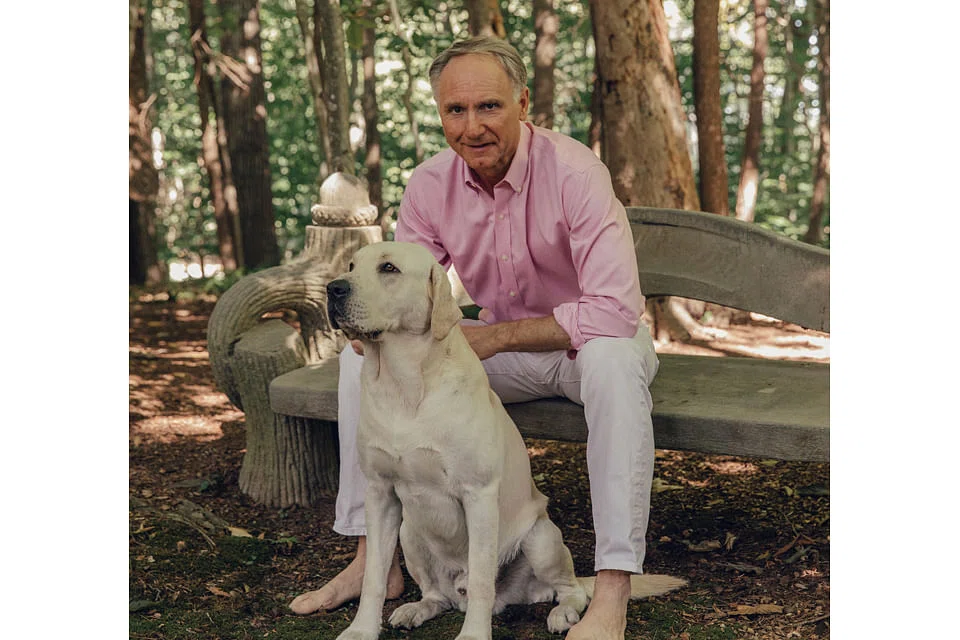
DeeperDive is a beta AI feature. Refer to full articles for the facts.
New York
EVER since his breakout with The Da Vinci Code, novelist Dan Brown has been renowned for his twisty, adrenaline-fuelled yet cerebral plots involving cryptography, symbology, smart and sexy lady sidekicks, secret and violent religious cults, and unhinged zealots bent on mass murder and destruction.
His new book, on the other hand, features a mouse conductor who recruits a menagerie of animals to perform in an orchestra while delivering proverbs about the virtues of fortitude, patience and cooperation. (Its target audience is children ages 3-7.) It will be released this week alongside a classical music album for children, called Wild Symphony, that was composed by Brown and based on songs he self-produced some 30 years ago, back when he was an aspiring musician in his 20s - long before he had published any novels.
At that time, Brown, who is now 56, recorded the songs using synthesisers in his tiny studio. He made about 500 cassettes (and booklets of poetry) and sold them on consignment at his local bookstore. The newly released album features updated versions of the original songs along with new ones, all performed and recorded by the Zagreb Festival Orchestra in Croatia.
It's an unexpected professional detour after Brown's seven thrillers, which collectively have more than 234 million copies in print and have made him a multimillionaire.
Wild Symphony is also, somewhat awkwardly, an unexpected item of contention in a messy legal battle between Brown and his ex-wife, Blythe Brown, after their divorce last year.
Navigate Asia in
a new global order
Get the insights delivered to your inbox.
In a complaint filed this summer, Blythe Brown claimed that her former husband misrepresented their assets during the divorce proceedings and lists Wild Symphony as one of several projects that she claims he failed to disclose when they separated. She also alleged that he led "a secret life" for years, hiding an affair with a Dutch horse trainer and concealing lavish purchases he made for his mistress, including two Friesian horses, one of them named Da Vinci. (The other horse was a "highly coveted, prizewinning Friesian" black stallion named "Limited Edition" that cost US$345,000, according to her complaint.)
Dan Brown filed a countersuit for libel and slander, among other claims, on July 30, arguing that his former wife set out to "publicly shame him" and "destroy his legacy".
"Any implication or claim that I lied or hid money is absolutely false," Brown said during a recent interview. "I'm actually utterly shocked that she chose to do this."
Dan Brown spoke to me over video on a recent August afternoon from the cavernous, baroque library of his home in Rye Beach, New Hampshire, a short drive from where he grew up on the campus of the boarding school Phillips Exeter, where his father taught mathematics. His cat, Zeus, snoozed on the floor.
Dressed in a pale pink button down, he showed me a secret chamber behind a revolving bookcase that revealed a shelf with the first book he ever wrote, at age five, titled The Giraffe, the Pig, and the Pants On Fire, as well as the Steinway B piano where he pursues his hobby and first professional aspiration: Formulating musical compositions.
To gain access to his recording studio, where he has a synthesiser hooked up to a computer, he presses the corner of a painting - a canvas depicting a Victorian woman sitting in a garden - and a hidden door swings open.
The walls of the studio are decorated with gold records he received for blowout sales of his German-language audiobooks - not quite what he had in mind when he set out to become a musician, but "I'll take it," he said.
Dan Brown's musical process goes like this: He composes on his piano, trying out melodies and building them into a piece that he memorises. He plays the song on a piano keyboard that's hooked up to a computer, creates a digital file, then uses a sequencing programme that allows him to add instrumentation, assigning the musical lines to different instruments.
Then, usually, the music stays in its digital vault. But two years ago, when Dan Brown was in Shanghai to promote his 2017 novel, Origin, he was asked on television about an old, long-forgotten project.
The host of the TV show brandished a copy of the album. It was the children's album Dan Brown had recorded decades ago, originally called Synthanimals. "I kept saying, well you know, I'm here to talk about Origin," Dan Brown recalled. "They kept coming back to the music."
The new project came together pretty quickly after that. Dan Brown was surprised that his children's album had resurfaced this way, on a Chinese TV show, and that it caused such a stir. His Chinese publisher asked about releasing it. His American publisher wanted in on the project, too.
So Dan Brown enlisted the help of producer Bob Lord, the chief executive of Parma Recordings, and an acquaintance of Dan Brown's for nearly 15 years. He travelled to Croatia to work with the Zagreb orchestra on the recording and helped fine tune the performance, making minor adjustments to the musical sequences and pacing.
"He really knows what he's doing," said Lord, who revealed that Dan Brown also sings. "It's not just a hobby. It's central to his artistic vision."
As surprising as his latest venture may be to his fans, Dan Brown said there are common threads in his music and writing. Composing and writing fiction are closely intertwined for him.
"To write a song or a piece of classical music, you have to understand structure, you have to understand tension and release. Good musical lines ask a question and give an answer," he said. "You can't have five chase scenes in a row, the same way you can't have five fortissimos in a row. You need that interstitial material to let the listener or the reader breathe."
Dan Brown was always musically inclined. His mother was a piano teacher and church organist, and Dan Brown played piano from an early age. Growing up, he loved Bach, Tchaikovsky and Béla Bartók, and started composing his own songs when he was five. He studied music composition and English at Amherst College, and after graduating, he debated whether to become a novelist or musician. Making music seemed like "much more fun," he said.
In 1990, he met Blythe Brown, who at the time was the director of artist development at the National Academy of Songwriters, and she helped him make connections in the industry. For his day job, he taught at Beverly Hills Preparatory School.
When his career as a singer-songwriter fizzled, he and Blythe Brown moved to New Hampshire, where he found a job as an English teacher at Phillips Exeter, and she worked as a dental assistant. Eventually, he turned to his backup plan, writing novels, and kept making music on the side.
In 1998, Dan Brown published his first book, Digital Fortress, starring an attractive, brilliant National Security Agency cryptographer named Susan. He followed with Angels & Demons, featuring his now-famous Harvard symbologist Robert Langdon, then Deception Point, about another attractive, brilliant government bureaucrat, a White House intelligence analyst named Rachel, who uncovers a conspiracy when she investigates a NASA discovery. All three books initially sold poorly.
Then came The Da Vinci Code, an explosive thriller published in 2003 that hinged on the premise that Jesus and Mary Magdalene were married and had a child together. It was made into a movie starring Tom Hanks as a code-cracking Robert Langdon, which grossed more than US$760 million globally. To date, the book has 85 million copies in print.
It was Blythe Brown who persuaded him to explore the idea of the sacred feminine, the Holy Grail and Mary Magdalene. "She pushed this notion that hey, you should write a thriller about Mary Magdalene," Dan Brown said. "My first response was, that's insane, who could possibly do that?"
He has long credited her for supporting his career and helping to research and shape his books. But massive success, fame and wealth eventually had a corrosive effect on their marriage, Dan Brown said in his countersuit. They drifted apart. Blythe Brown began devoting herself to dressage horse riding. They divorced in December 2019, and Blythe Brown received half their assets, Dan Brown said.
Their marital troubles spilled into public this summer, when Blythe Brown filed a lawsuit alleging, among other things, that her former husband had been unfaithful and had spent hundreds of thousands of dollars on champion horses and equipment for his younger Dutch mistress, a horse trainer he met through Blythe Brown.
In a statement, Blythe Brown disputed that her lawsuit was an effort to get more money, or revenge. "This is not about money, it's about Dan's lying and betrayal," she said.
Dan Brown said: "I had enormous respect for her, and she was somebody I loved deeply once."
He said he plans to donate the US royalties he receives for Wild Symphony to support music education for children.
"We were a wonderful pair for a long time," Dan Brown said. "People evolve differently. We started living separate lives and had been for quite some time. It was time for it to be over for both of us. She agreed, so this has come as a total shock."
Early on in the pandemic, after he'd been travelling to a film set in Toronto, among other places, Dan Brown came down with a 103-degree fever and shortness of breath.
He thought he had the flu but tested positive for coronavirus. He recovered relatively quickly - in three days - and has kept busy since, writing a script for a show about God and science at the Hayden Planetarium and working on his next novel, another Robert Langdon thriller.
He's also been travelling a bit to research it, although he wouldn't say where ("I'm not going to tell you what government gave me permission to come in and do research," he said).
He was coy about whether there would be more music for public consumption. He hasn't been tempted, yet, to release any more of his older recorded work. For now, he's bracing himself for how the music world will respond to his latest release.
"I'm no stranger to people hating what I do and liking what I do," he said, cheerfully. "That doesn't faze me." NYTIMES
Decoding Asia newsletter: your guide to navigating Asia in a new global order. Sign up here to get Decoding Asia newsletter. Delivered to your inbox. Free.
Share with us your feedback on BT's products and services
TRENDING NOW

Air India asks Tata, Singapore Airlines for funds after US$2.4 billion loss

Beijing’s calculated silence on the Iran war

China pips the US if Asean is forced to choose, but analysts warn against reading it like a sports result

Richard Eu on how core values, customers keep Singapore’s TCM chain Eu Yan Sang relevant

