Meet Japan’s cyborg cockroach, coming to disaster area near you
 Add BT as a preferred source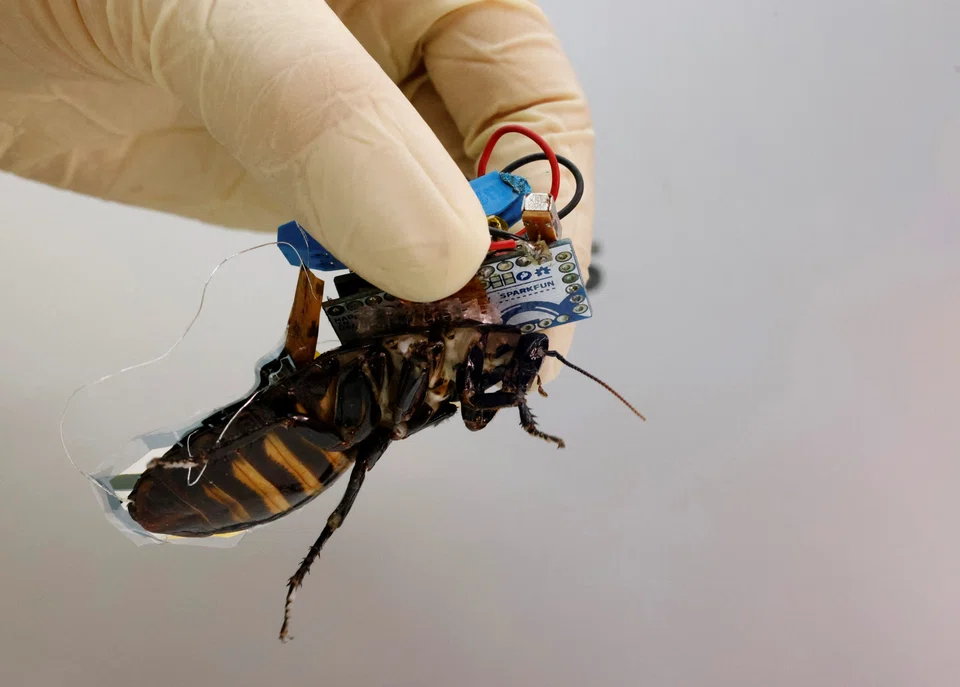
IF an earthquake strikes in the not too distant future and survivors are trapped under tonnes of rubble, the first responders to locate them could be swarms of cyborg cockroaches.
That’s a potential application of a recent breakthrough by Japanese researchers who demonstrated the ability to mount “backpacks” of solar cells and electronics on the bugs and control their motion by remote control.
Kenjiro Fukuda and his team at the Thin-Film Device Laboratory at Japanese research giant Riken developed a flexible solar cell film that’s 4 microns thick, about 1/25 the width of a human hair, and can fit on the insect’s abdomen.
The film allows the roach to move freely while the solar cell generates enough power to process and send directional signals into sensory organs on the bug’s hindquarters.
The work builds upon previous insect-control experiments at Nanyang Technological University in Singapore and could one day result in cyborg insects that can enter hazardous areas much more efficiently than robots.
“The batteries inside small robots run out quickly, so the time for exploration becomes shorter,” Fukuda said. “A key benefit (of a cyborg insect) is that when it comes to an insect’s movements, the insect is causing itself to move, so the electricity required is nowhere near as much.”
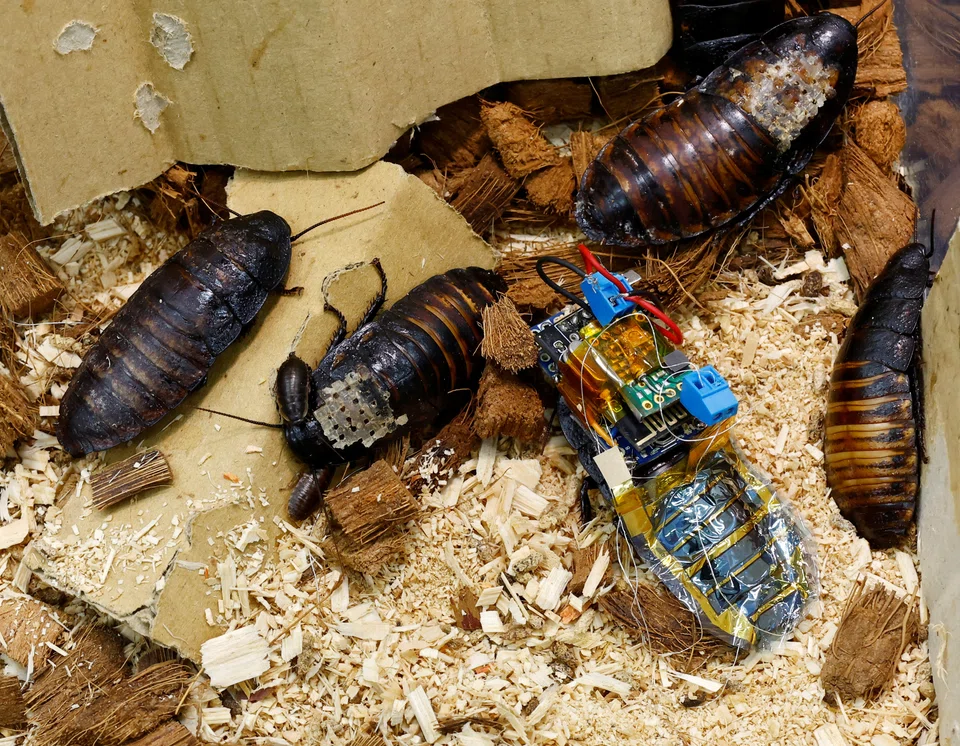
Fukuda and his team chose Madagascar hissing cockroaches for the experiments because they are big enough to carry the equipment and have no wings that would get in the way. Even when the backpack and film are glued to their backs, the bugs can traverse small obstacles or right themselves when flipped over.
The research still has a long way to go. In a recent demonstration, Riken researcher Yujiro Kakei used a specialised computer and wireless Bluetooth signal to tell the cyborg roach to turn left, causing it to scramble in that general direction. But when given the “right” signal, the bug turned in circles.
The next challenge is miniaturising the components so that the insects can move more easily and to allow for mounting of sensors and even cameras. Kakei said he constructed the cyborg backpack with 5,000 yen (S$2813) worth of parts purchased at Tokyo’s famed Akihabara electronics district.
The backpack and film can be removed, allowing the roaches to go back to life in the lab’s terrarium. The insects mature in 4 months and have been known to live up to 5 years in captivity.
Beyond disaster rescue bugs, Fukuda sees broad applications for the solar cell film, composed of microscopic layers of plastic, silver, and gold. The film could be built into clothing or skin patches for use in monitoring vital signs.
On a sunny day, a parasol covered with the material could generate enough electricity to charge a mobile phone, he said. REUTERS
Decoding Asia newsletter: your guide to navigating Asia in a new global order. Sign up here to get Decoding Asia newsletter. Delivered to your inbox. Free.
Share with us your feedback on BT's products and services