

MTV awards to feature cutting-edge videos
This year's Video Music Awards ceremony may celebrate music videos as it originally intended to
New York
AS music awards shows go, MTV's annual Video Music Awards ceremony - the VMAs - is by far the loosest, the most vibrant and the most prone to disruption. It has long been the platform where pop stars know a medium amount of misbehaviour will be tolerated - encouraged, actually. The show isn't about trophies, but moments. That MTV itself isn't much in the music business anymore only makes the playing field clearer for provocation: Acting out here is like trashing a hotel room, not your house.
Accordingly, in recent years, the most memorable parts of the awards have been . . . not quite musical. There was the Kanye West-Taylor Swift kerfuffle, still reverberating after all this time. And then there was Miley Cyrus's coming-out party as a pop fire-starter, followed a couple of years later by her squaring off with Nicki Minaj.
All of which is fine fun, truly. Just because the show was originally intended to celebrate music video doesn't mean that's what it needs to excel at.
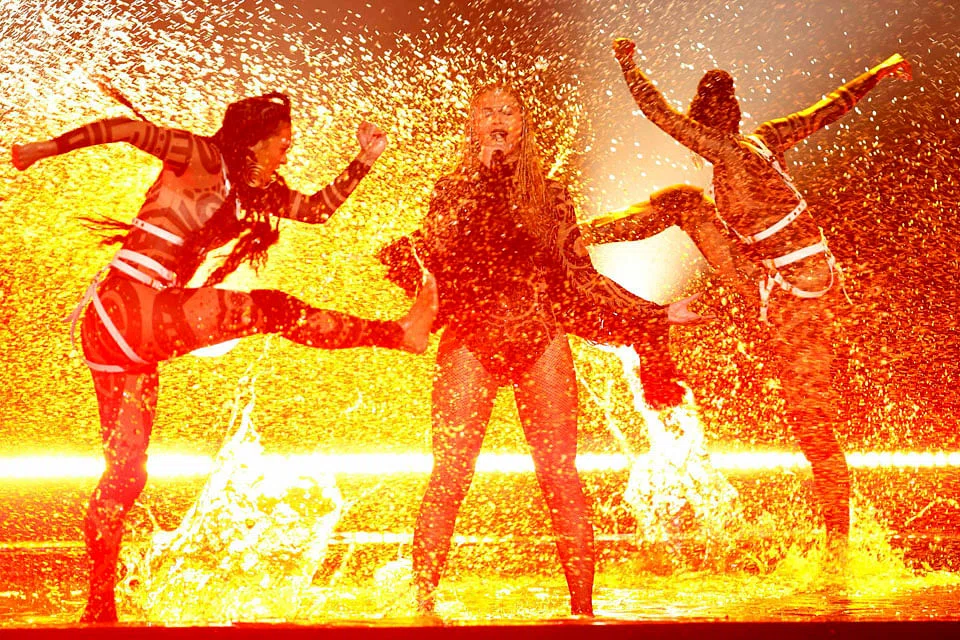
And yet, for the first time in several years, there's something exciting about the current collection of nominees, particularly in the video of the year category. Of the five nominated for the show's Moonman awards on Sunday night, when the event will be broadcast live from Madison Square Garden for the first time, four are state-of-the-art in content, concept or delivery: Beyoncé's Formation, Drake's Hotline Bling, Justin Bieber's Sorry and Kanye West's Famous. (The fifth, Adele's Hello, is elegant and stars Adele, but that's about it.) For the first time in recent memory, the awards have the opportunity to be more than an outlandish pop star playground and to serve as a reminder of how essential music video can be as a stand-alone art form.
This is the ideal year for such a reframing: Video has been an essential part of several important artists' releases, not just as a secondary element, but also as part of the primary project. Beyoncé's Lemonade album, which added political and psychological depth to her songs of mistrust and hurt, came into the world first as a short film that had its premiere on HBO. The Formation video preceded Lemonade, setting the table for its messages of black empowerment with rich Southern gothic imagery and provocative messages about police violence against black bodies, which made Beyoncé a culture-war flashpoint in a way she had never been.
For West, the Famous video wasn't a disruption of his public narrative, but a bold extension of it. The controversial work, in which he and his wife, Kim Kardashian West, lie naked in a large bed, surrounded by nude lookalikes of their friends and foes (Swift, Ray J, Donald Trump, Caitlyn Jenner and more) was a reinterpretation of a painting by the artist Vincent Desiderio. It is also a mood piece about innocence, a provocative and unlikely rejoinder to the song's tabloid DNA. But it, too, ruffled the feathers of those who thought West's use of his peers' images was a violation too far.
Beyoncé's and West's uses of music video are aesthetic and conceptual, and their projects served as vehicles for extending their public images. What Drake and Bieber have done is perhaps the opposite: letting go of the wheel and using the music video as a focal point for mass reinterpretation. Drake's Hotline Bling, with its soft pastels and spacious backdrops, is a virtual meme generator. It understands the video art form as a starting point, not a conclusion, and has served as raw material for endless gifs, memes and cover versions. Bieber's Sorry acknowledges crowdsourcing in a different way: It is a dance video, featuring a host of young female performers, and recalls how, on Vine or Instagram or Snapchat, young people everywhere make themselves the stars of their own dance videos. Bieber isn't even present.
Each of these videos, in its own way, shows an artist deploying the form as a novel means of garnering attention in an increasingly scattered marketplace, using either provocation or participation. That all these approaches are arriving at once suggests a new era of maturity for music video, one in which the biggest stars are also among the biggest innovators.
That's reminiscent of the 1980s and 90s, the golden era of MTV, when having an awards show to celebrate the artistry of music videos made the most sense. But as MTV began to retreat from playing videos in the early 2000s, major-label budgets set aside for music videos shrank. This coincided with the end of the peak CD era - the Internet was beginning to chip away at all that. By the mid-to-late 2000s, the Internet - and YouTube specifically - became the natural home for music videos, though it still existed largely in the shadow of the outlet that was once that sanctuary, MTV. It felt comparably small, and therefore music video felt diminished.
YouTube is widely perceived as the most popular online outlet for music - it has a reach exponentially greater than cable TV could ever have. The music video, less and less an afterthought, is often embedded in the album release process. Some artists go so far as to make videos for every song they record, and release the videos first, or, in the case of artists such as Beyoncé and Frank Ocean, use video as an integral part of the rollout of their music in the form of a "visual album".
This full-circle re-embracing of video is now the new normal, and might make for VMA ceremonies - this year's and beyond - in which the videos are once again the stars, not the sideshow. NYT
Share with us your feedback on BT's products and services
TRENDING NOW

He built the Vingroup empire. Now South-east Asia’s richest man is handing some key roles to his sons

32 companies, 6 individuals bag accolades at Singapore Corporate Awards 2026

Can a first-time homebuyer couple earning S$18,000 a month afford a new EC unit?

Floods compound Philippine growth woes from public-works scandal

