Musician Zakir Hussain preaches what he practises
World renowned percussionist talks about Singapore, collaborations and the importance of love
 Add BT as a preferred source
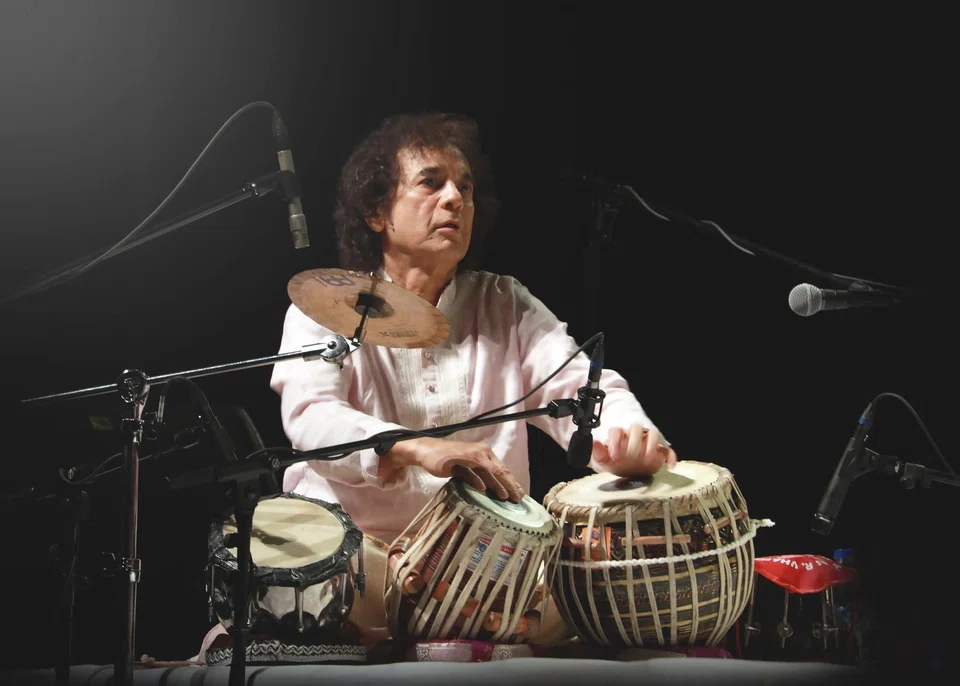
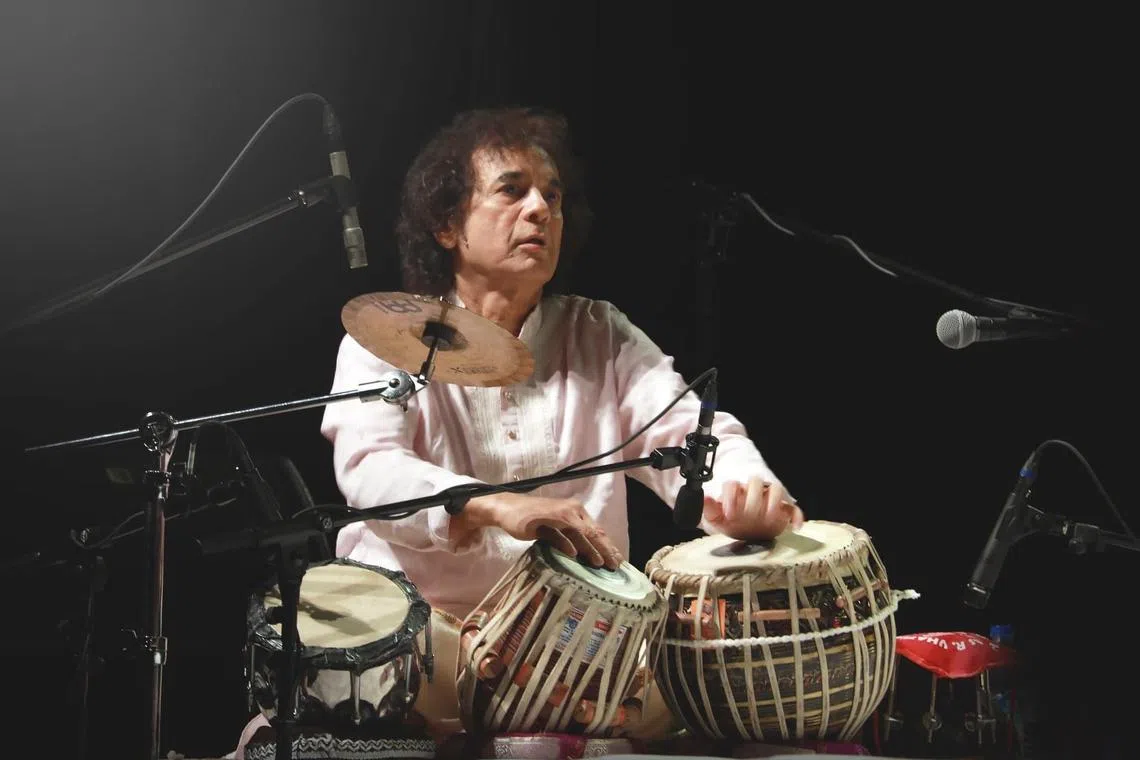
LEGENDARY tabla virtuoso Zakir Hussain first played in Singapore in 1973. He was on his way to Perth for an international music festival, and stopped by Singapore to play at a small hall. Since then, he’s returned to the island city several times, and the 19-year-old Esplanade has become one of his favourite places in the world to perform “because of its amazing theatre design and acoustics”.
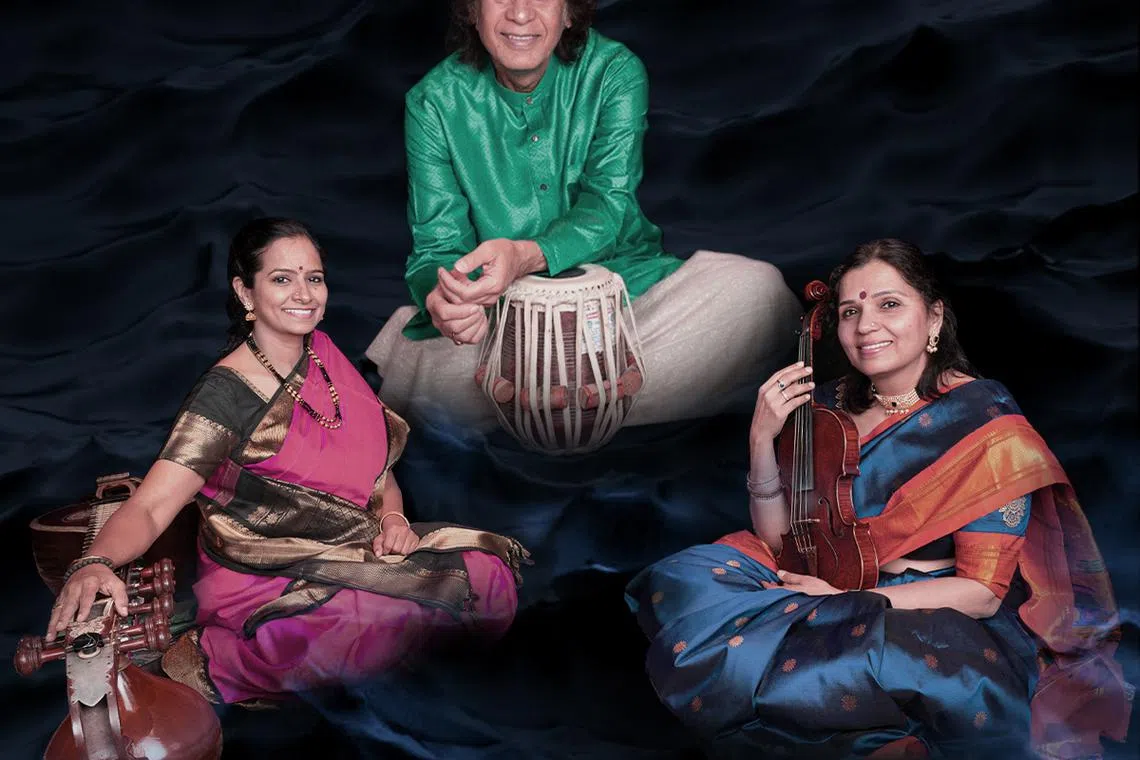
Come Aug 14, Zakir will be playing at the Esplanade again to mark India’s 75th year of independence from the United Kingdom, as well as to celebrate Singapore-India bilateral ties. He will be joined by 2 other classical maestros, Jayanthi Kumaresh, a veena (South Indian lute) player of astonishing gifts, and Kala Ramnath, a highly skilled violinist and composer of classical North Indian Hindustani melodies.
The 3 represent different traditions of Indian music dating back centuries. But when they come together, the meeting of minds is instantaneous. “Jayanthi with the ancient veena, Kala with her violin, essentially a Western instrument, and I with the tabla, honouring the percussion traditions of India, are somehow able to co-exist, to look and sound like a family, to make a unified statement.”
Collaborative process
The collaborative process is complex and involves skill, instinct and improvisation. Zakir, 71, explains: “I start a particular rhythm that I want to introduce into our journey, so I become the vehicle in a way, and I set the tempo as to how fast the vehicle will go. Then Kala and Jayanthi join in as and when they see an opening to get into the vehicle and insert their own ideas into this system. There is no imposition on anybody by anybody to enforce certain ideas. But what transpires is that it becomes more like a journey, where we would pick one particular mode or melodic scale, which would become our main vehicle. And sometimes we may take a side road and stay somewhere for a while. But we always come back to the main theme or storyline.”
Of course, Zakir is a master collaborator. He has worked with The Beatles, Van Morrison and The Grateful Dead, among many others. He has scored music for Francis Ford Coppola (Apocalypse Now), Ismail Merchant (The Mystic Masseur) and Bernardo Bertolucci (Little Buddha). His discography cannot be contained on a page.
“For the past 40 to 45 years, I’ve worked and interacted with musicians of many genres, be it jazz, Latin jazz, hip hop, rock, pop, western classical or bluegrass. I’ve developed a different kind of an approach to the way I present the North Indian percussion repertoire and its tradition in these contexts. Automatically or by default, I’ve become the bridge between contrasting styles of music – as in this case with Jayanthi and Kala.”
Organised by the Singapore Indian Fine Arts Society, the concert is fittingly titled Triveni, after Triveni Sangam, the meeting point of 3 important rivers of India: the Ganges, the Yamuna and the Saraswati.
Family is everything


Because of the extraordinary life music has given him, Zakir has always encouraged his 2 daughters to pursue the arts. His older daughter Anisa is a filmmaker, while his younger daughter Isabella teaches ballet. He recalls: “My father always instilled in us this idea that, no matter what, do something creative with your life and don’t get stuck in a 9-to-5 job. I’ve said the same thing to my daughters: Do something creative even if I have to support you off and on. Just don’t wither away behind a desk. Get out there, see the world and find a way to express yourself.”
Asked which love is deeper: the love of family or the love of music, Zakir says they are one and the same: “When I was a struggling musician in the early years, I would go on tour for 6 to 8 weeks, sometimes 3 months, and I didn’t have the money to fly back home to see my wife and young kids during the breaks in-between. And my wife (kathak dancer Antonia Minnecola) always said to me, go ahead, do what you love, we’re behind you. She would work as in intern in the meantime to help make ends meet.
“If my family was not behind me, giving their support and love, if they didn’t believe in my ability, I couldn’t find my way forward and be a success. I draw a lot on the love that my family generates, and with that I am able to create the kind of music that I do. My love of family and music are tied together, and I cannot imagine one without the other.”
Triveni runs at the Esplanade on Aug 14 at 7.30 pm. Tickets from Sistic.
Decoding Asia newsletter: your guide to navigating Asia in a new global order. Sign up here to get Decoding Asia newsletter. Delivered to your inbox. Free.
Copyright SPH Media. All rights reserved.