
Naomi Osaka is steadfast in winning, and her message
The Japanese tennis star has focused not only on her game, but also on highlighting racism to a worldwide audience
 Add BT as a preferred source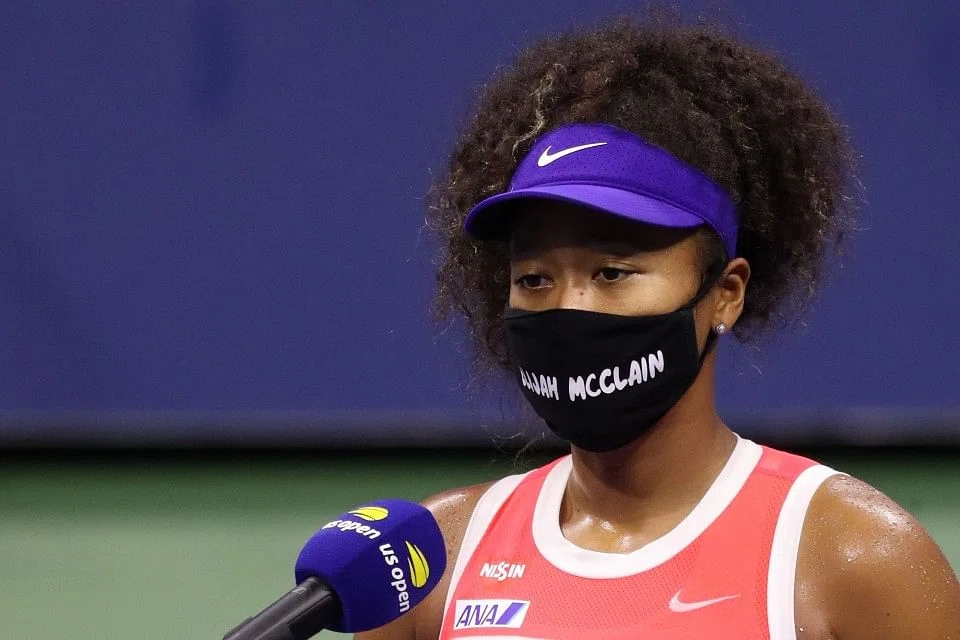
New York
DURING the first week of the US Open in New York, Japanese star Naomi Osaka is staying on message. The 2018 champion re-asserted herself as the favourite in the top half of the women's singles draw with a dominant 6-1, 6-2 victory over Camila Giorgi of Italy in 70 minutes on Wednesday night, and faced 18-year-old Ukrainian Marta Kostyuk on Friday (early Saturday morning, Singapore time) in New York.
The fourth-seeded Osaka advanced in the tournament that has already seen many of the other top seeds in her half of the draw stumble, with No 1 Karolina Pliskova, No 12 Marketa Vondrousova and No 13 Alison Riske all losing.
After Pliskova's exit, Osaka is the only player in the top 10 of the WTA singles rankings remaining in the top half of the draw; six top-10 players, including world No 1 Ashleigh Barty and No 2 Simona Halep, did not enter this year's tournament.
Osaka's left leg was heavily taped during her match, but she appeared unburdened despite admitting that the hamstring injury that forced her out of Saturday's Western & Southern Open final was not healing as rapidly as she hoped.
"I feel like I want to be the player that you can't tell I'm in pain," Osaka said in a post-match interview on ESPN.
Navigate Asia in
a new global order
Get the insights delivered to your inbox.
Her steadiness through physical pain is complemented by her steadfastness highlighting police violence against black people. She has found her voice in that campaign in recent months, which led her to provoke a one-day stoppage in the Western & Southern Open last week, simultaneously drawing praise from many around the sport and stunning several other players remaining in the tournament.
"I don't feel like I'm being brave; I just feel like I'm doing what I should be doing," Osaka said last week. "So honestly, when people say 'courageous' or anything, I don't really resonate that well with it. This is what I'm supposed to be doing in this moment."
Osaka said she didn't think her prominence came with pressure. "A lot of people ask me if I feel more stressed out ever since I started speaking out more; to be honest, not really," she said. "At this point, like, if you don't like me, it is what it is. You know what I mean? I'm kind of here for pride. I don't have to be here. So for me, I'm just here to, hopefully, beat people."
Osaka has been using the mask she wears before and after matches at the US Open to spotlight victims of police violence.
On Monday, it was Breonna Taylor, a 26-year-old medical worker killed in March in Kentucky; on Wednesday evening, it was Elijah McClain, a 23-year-old who died last year days after police in Colorado, used a banned chokehold.
Racism is a global issue
In comments to the Japanese news media during her news conference on Wednesday, she explained that she wanted to take what some see as an American issue to a worldwide audience.
"The biggest thing I can gain off of international viewers watching is for them to, like, Google the name, research the story, find out exactly what's going on," she said. "Racism isn't just an American thing. It's all over the world. It affects people literally every day."
One of the international players who has been affected by Osaka's messaging is her Greek friend Stefanos Tsitsipas, the fourth-seeded men's player who won his match over American wild card Maxime Cressy.
Tsitsipas wore a Black Lives Matter T-shirt as he watched matches from his suite inside Arthur Ashe Stadium, next door to Osaka's. "I'm super proud of him," Osaka said. "I'm very glad that his first response when everything started happening was to ask me questions. For me, I feel like I like to get knowledge; for him to do the same thing, to start branching out and asking questions on topics he's not so sure of, is very mature and intelligent."
Although tennis players have typically been encouraged by coaches and athletes to remain mum on social and political issues, Osaka's increasingly vocal stances have been supported by both her agent, Stuart Duguid, and her coach, Wim Fissette.
Fissette said that despite her high profile social and commercial endeavours, Osaka's attention has been "100 per cent focused on the tennis" during their training blocks together this year.
He marvelled at her ability to change her relaxed, quiet personality to a single-minded intensity during training sessions.
"When she comes to the court, she's very perfectionist," Fissette said. "She's a super champion. It's very, very different."
He also sees Osaka 's self-belief in how she handles situations during matches. "She has no doubts that she will serve out the set," he said. "She's very confident in her strength, and she's very confident in herself."
Osaka's management has carefully made sure her media and sponsor activities happen in blocks away from her tennis training. This summer, Forbes magazine named her the world's highest-paid female athlete for the first time, surpassing her role model Serena Williams.
Osaka said that she has felt her peers change their perception of her this summer. "I mean, I'm weird, right?" Osaka said. "It's kind of a fact. So people were always looking at me differently. Now, people are just kind of looking. It's a different vibe."
They won't stop looking any time soon. Knowing that, Osaka hopes to continue her journey at the US Open with another name written across her mask, and yet another story to share. NYTIMES
Decoding Asia newsletter: your guide to navigating Asia in a new global order. Sign up here to get Decoding Asia newsletter. Delivered to your inbox. Free.
Share with us your feedback on BT's products and services

