
Nasa says Dart mission succeeded in altering asteroid’s trajectory
 Add BT as a preferred source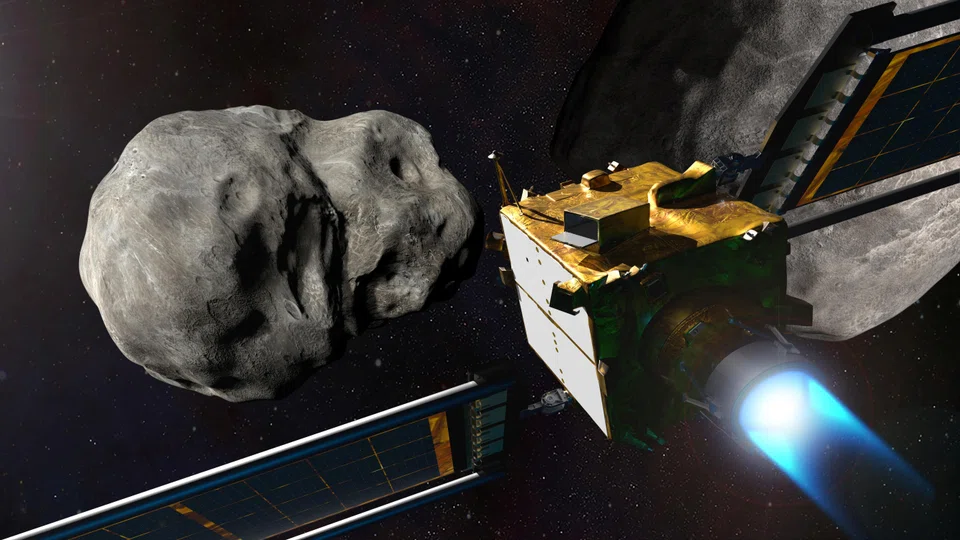
THE spacecraft that Nasa deliberately crashed into an asteroid last month succeeded in nudging the rocky moonlet out of its natural orbit - the first time humanity has altered the motion of a celestial body, Nasa’s chief announced on Tuesday (Oct 11).
“This is a watershed moment for planetary defence and a watershed moment for humanity,” Nasa chief Bill Nelson told reporters in announcing the results.
Findings of telescope observations unveiled at a Nasa news briefing showed that the suicide test flight of the Dart spacecraft on Sep 26 achieved its primary objective: changing the direction of an asteroid through sheer kinetic force.
The US$330 million proof-of-concept Dart mission, which was seven years in development, also marked the world’s first test of a planetary defence system designed to prevent a potential doomsday meteorite collision with Earth.
The celestial target of the Dart flight was an egg-shaped asteroid named Dimorphos, roughly the size of a football stadium, orbiting a parent asteroid about five times bigger called Didymos once every 11 hours, 55 minutes.
The aim was to fly the Dart impactor vehicle - no bigger than a vending machine - directly into Dimorphos at about 22,531 kph, creating enough force to shift the moonlet’s orbital track closer to its larger companion.
Navigate Asia in
a new global order
Get the insights delivered to your inbox.
A comparison of pre-and post-impact astronomical measurements of the Dimorphos orbit around Didymos showed a 32-minute shortening of its trajectory, proving the exercise as a viable technique to deflect an asteroid from a collision course with Earth if such an asteroid were ever discovered.
APL scientists had predicted that the Dart impact would shorten the orbital path of Dimorphos by at least 10 minutes but said they would have considered a change as little as 73 seconds a success.
Neither of the two asteroids involved in the test nor Dart, short for Double Asteroid Redirection Test, posed any threat to Earth, Nasa scientists said. REUTERS
Decoding Asia newsletter: your guide to navigating Asia in a new global order. Sign up here to get Decoding Asia newsletter. Delivered to your inbox. Free.
Share with us your feedback on BT's products and services

