A native American spin on Shakespeare
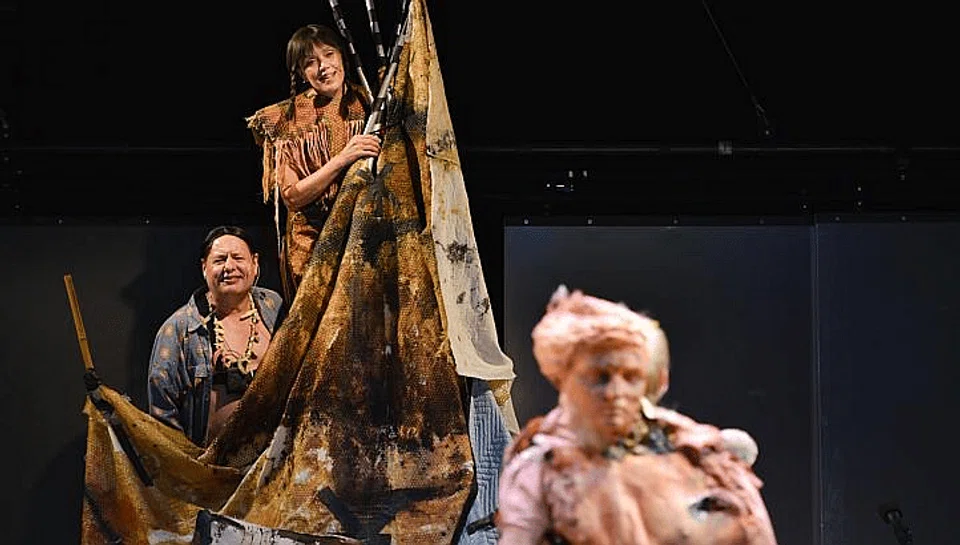
CRITICISM of The Wooster Group's Shakespeare adaptation, Cry, Trojans! (Troilus & Cressida), has run the gamut from being confusing at best, to racially offensive, at worst. But as an experimental adaptation of one of Shakespeare's more convoluted (and boring, may I say) plays, Troilus and Cressida, the hodgepodge reconstruction of native American culture on stage certainly helped distract from the play itself.
Founder and play director Elizabeth LeCompte, long known for generating experimental works, adopted the native American culture to depict Trojans in the play that's essentially about the Trojans and the Greeks.
In the original production for the 2012 Summer Olympics in London, The Wooster Group was invite to play the part of the Trojans, to the Royal Shakespeare Company's Greeks in the full run of Troilus and Cressida. But for this solo company adaptation, the group decided to tell the tale mainly from the Trojan side.
LeCompte's presentation won't see her invited for the next peace pipe session with native American groups in the US. But in this part of the world, where our understanding of native Americans is derived from TV and cinema rather than reality, this approach made for intriguing theatre.
How so? Because of LeCompte's method of getting the actors to mimic the mannerisms and behaviour, and cadence of speech, of native Americans as depicted in two films - the 1998 Native American film Smoke Signals, and The Fast Runner, a 2001 film featuring an entirely Inuit cast. And then for the (overly dramatic) love scenes, Hollywood met Shakespeare in the classic Natalie Wood/Warren Beatty romance Splendor in the Grass.
Several TV monitors in the background, hung above the stage, played the corresponding clips - so that the actors looked like they were aping the onscreen action, but mouthing entirely different dialogues. The clips were edited so that they fit into the action of the play itself. For most part, the onscreen and the stage action matched and moved in tandem, and the camerawork - for the Inuit film especially - featured quite interesting camera angles, such as the constant shooting from ground upwards.
From the screens, the audience could see the exact inspiration for how the men behaved when they mourned, fought and celebrated (yes, in the typical leg-lifting jig in a circle).
Drawing direct inspiration from film isn't a new method for LeCompte, her other only previous attempt at Shakespeare also featured a recreation of Richard Burton's 1964 Hamlet, where actors actually lip-synced to a large video projection.
LeCompte had also previously explained how Cry, Trojans! was "set in an imagined theatrical world drawn from literary, filmic and personal materials" referencing native American culture.
Two characters in particular shone in the play - Pandarus, acted inimitably by Greg Mehrten and Cressida, passionately, by Kate Valk. Troilus (Scott Shepherd) and the other men became a swathe of white hairless chests and messy long hair, and human-skin inspired coats and feathers. Best prop had to go to the cauldron-over-the-fire triangle, which was dragged around a lot, but helped to set the context of a domestic scene inside a teepee (which, incidentally had a nice virtual smoke going on in the TV screen mounted behind, at the top).
It didn't help that the Americanised speech, and Shakespeare's language itself, was hard to understand - and more so when delivered in that supposedly mid-Plains accent.
Ultimately, it was the faithful adherence to native American cinema that was the key to this experiment. There was a chilling scene, for example, when the Korean-Japanese actor, Koosil-ja, was in mourning, and looked uncannily like the Inuit lady shown in the TV clip.
The extreme cross-cultural mish mash on stage, not to mention the karang guni-like cobbling together of outfits and the set, worked to relieve the heavy plot even if it didn't do much to endear the bard's Troilus and Cressida to a contemporary audience.
Share with us your feedback on BT's products and services