Neolithic village discovered in France after 150 years of research
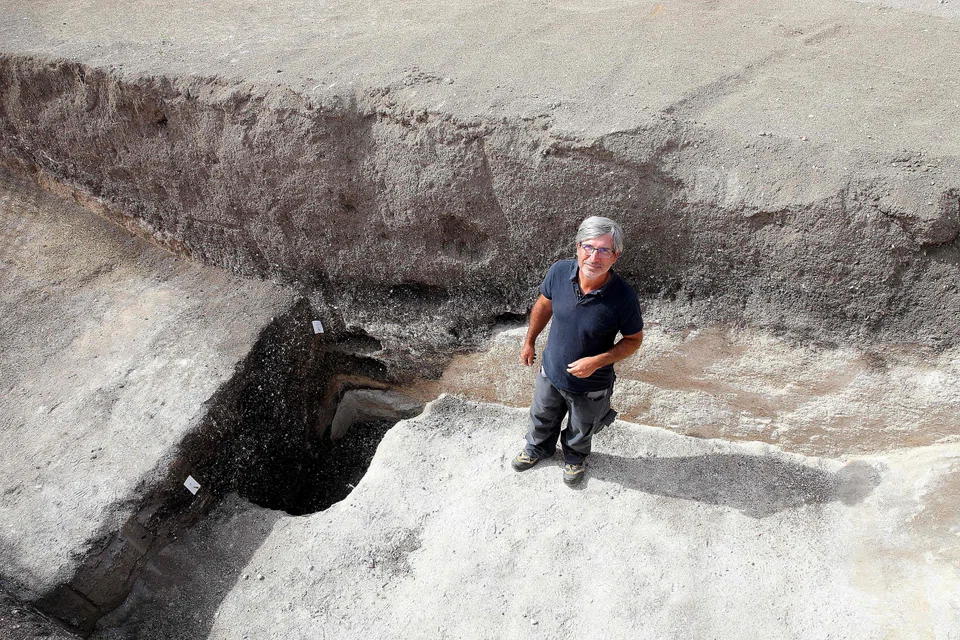
ARCHAEOLOGISTS working a vast Neolithic site in north-east France have uncovered what they say is the last piece of the puzzle – traces of a permanent settlement.
The settlement was unearthed at the vast Neolithic site of Marais de Saint-Gond, giving rare insights into its social organisation 150 years after the first flints were discovered.
“This is the last piece of the jigsaw we were missing,” said Remi Martineau, a researcher at France’s National Centre for Scientific Research (CNRS), who located the village with his team this summer.
In Marais de Saint-Gond in north-eastern France, 15 large flint mines have already been identified on 450 hectares, as well as 135 hypogea – constructed underground chambers.
Five megalithic covered alleys, ten polishers for axes and fields cultivated by controlled burns have also been located since flints were first discovered a century and a half ago.
This new discovery makes it possible to pass a milestone in the understanding of “the economic, societal and territorial organisation of the Neolithic”, Martineau said, adding that there is “no equivalent” in all of Europe.
The village was discovered when a ditch for the installation of a palisade was identified in the commune Val-des-Marais, around 136 km from Paris.
The prehistoric enclosure was circling a hill, enclosing an estimated area of one hectare, according to the archaeological evaluations.
In the process, an apse building was cleared near a large rubbish pit some 20 m in diameter, along with wells.

“The site was completely structured,” said Martineau. “The foundations of our society are already there.”
These successive discoveries are the result of a research programme started 20 years ago, led by the CNRS.
The last campaign, which brought together CNRS, the joint laboratory Artehis, the University of Bourgogne Franche-Comte and the culture ministry, involved 50 people including researchers from France and abroad, as well as 20 “excavators”, mainly archaeology students.
They have also unearthed a tiny oval object made of mother-of-pearl – a true “museum piece”, according to Martineau.
It is pierced with two holes in the centre and is a likely ancestor of the button, which dates to 3,400 to 3,300 years ago.
Given its well-preserved state, researchers hope that the rest of the site will be equally well-preserved if more excavations are conducted in the future. AFP
Decoding Asia newsletter: your guide to navigating Asia in a new global order. Sign up here to get Decoding Asia newsletter. Delivered to your inbox. Free.
Share with us your feedback on BT's products and services