
Net-zero Picasso: Museums rethink art shows to cut climate impact
 Add BT as a preferred source
WHEN the coronavirus forced some of the France’s busiest museums to close their doors in 2020, it was a rare chance for reflection.
Curators’ conversations during lockdowns centred on the question: “What kind of world do we want to live in post-pandemic?“, said Julie Narbey, director of the Centre Pompidou in Paris, which houses Europe’s largest modern art collection.
She said her team concluded over video calls that the pandemic was the “moment to step up a gear on the environment”.
“It’s in our DNA to tackle the big questions of the modern world,” she told the Thomson Reuters Foundation.
This prompted a rethink of how to cut the carbon footprint of exhibitions — from recycling staging and extending the length of major shows to scaling back on overseas loans of artworks.
Such measures appear to be a win-win for museums as they not only slash emissions, but can also reduce costs.
Navigate Asia in
a new global order
Get the insights delivered to your inbox.
That is crucial for a part of the economy hit hard by coronavirus restrictions, said the International Council of Museums. It can also help museums avoid growing criticism for accepting sponsorship for exhibits from fossil fuel companies.
The art world has been lagging behind other industries in addressing greenhouse gas emissions, said Sarah Sutton, head of Environment & Culture Partners, a US non-profit non-government organisation advising cultural bodies on sustainability.
“Fortunately, the sector is finally recognising that it is late to the party, which means we’re finally seeing great interest in these changes,” she said.
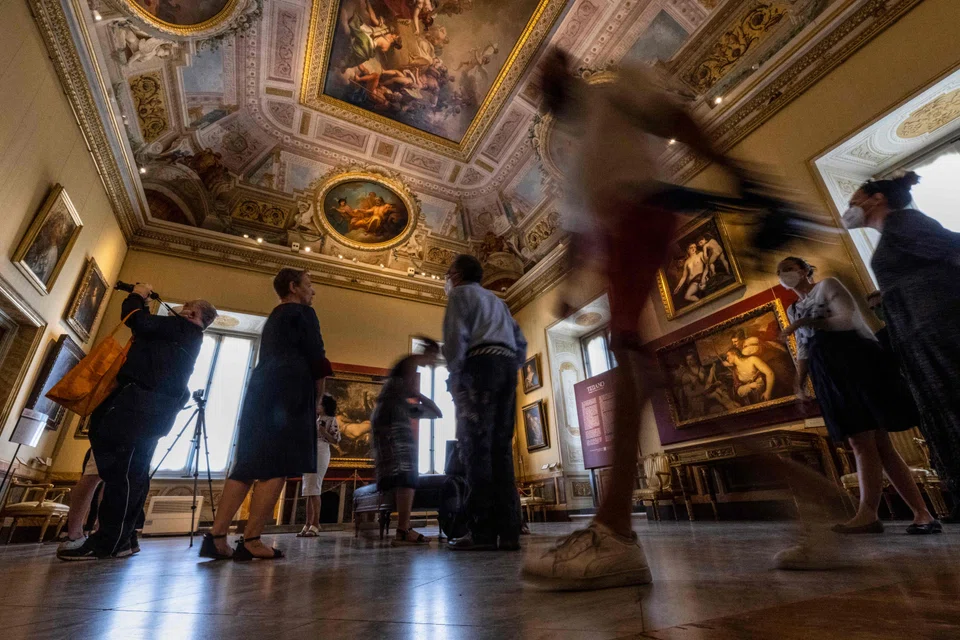

Several initiatives have been launched in the past few years in Europe and the United States, from carbon calculators to consultations and audits of galleries’ efforts to go greener.
“For me, it’s not a question how long will it take, but how quickly can we accelerate it,” said Sutton.
While she said she was “hugely optimistic”, she stressed that more must be done to raise awareness among funders and donors of art museums’ work for it to become more sustainable.
There has long been an assumption that museums’ climate impacts are too small to warrant change, or art directors equate climate with politics and fear this may hurt funding, she said.
Paris is home to 3 of the world’s most-visited art museums: the Louvre, Musee d’Orsay and Centre Pompidou. In a normal year, they welcome millions of visitors, mostly from overseas, producing a substantial carbon footprint.
While there is little museums can do to reduce air travel by tourists, they can cut back on the flights a Warhol or Picasso makes, said Guergana Guintcheva, a professor of marketing at Lille’s EDHEC Business School who has researched on museums.
One of the main sources of exhibition carbon emissions comes from transporting artworks from collections around the world, said the Galleries Climate Coalition (GCC), a global charity providing sustainable guidelines for the art sector.
“For every artwork, there is round-trip air travel — and at least 2 round-trip journeys for a curator,” said Guintcheva.
She cited Lille’s Palais des Beaux Arts as having taken a climate-conscious approach with its recent Goya exhibition. By prioritising works in its permanent collection and pieces located in neighbouring European countries, the museum cut down on freight transport for the art it displayed.
The Centre Pompidou is also focusing on sourcing local artworks rather than taking loans from the United States or Asia.
Some museums are also making exhibitions greener by pooling resources. Narbey of the Centre Pompidou said shipping requests can be shared with the Louvre or Musee d’Orsay for transport from the same locations, such as New York, cutting both emissions and costs.
The GCC last month launched its “Sustainable Shipping Campaign”, which calls for an overall reduction in air freight by 2028, and local deliveries to be low- or zero emissions by 2025.
Curators are used to creating blockbuster shows featuring 150 to 200 works, but sustainability advocates say those could be scaled back.
Staging a show requires a large amount of carbon-intensive materials, which are often thrown out at the end of the run. More museums are now seeking to recycle where possible.
At the Centre Pompidou, parts of the staging for the 2020 show “Christo and Jeanne-Claude” were reused in last year’s Hito Steyerl exhibition at the request of the artist.
“She admired Christo, and was interested to follow in their footsteps, but she also wanted, like us, to have a smaller carbon footprint,” said Narbey.
In Lille, the Palais des Beaux-Arts has a new exhibition, “The Magic Forest”, that recycles 70 per cent of the scenography and staging from the Goya exhibit.
One of the ways the museum achieved this was by reusing a rotunda room in the lobby that was designed to be multi-use.
Slowing down is also part of the green ethos at some French museums. Extending the duration of major exhibitions instead of having a high turnover of shows can reduce carbon emissions.
This may also prove popular with visitors to the Centre Pompidou, who sometimes complain when shows only last 3 months, Narbey said.
Yet the public appears largely unaware of museums’ efforts to cut emissions, said Guintcheva, noting that many people paid little attention to the sustainability notices at the Goya exhibit.
Sutton of Environment & Culture Partners said tackling climate change was still not a key selling point for many members of the public.
“I see it as matter of credibility more than of visitor attraction, and credibility matters to the funders, policy makers and community members,” said Sutton, who previously held various museum roles and taught at universities on the topic.
“Museums and galleries are public-benefit organisations. This requires them to do no harm,” she added.
“‘Do no harm’ is a definitive, not a comparable.” THOMSON REUTERS FOUNDATION
Decoding Asia newsletter: your guide to navigating Asia in a new global order. Sign up here to get Decoding Asia newsletter. Delivered to your inbox. Free.
Share with us your feedback on BT's products and services

