

New Zealand scientists discover ghostly ‘spookfish’
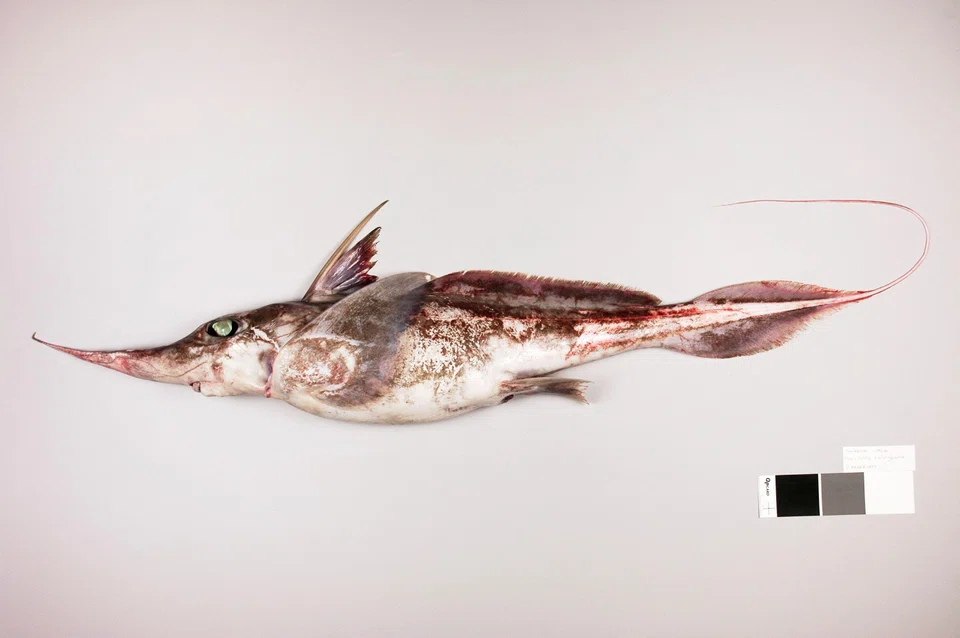
SCIENTISTS in New Zealand said on Tuesday (Sep 24) they have discovered a new species of “ghost shark”, a type of fish that prowls the Pacific Ocean floor hunting prey more than a mile down.
The Australasian Narrow-nosed Spookfish was found living in the deep waters of Australia and New Zealand, according to scientists from Wellington-based National Institute of Water and Atmospheric Research.
The specimens were discovered during research in the Chatham Rise, an area of the Pacific which stretches around 1,000 kilometres east near New Zealand’s South Island.
Ghost sharks, or chimaeras, are related to sharks and rays, but are part of a group of fish whose skeletons are entirely made of cartilage.
The ghost sharks, also known as spookfish, have haunting black eyes and smooth, light brown, scale-free skin.
They feed off crustaceans at depths of up to 2,600 metres using their distinctive beak-like mouth.
“Ghost sharks like this one are largely confined to the ocean floor,” said research scientist Brit Finucci.
Finucci gave the new species its scientific name “Harriotta avia” in memory of her grandmother.
“Their habitat makes them hard to study and monitor, meaning we do not know a lot about their biology or threat status, but it makes discoveries like this even more exciting.”

The spookfish was previously thought to be part of a single globally distributed species until scientists discovered it is genetically and morphologically different to its cousins. AFP
Decoding Asia newsletter: your guide to navigating Asia in a new global order. Sign up here to get Decoding Asia newsletter. Delivered to your inbox. Free.
Share with us your feedback on BT's products and services
TRENDING NOW

Singapore government slaps loan curbs on individual private-hire car buyers

If Europe goes to war, the fallout will be felt in East Asia

The grid is the transition: Why Asean’s next energy challenge is coordination

Indonesia stocks suffer worst plunge in nearly 30 years as MSCI proposes standalone status

