NVPC’s Company of Good marks 10th anniversary with 481 businesses recognised for their contributions in 2026
The movement now looks beyond corporate giving to helping firms create impact through their operations
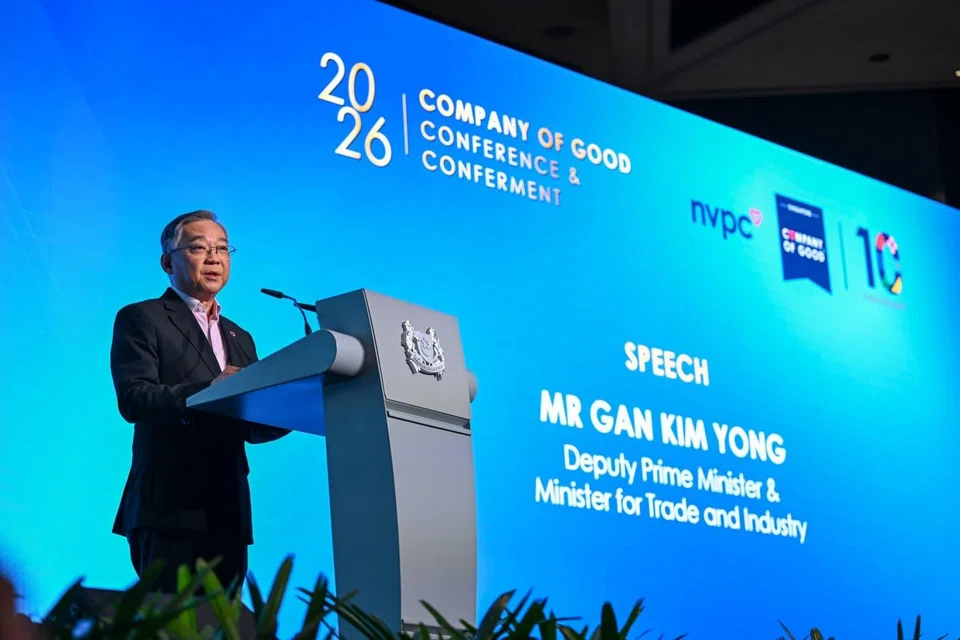
[SINGAPORE] The National Volunteer and Philanthropy Centre (NVPC) marked the 10th anniversary of its Company of Good movement in 2026, with 481 businesses recognised for their contributions to society on Monday (Jul 20).
This brings the total number of firms that have been similarly lauded to 1,046 over the three years since the Company of Good Recognition System was refreshed.
These companies have contributed nearly S$384 million in donations – with more than S$85 million as donations in kind – and over 1.1 million volunteer hours since 2024.
Deputy Prime Minister and Minister for Trade and Industry Gan Kim Yong, who was guest of honour at NVPC’s Company of Good Conference and Conferment at Fairmont Singapore, said: “Crossing the 1,000 mark within three editions of the refreshed recognition system is encouraging.
“(The initiative’s) ambition is to grow the pool of recognised Companies of Good to 5,000 unique companies over the next decade.”
Out of the 481 companies recognised this year, 63 were placed in the highest tier: Champion of Good. This is awarded to exemplary organisations that influence stakeholders for multiplied impact.
Among the whole 2026 cohort, 78 per cent or 376 firms were small and medium-sized enterprises.
A decade of creating impact
When the Company of Good movement was launched in 2016, the focus was on getting businesses to give back through donations, volunteering and community initiatives.
Since then, this has broadened to help firms create impact through their operations, said Tony Soh, CEO of NVPC.


He also highlighted the Alliance for Action on Corporate Purpose as a “key milestone”.
Launched in 2021, the initiative was a public-private coalition leading to the creation of a framework and blueprint for corporate purpose. NVPC then used this to refresh the Company of Good Recognition System in 2023.
“Today, companies are assessed more holistically across five impact areas – people, society, governance, environment and economic – reflecting a broader understanding of how businesses can be a force for good in society,” noted Soh.
Over the past decade, a growing emphasis on collaboration has enabled businesses to create greater impact, through initiatives such as the Queen Bee programme, in which established companies mentor smaller ones, and structured corporate volunteering initiative Project V.
Soh added that he hopes companies can take on a “multiplier role” by bringing together their business partners, vendors and suppliers so that their impact can be scaled up.
“The first decade of Company of Good was about building awareness and helping businesses recognise that profit and purpose can go hand in hand,” he said.
“As we look ahead to the next 10 years, we will focus on multiplying impact by rallying more organisations to join the movement and collaborate for greater collective impact.”
Doing good in the community
One Champion of Good this year is Luxasia, an omnichannel distributor of luxury beauty and lifestyle brands across Asia-Pacific.
The Singapore-headquartered company has sponsored make-up skills accreditation courses for underprivileged women, supported Action for Aids, adopted otters at Rainforest Wild Adventure, and provided financial support for women at risk, orphanages and low-income communities.
For example, it has an ongoing partnership with Gladiolus Place, a residential home for teenage girls. Earlier this year, the firm’s philanthropic arm – Luxasia Foundation – sponsored the extension of the home’s laundry area.
Beyond Singapore, Luxasia also works with local communities in the markets it operates in as a way of giving back to society, said CEO Satyaki Banerjee.
Meanwhile, Nava 1872 – operating as The 1872 Clipper Tea Co – was upgraded to a Champion of Good this year from its Company of Good - 3 Hearts recognition in 2024.
General manager Xanthe Ang said it has become more inclusive in its hiring practices, leveraging its long-term partnerships with the National Kidney Foundation and Institute of Technical Education.
The company has a manufacturing plant in Sri Lanka and hires inclusively there, too. “The impact that we are (creating) is not just local, but also extends all the way down our supply chain,” she added.
Micron – a Champion of Good from the 2025 cohort – works with community partners such as AI Singapore and Daughters of Tomorrow, focusing on education in the areas of science, technology, engineering and mathematics, artificial intelligence literacy and workforce development.
April Arnzen, executive vice-president and chief people officer at Micron Technology and president of Micron Foundation, said: “While these priorities remain constant, our approach has evolved beyond traditional philanthropy and volunteerism towards strategic partnerships that build sustainable capability and multiply impact.”
For example, its AI Bridges initiative is co-developing curriculum, training community educators and equipping Micron employees to become AI Singapore-certified trainers to train the community in AI skills.
It aims to reach 5,000 learners from local social service organisations by the end of 2026.
Decoding Asia newsletter: your guide to navigating Asia in a new global order. Sign up here to get Decoding Asia newsletter. Delivered to your inbox. Free.
Copyright SPH Media. All rights reserved.