

Oh Romeo, wherefore art the stage direction?
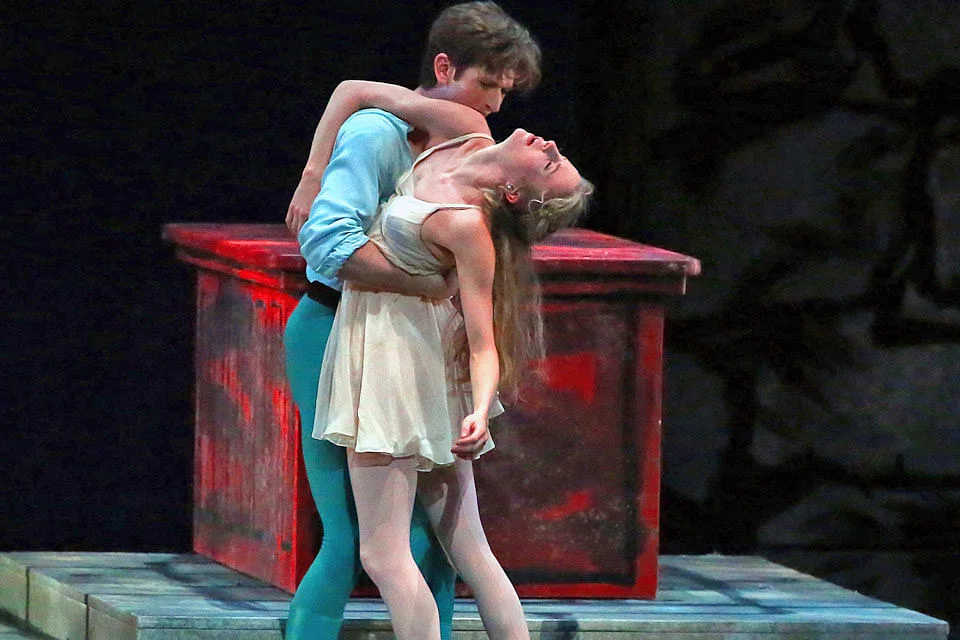
THE issues arising from the departure of Peter Martins as ballet master of New York City Ballet keep multiplying. What value do Martins' own ballets have?
For decades his choreography has been an easy punching bag. There were always worse dance makers, but he was singularly prestigious (thanks to his job at City Ballet) while his ballets were seldom interesting.
If most of his one-acts fell out of repertory, they would not be missed. In an era when the ballet audience needs lures, however, he has given City Ballet three full-length productions that have drawn the throng. In the case of his Sleeping Beauty and Swan Lake, he drew on the work of previous masters.
But Romeo + Juliet, which returned to repertory on Tuesday, is all Martins. (The "+" comes from the 1996 Baz Luhrmann movie.) There are worse versions of Romeo, but few so perfunctory or thin.
Originally choreographed in 2007, Martins' featured an immediately notorious moment - Lord Capulet audibly slapped his daughter Juliet - that has now been excised. Instead of the slap, Lord Capulet now merely swipes the air in anger. Amid his several showily blustering gestures, this one is scarcely noticeable.
What remains, however, is the gruesome way Romeo kills Tybalt. What on earth impelled Martins to make Romeo suddenly wrap Tybalt's head in his cloak and stab him repeatedly in the back? Any Romeo abounds in fights and deaths, but this incident remains among the most gratuitously unpleasant. It also robs Romeo of audience sympathy.
Martins' choreography allows Prokofiev's illustrious score to do much of his work for him. Although most of his dances here look like unfinished sketches - as is true of most of the ballets Martins made after taking over City Ballet - the narrative action they represent is almost always the action Prokofiev's music has in mind.
I don't find this to be one of the great ballet scores; in terms of rhythm and melody, Prokofiev composed much better dance music in Cinderella. But for an audience, Romeo is like the best movie accompaniment ever written.
If only Martins had a better notion of how to direct this movielike ballet. There are several passages in which the stage action makes little rhythmic response to the music's overwhelming pulse - most obviously in the Capulets' outrage over the death of Tybalt.
The best sustained dances are for peripheral characters and don't advance the plot. The production's sole true hit is a number for five boys (students from School of American Ballet) who turn up out of nowhere.
Juliet's five girlfriends, arriving on the morning of her wedding to Paris, have a dance that has more charm and musical phrasing than anything she gets.
When this production was new, Martins cast four pairs of junior dancers - all beneath principal level, and most in the corps - and announced that he wanted their youthfulness to make the story "for real".
It paid off in terms of those young dancers' careers. The first-cast Romeo was Robert Fairchild, now a Broadway name. Yet, almost 11 years later, Sterling Hyltin, Tiler Peck and Erica Pereira are still cast as Juliet, and Daniel Ulbricht remains the first-cast Mercutio. Tuesday night's performance was my first return to the production since its first year: Hyltin and Ulbricht were no less real than before.
Harrison Coll, a corps dancer who made his debut as Romeo on Tuesday, is endearingly impulsive and coltish. It's to his credit that he can't making the brutal killing of Tybalt ring true. That savagery is uncharacteristic of this Romeo anyway; it's just another of the production's gimmicks.
Supporting characters - Lady Capulet (Maria Kowroski), Paris (Russell Janzen), the Duke of Verona (Silas Farley), Friar Laurence (Aaron Sanz) - have mime gestures that register with more force than when the production was new.
As with so many Martins ballets, you think: "This could be good, when he gets around to finishing it." NYTIMES
Share with us your feedback on BT's products and services
TRENDING NOW
Singapore expects all parties to honour commitments, says PM Wong after Indonesia cuts gas exports
Gas Supply may pursue remedies if contract breached following Indonesia’s export cuts: Tan See Leng
SoftBank’s Son plans US$50 billion Malaysia tech outlay: Anwar Ibrahim

Is Manila Asia’s new dining hot spot?

