One city, three great artists: Reuniting Leonardo, Michelangelo and Raphael

A London exhibition shows how the three painters circled one another as rivals and role models in 16th-century Florence
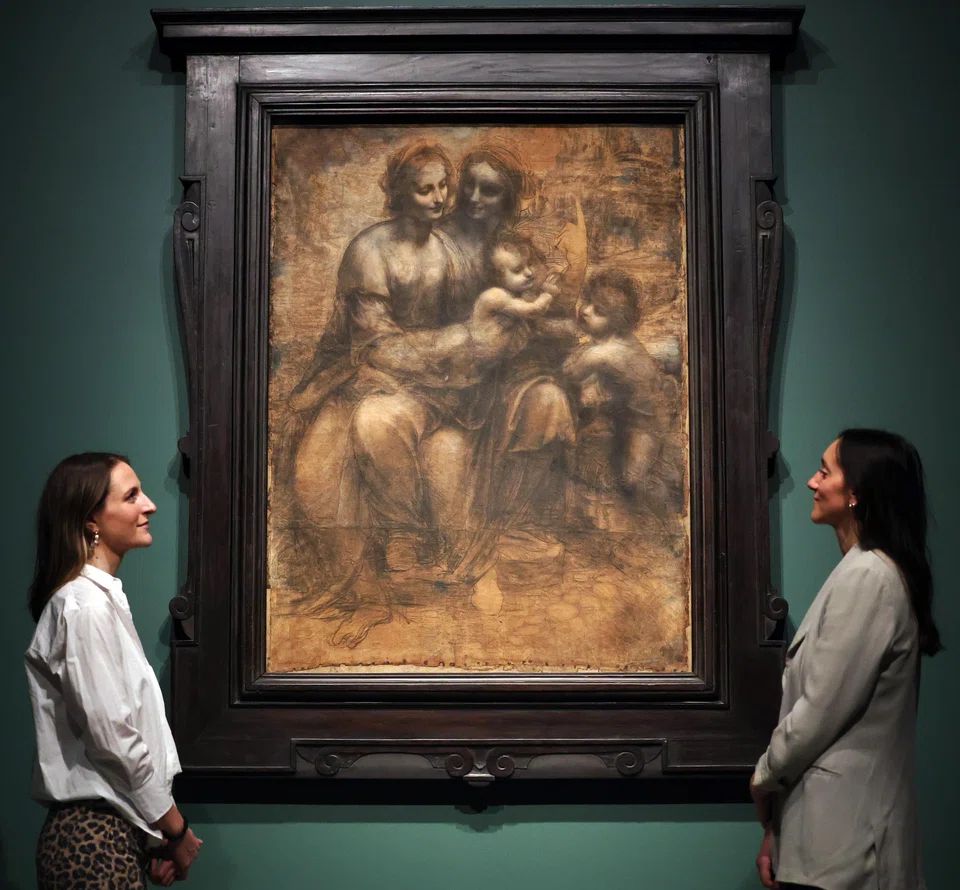
    • Leonardo da Vinci’s ‘The Virgin and Child with Saint Anne and the Infant Saint John the Baptist', from around 1506-08, at the Royal Academy of Arts in London, Britain, Nov 2024..
    • Leonardo da Vinci’s ‘The Virgin and Child with Saint Anne and the Infant Saint John the Baptist', from around 1506-08, at the Royal Academy of Arts in London, Britain, Nov 2024.. PHOTO: EPA-EFE
    Published Fri, Nov 15, 2024 · 09:00 AM

    WE ALL know what they say about imitation and flattery, in art as in life. Things were no different in Florence during the early 16th century, when three artists who would become known as the brightest stars of the Italian Renaissance brought a brief flurry of activity – rivalry, camaraderie, innovation – to the city that was changing rapidly under new political leadership after six decades of Medici family rule.

    In the exhibition “Michelangelo, Leonardo, Raphael” at the Royal Academy in London, which runs till Feb 16, a subtle dance of influence between the three men is traced through three rooms of paintings and sculptures, but predominantly drawings – a medium of experimentation, study and process.

    The story begins in 1504, a pivotal year when Florentine officials and the recently elected head of the city government, Piero Soderini, were deeply invested in representing the fresh and independent attitude of a new era through art.


    On Jan 25 of that year, 30 of Florence’s foremost artists met to discuss where to install a newly unveiled sculpture: David, by the 29-year-old Michelangelo. They decided to put the muscular biblical hero, with a slingshot in one hand and a stone in the other, at the doors of the Palazzo Vecchio, Florence’s town hall, as a symbol of plucky might. (It is now in the city’s Galleria dell’Accademia, and a copy stands in the original spot.)

    One of the artists weighing in on Michelangelo’s giant was Leonardo da Vinci. He was 23 years Michelangelo’s senior, and, like the younger artist, had recently returned to Florence. At the time, da Vinci was working on his own masterpiece, the “Portrait of Lisa Gherardini, Wife of Francesco del Giocondo”, later called the Mona Lisa.

    The two would soon come into closer contact – and competition – when they undertook parallel commissions for the town hall’s lavish Great Council Hall, which was to be filled with art that promoted Florentine independence and military strength.

    Asean Intelligence

    Get insights into businesses across South-east Asia

    Get the free report

    Later that year, a 21-year-old upstart named Raphael also arrived in Florence to study the work of the two vying men he saw as the greatest living artists, and it is from here that the exhibition’s compelling argument of rivalrous influence unfolds.

    In the first room, we see Michelangelo’s unfinished Taddei Tondo from around 1504-05, a hulking round marble relief of the Virgin and Child with the infant St John the Baptist. Delicate pen and brown ink sketches, sometimes accented with black chalk, show the artist trying out different configurations of mother and child to fill the unwieldy circular space. He solved the problem by elongating the form of the Christ child so that it twists across the image in an uncanny oblique.

    Nearby, numerous drawings capture Raphael scrutinising Michelangelo’s innovations, but always with a slight shift. Raphael’s sketch of David, from behind, has slightly more proportional hands and feet; in his many studies based on the Tondo, the twisting Christ child is less muscular and the Virgin’s face features the pointed chin so characteristic of Raphael’s work.

    These influences come together in the artist’s Bridgewater Madonna, also on display, in which the pale body of the infant Christ undulates dynamically across the painting’s foreground. And at the same time, Raphael was also studying da Vinci, as seen in a beautiful drawing after the older man’s now lost Leda and the Swan (this drawing is one of the primary records of its existence).

    A darkened chapel-like room brings us back to the interiors of the civic Palazzo. Here, the exhibition curators propose, for the first time, that da Vinci’s The Virgin and Child With St Anne and the Infant John the Baptist, might have been created as a cartoon, or full-scale preparatory drawing, for an unrealised altarpiece for the Great Council Hall.

    Spotlit and hung at altar height, the work is extraordinary, sumptuous and, like many works in the show, unfinished. The faces of the Virgin and her mother, Anne, are highly detailed in charcoal with white chalk, and the visages of the baby and the young John also emerge with clarity, but the rest fades away into a smoky background. Departing from the theme of imitation and rivalry for a brief pause, the work shows that even da Vinci’s incomplete studies have the power of finished works.

    The final room offers an array of drawings that place da Vinci and Michelangelo head-to-head, while working simultaneously on battle scenes to decorate the walls of the same hall at the heart of the republic. (Neither commission was completed.)

    Da Vinci maintains his fascination with extreme facial expressions and shows horses and sometimes machines in movement, while Michelangelo reigns supreme at the male nude in action, with every muscle outlined, cross-hatched and highlighted. In some of the drawings, the two men swap preoccupations, as though looking over each other’s shoulders, tentatively testing the waters, before returning to what they do best.

    If this elegant, scholarly exhibition traces an anxiety of influence, it also shows that imitation offers artists a chance to hone individuality. NYTIMES

    Decoding Asia newsletter: your guide to navigating Asia in a new global order. Sign up here to get Decoding Asia newsletter. Delivered to your inbox. Free.

    Share with us your feedback on BT's products and services