Pausing for breath
Regular yoga practice creates a body-and-soul connection that cultivates the right attitude for meditation.
Tan Su Yen
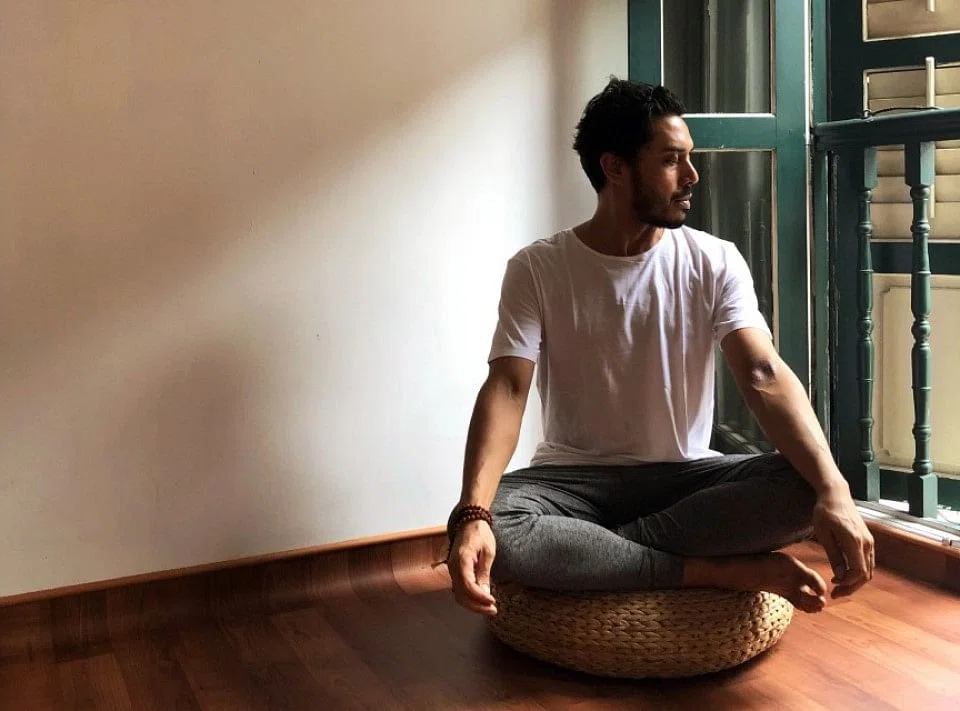
IT IS mid-morning on New Year's Day at the start of the new decade and close to 30 people have gathered at Ziva Yoga in Tanjong Pagar for a meditation workshop.
Natural light, thoughtfully filtered to minimise the glare, streams through the tall windows of the shophouse space in the financial district; shadows fall gracefully across the wooden floorboards adding to the warm, hopeful vibe in the room.
But the day's agenda goes well beyond the feel-good factor. In a sense, the workshop sets out to demonstrate that there is a place for meditation amid the incessant demands and unyielding pace of everyday life in urban Singapore.
And New Year's Day is a perfect time to embark on this journey to inner calm, says Faiz Alkhatib, a lawyer turned yoga teacher and co-owner of Ziva Yoga.
"People get reflective around New Year's. We wanted to support our members who may have made resolutions to start meditating in the new year. We know how tricky these resolutions can be to keep."
The workshop, subitled "Move + Meditate" and conducted by Mr Alkhatib, delivers on its promise of pithy, specific instructions on how to incorporate meditation into a wholistic yoga practice.

Says Mr Alkhatib: "We tried to do this by demistifying the benefits of yogic meditation and by contextualising it within a framework of yoga practices they are already familiar with."
Some background on how yoga practice lends itself to meditation: yoga, as it is practised in current times, focuses mainly on two pathways, pranayama or the practise of the breath, and asanas, the physical practice of postures.
Regular yoga practice, comprising pranayama and asanas, links breath to movement and action to intention, capturing the very essence of yoga, a Sanskrit word which means "to join" or "to yoke". This body and soul connection in turn cultivates the right attitude for meditation.
To start us off, Mr Alkhatib took the class through the paces of a simple Hatha yoga sequence, to warm up our bodies for a short seated meditation. Like any Hatha yoga sequence, the series of postures also served to condition the breath and the mind for meditation.
The sequence comprising neck, shoulder, hip and back stretches, interspersed with supported variations of classic yoga poses like baddha konasana or cobbler's and adho mukha svanasana or downward dog, was reassuringly familiar for yoga practitioners. At the same time, the poses were simple enough to offer newcomers to yoga an accessible gateway to meditation.
Says Mr Alkhatib: "Meditation prep should be short. It should be just long enough to connect with the targeted body part, but not so long that it tires or creates strain. It is important that the meditation prep doesn't encumber the meditation itself."
Before long, we transitioned to the actual meditation. Mr Alkhatib had us assuming a "comfortable seated position" on our mats, supported by a block if needed. No fancy full lotus position is called for, unless you can manage it with ease. Then he led us in an alternate nostril breathing exercise.
One of the classics of yogic breathing or pranayama, it involves breathing in through one nostril while covering the other, then breathing out through the other nostril while covering the first.
Once done, we sat quietly and breathed naturally, the only instructions we were given were "deep inhalations" and "slow exhalations". So there we sat on our mats for 10 minutes, doing what comes naturally: breathing.
The difference was that we were focusing on our breath, and being present in the moment, not thinking about much else, as far as possible, that is. Yet this version of "idling", to put a Singlish spin to it, was at once strangely uplifting and calming if ever so slightly surreal.
Before long, we were done and I for one was all set for some mindful indulgence over a brunch of Japanese pancakes. After a not-so-great 2019, 2020 was starting to look pretty good.
Start with baby steps
REGULAR meditation fosters a sense of well-being through a host of physiological benefits, among them greater focus, a more robust immune system and pain management. More importantly for this day and age, as yoga teacher Faiz Alkhatib of Ziva Yoga points out, meditation helps drive central nervous system functioning out of "flight and fight" mode into "rest and repair" to mitigate the effects of stress.
The morning is traditionally seen as the best time to meditate before the demands of the day start encroaching on our thoughts. According to Yoga Journal, a five- to 10-minute morning meditation helps people start their day with greater equanimity and poise.
Newcomers may want to set themselves more modest goals, Mr Alkhatib of Ziva Yoga says. "The meditation itself should be very short in the beginning, even one to two minutes is fine. Forcing yourself to meditate longer than you're ready for can quickly detract from the practice. Approaching the practice with baby steps makes it less intimidating and more sustainable, which is key."
While meditating in the same place and at the same time every day is recommended for consistency, meditation-on-the-go has been made possible by meditation apps, such as Buddhify. It offers options like "Travelling", which then leads to further options like 'A unique meditation for when you're on a plane'. How about a little bubble of tech-enabled inner calm on your next business trip?
Copyright SPH Media. All rights reserved.