

‘The pictures are miracles’: How Judith Joy Ross finds pain and nobility in portraits
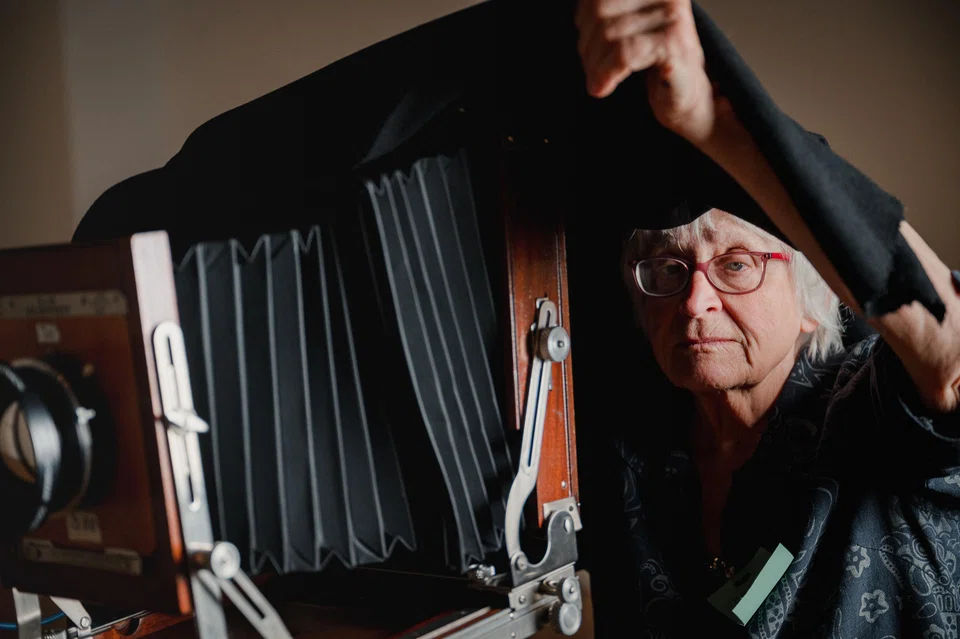
IN A room hung with empathetic black-and-white photographic portraits for her retrospective at the Philadelphia Museum of Art, Judith Joy Ross, frail-looking and white-haired, was recently taking pictures for her next series. Posing a guard in front of her old-fashioned wooden view camera, she chattered on in an obscenity-laced monologue about her ineptitude.
Seemingly to herself, she said, “I have no idea what I’m doing. I’ve forgotten.” Then she looked up at the bald, bushy-bearded guard, who was standing compliantly where she had placed him. “That’s great,” she gushed. “Everybody can see that’s great. Fantastic. You are perfect.” He gazed ahead stolidly.
Ross turned to me and said, “People don’t like to be photographed, but photographers also don’t like to photograph. You have to get in the zone. You have to get rid of all the bull: ‘It’s not working, it’s not going to be right, it’s not as good as it was before.’ And then it might – it might – happen.”
The moment she seeks to capture is mysterious. At least as mysterious is how she has managed to find it so often. Portrait photographers are usually looking for a quality that can be described in a few words. Julia Margaret Cameron sought genius in men and beauty in women. August Sander revealed how Germans did and didn’t conform to their stations in life. Diane Arbus exposed the flaws in her subjects’ self-presentation. Ross assumes a more passive position. By downplaying her prowess, in a daffy, self-deprecating manner, and showering compliments, she allows her sitter to fill the space with a tentative individuality.
“The pictures are miracles,” said Joshua Chuang, the independent curator who organised the show, which originated at Fundación MAPFRE in Madrid and runs here until Aug 6. “It’s not like she has command over the subject or the moment. With Judith, it is complete surrender to that moment, even to the point of forgetting the technique.”
The large-format Deardorff camera contributes to the magic. Technically, it allows Ross to avoid using an enlarger and instead make 8-by-10 inch contact prints that register fine detail. She also can release the shutter without an apparatus obscuring her face. Less obviously, the view camera adds a sense of occasion to the act of being photographed – the feeling, as she likes to say, that “the circus has come to town.” Her subjects hail mostly from humble backgrounds and find the unaccustomed attention gratifying.
“I don’t photograph people with money,” she said. “I don’t photograph people outside what I consider my class. I probably don’t like them. And I don’t know them. These are the people I know.”
Arguably her greatest achievement is the series of portraits she made in 1983 and 1984 at the Vietnam Veterans Memorial, designed by Maya Lin, which had recently opened in Washington. “I was going to go out and ask people stupid questions – how do you deal with pain and suffering,” she said. “Then I heard about the Vietnam memorial. I knew I could ask that question without words.”
Most of the American toll of the war was borne by the working-class and lower-middle-class people Ross prefers to depict. Her portraits of solemn visitors caught up in silent emotion constitute a memorial as pared down and elegiacal as the monument they were visiting. In 1984, when she was briefly barred from photographing there, Ross continued the project back in Pennsylvania, outside a Pathmark store in Allentown. “I looked for pain and suffering in the local crap mall,” she said. “It exists everywhere. The pictures I made there are about Vietnam.”

Ross, 76, lives modestly in Bethlehem, Pennsylvania, near Hazleton, the depressed coal-mining town where she grew up, a middle child of three raised by a father who owned a small chain of five-and-dime stores and a mother who taught piano. From her parents, she acquired a lifelong love of classical music and the natural world.
As a student on scholarship at Moore College of Art & Design in Philadelphia, she was smitten with photography, and after receiving a degree in art education, she enrolled in a graduate course at the Institute of Design in Chicago. She felt so alienated in those early days that she was often unable to photograph people frontally. “I would spend all day at the movies, and you would see people from behind,” she said, explaining how she trained her lens on the backs of people’s heads. In 1972, she secured a part-time job teaching photography at Moravian College in Bethlehem. When that ended, she supported herself for several years by cleaning houses.
The turning point in Ross’ career occurred after the death of her father in spring 1981. Profoundly depressed, she went that summer to a swimming hole in Eurana Park in Weatherly, Pennsylvania, a few miles from a creekside cabin in Rockport where the Ross family had spent summers in her childhood – and on memorable occasions visited the park.
Now she photographed teenagers there. “It was about connecting to life again,” said Susan Kismaric, a curator who has been friendly with Ross since meeting her in the mid-1980s while working at the Museum of Modern Art. “The pictures are fabulous, and it did help her understand something about life.”
Ross returned to Eurana Park the next summer with an 8-by-10-inch Deardorff view camera she had just acquired and took a series of photographs that established her artistic style. (She now uses a replacement for that camera, which broke after heavy use.)
The Eurana Park photographs convey the awkwardness and uncertainty of youth. The soon-to-melt frozen pops in the hands of three little girls in swimsuits – two gazing back at the camera, one looking away – accentuate the fleetingness of these years. In many portraits, teenagers seemingly lost in thought stare into the middle distance. Focusing her camera with a shallow depth of field, Ross rendered her subjects crisp and clear against backgrounds of trees or water that blur until only softly discernible. She suffused the images with a warm, archaic glow by making the prints on light-sensitive, gelatin silver chloride printing-out paper toned with gold. A photograph of first graders napping in a classroom taken in 1993 might have been produced by Lewis Hine nearly a century earlier.
Ross likes to work in series. She has photographed students in her hometown, Hazleton; people at their various jobs in eastern Pennsylvania; young people (mostly African American) in northeast Philadelphia; adolescents in Easton, Pennsylvania; political operatives working elections; and visitors to a New Jersey lookout point as they contemplate the mutilated New York skyline following the Sept 11 attack. In a rare look at people with power, she received a commission to photograph US senators and representatives, and their staff members, in 1986 and 1987. She assiduously avoided making the publicity shots that elected officials might typically send to their constituents. “I generally fall in love with people, even if I don’t like them,” she said. “We’re all vulnerable. That’s what these pictures are about.” NYTIMES
Decoding Asia newsletter: your guide to navigating Asia in a new global order. Sign up here to get Decoding Asia newsletter. Delivered to your inbox. Free.
Share with us your feedback on BT's products and services
TRENDING NOW

Simba admits exceeding spectrum limits amid failed M1 deal; parent company Tuas’ full-year profit surges 277%

He built the Vingroup empire. Now South-east Asia’s richest man is handing some key roles to his sons

What’s on the agenda when Xi and Trump meet in Washington

Ex-execs of CW Group, Allied Tech charged with offences linked to lawyer’s S$76 million misappropriation

