

Power Plays
The Singapore Theatre Festival, arguably the country's most politically and socially relevant art event, returns with bold works

Helmi Yusof
THE THING ABOUT the arts is this: it's not easy, even for the seasoned eye, to predict whether an artwork will stand the test of time. There are, of course, benchmarks of excellence, but these don't guarantee whether, in the case of a play, it will be restaged again, attract serious academic scrutiny, be fussed and fawned over for posterity, and become part of the canon.
There are times when this reviewer thinks that a play is terrific and generations of theatregoers would admire its story, characters, themes and structure - only to find the play slipping into dramatic oblivion. And then there are plays this reviewer considers maudlin, kitschy, over-calculated and obvious, only to find them being revived time and again to the point they're billed unabashedly as "classics".
Watching the three opening plays of the sixth Singapore Theatre Festival, one wonders if any of these plays will be reworked, revived and tailored for a future audience, allowing them to inch closer towards that elusive "classic" status. But looking at them through the lens of July 2018 alone, there's no doubt that they're among the most socially and politically relevant plays about Singapore you could find today. Hopefully, they're talked about enough to prompt at least university students someday to look for their scripts.
Running till July 22, the festival is led by festival artistic directors Ivan Heng and Alfian Sa'at. Both are no strangers to speaking candidly on various issues, and have programmed eight plays that examine the kind of topics some theatre companies wouldn't touch with a stick.
Many of the topics fall within the grey areas of "could these things be discussed publicly in Singapore at all?"
PRESSING ISSUES
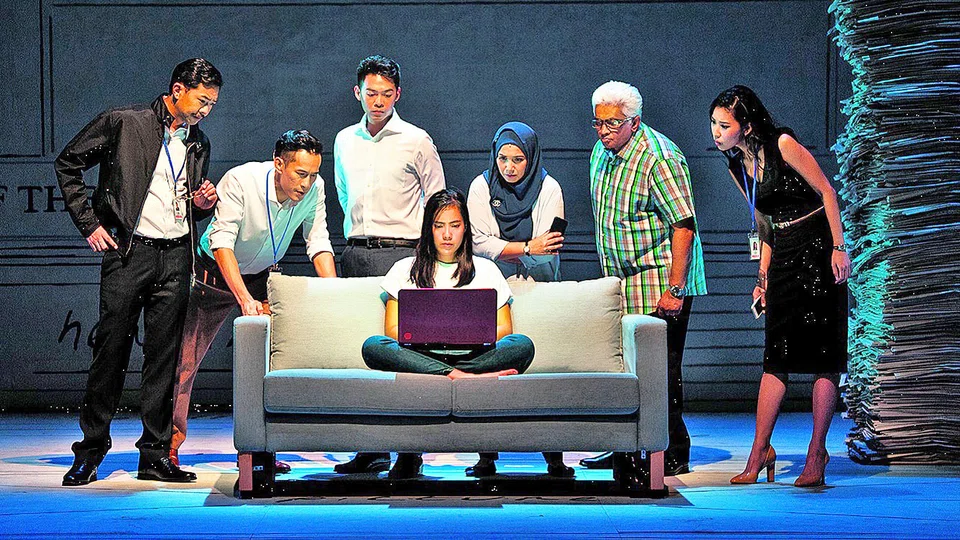
The first show of nerves is Tan Tarn How's play Press Gang, rigorously directed by Heng. It looks at life in a Singapore newsroom as it vacillates over whether to print a scandalous story involving the country's most powerful individuals. The journalists (played by some of Singapore's best actors) find themselves in a difficult situation of balancing journalistic integrity and political success - for to print the "wrong" story or opinion is to fall out of favour with the establishment and have one's career derailed.
For anyone unfamiliar with the way the local media landscape works, the drama can come off as a little inert. The carefully constructed scenes of newsroom paralysis is hardly the stuff of high suspense - especially when compared to the propulsive narratives of Hollywood newsroom films such as The Post, All The President's Men and Spotlight.
But some who have worked in the mainstream media might contend that this is as close to the truth about Singapore journalism as you'll get. Tan, who spent 15 years as a journalist mostly in The Straits Times, shows not just the real "two steps forward, one step back" struggles of telling politically sensitive truths in Singapore but also the waning power of mainstream media, the emerging but still limited impact of online sites, and the government's attempts to regulate both.
For Tan, whose last play Fear Of Writing also dealt with censorship, Press Gang is a significant addition to his oeuvre. It depicts the journalistic landscape as no previous Singapore play has.
MORE THAN SKIN DEEP
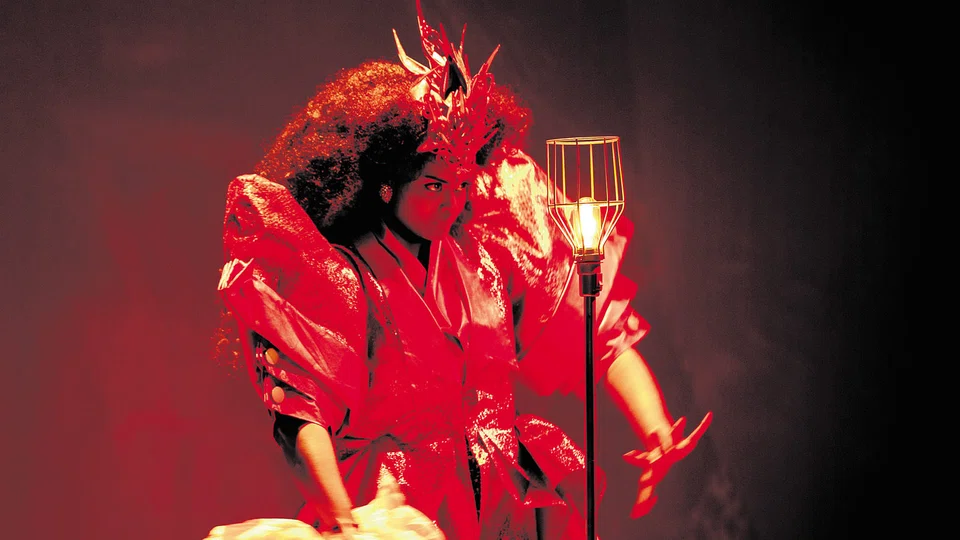
The second show of nerves is Building A Character, a monologue built around Rebekah Sangeetha Dorai, written by poet-playwright Ruth Tang and directed by Mei Ann Teo.
Dorai is a beautiful and talented actress-singer with a gift for accents and impersonation. Despite standing out as an acting student in LASALLE College of the Arts, she struggled after graduation to find roles on stage and screen because of her skin colour.
Casting agents and producers only want fair-skinned actresses, unless it's for a government video project where various races are expected to be represented. In one exhilarating scene, Dorai imagines herself starring in a typical condominium ad which, as everyone knows, showcases only attractive people of certain races.
Here again, the Festival breaks new ground by discussing racism in the arts, when issues of race and religion are thought to be too sensitive to discuss. Dorai shows courage in exposing her anger and insecurities before an audience. The monologue is rich, acerbic and insightful, dealing not just with discrimination but also femininity and family relationships. Tang's delightful script and Teo's ingenious direction are filled with many postmodern touches of wit and whimsy; one longs to see the play again, if only to re-experience its fleeting idiosyncratic charms.
SURVEILLANCE STATE
The third play of the opening weekend is Supervision, written by Thomas Lim and helmed by veteran director Glen Goei. Lim is a 20-something wunderkind whose previous play Grandmother Tongue is a sweet, surprising comedy about an English-educated man and his struggles to communicate with his Teochew-speaking grandmother.
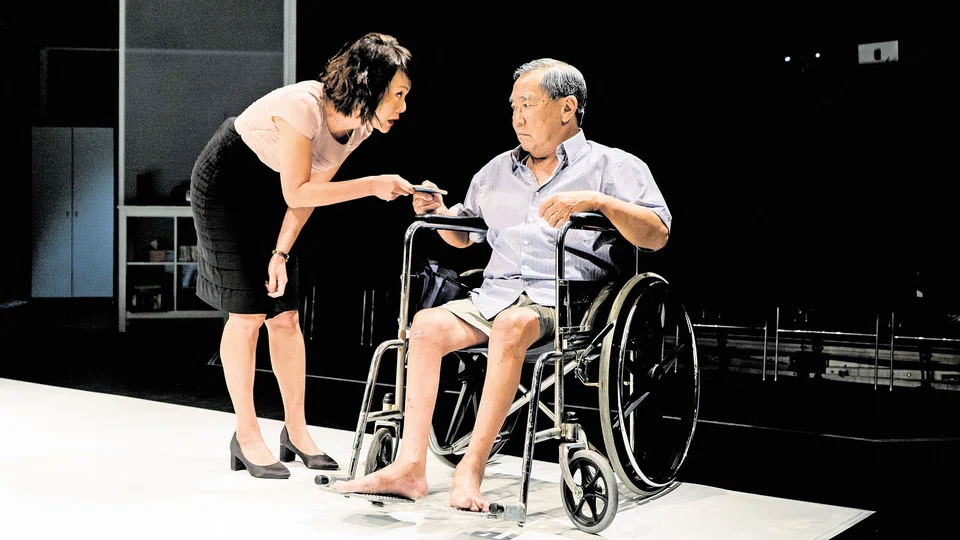
Supervision is strikingly different from that play: It's a serious, straightforward drama set in an apartment about a newly arrived Indonesian domestic helper (played by Umi Kalthum Ismail) and her relationships with her stern employer (Janice Koh) and the latter's invalid father (Patrick Teoh). All three actors fit their roles to a T, with Koh deserving special mention for layering her otherwise unlikeable character with deeply buried emotions.
In Press Gang and Building A Character, the underlying theme is power - who has it, who doesn't have it, and how do you take some of it back. In Supervision, nothing is more glaring than the power each character has or doesn't have: the employer who wields it through threats and surveillance cameras to monitor the activities of her father and helper; the father who tries to be fair and humane towards the helper but ultimately jeopardises her position by bribing her for simple favours; and the helper who's stripped of any kind of power even before she stepped into the place. These power dynamics change slightly throughout the play, and not enough to avoid a certain inevitable conclusion for the characters.
Director Goei, who's also a filmmaker, helps the play break out of its own stalemate by showing through brief videos the other sides of the characters when they're alone or out of the apartment. Wong Chee Wai's excellent set design allows these videos to be shown on monitors hung above the setting of the apartment, which itself is sprawled across four corners of the black box so we can see intimate scenes in the bedrooms, toilet and kitchen.
These monitors double as surveillance units for when Koh's character is supervising her unsuspecting father and helper, blithely invading their privacy as she tries to ensure everything in the house runs according to the strict rules she's set down. Press Gang may have asked this question too, but it is Supervision that whacks one's head with it: when one throttles up on power, how quickly does one's humanity get drained?
The Singapore Theatre Festival continues till July 22 with three other plays. For more information, visit https://singaporetheatrefestival.com/. Tickets from Sistic.
Copyright SPH Media. All rights reserved.
TRENDING NOW

Malaysian king buys stake in Singapore-listed mining firm expanding into rare earths

Grab CEO’s wife Chloe Tong on life with Anthony Tan and finding her purpose

Once staunchly pro-China, Malaysian Chinese businesses are now distancing themselves from Beijing

Longer wait times expected as S’pore healthcare institutions report system disruptions

